

My first brush with miserly behavior arrived through a childhood friend’s father. It’s not that he couldn’t afford things; hoarding money was simply his personality. Petrol, AC timings, electricity, discount sales, ice cream bowls, grocery bills: nothing was beyond him. He often claimed that he bought their first bungalow and car from all these micro-savings. After a point, I think he pretended to be a bigger cheapskate because he enjoyed our reactions. It became a performance to elicit shock and chuckles; he would even ask me why I’m having an extra chapati (“atta is not free”) to push everyone's buttons. I grew up to be cautious with money — borderline stingy, even — because he had reframed the condition as a punchline of sorts. At some level, I convinced myself that it's funny. So when I see incorrigable tightwads on screen, I’m immediately amused. They don't even have to be mined for laughs. And there's no place like Mumbai to normalise the tragicomic humour that haunts a penny-pinching protagonist. The city almost forces upon its people — regardless of social strata and wealth — an inherent middle-classness to process its absurd premiums and myths. It's so expensive that being frugal is more of a biological need than a mental state.
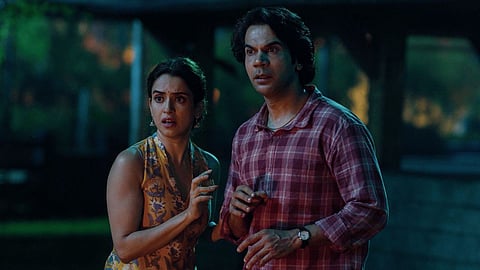
After Vicky Kaushal in Zara Hatke Zara Bachke (2023), it's Rajkummar Rao's turn to let Mumbai put into perspective the fact that there are worse conditions — or sicknesses — than being tight-fisted. All those other conditions are on display in Toaster: blackmail, greed, perversions, loneliness, corruption, murder, even constipation. Rao plays a man who pays the price for hating to pay any price. His Ramakant Parikh is almost nostalgic for the way he provokes others with his habit. He's a generational cheapskate, but an authentic one; he no longer cares for the reactions he elicits. He lives in a dated senior-citizens colony for the low rents, gets elated for winning 6-rupee telecom refunds, saves on breakfast every morning by ‘chatting’ at his catholic landlord’s (Seema Pahwa) dining table, parcels free food from weddings (and funerals), saves bike fuel by holding onto moving vehicles, uses his wife Shilpa’s (Sanya Malhotra) IVF treatment as an excuse to beg for discounts, and takes his wife to “lunch dates” to a local Gurudwara’s langar. His excessive habits do feature a few relatable ones: like absent-mindedly shutting off the lights the second he leaves the room (a blink-or-miss moment shows him stumble into his house after a traumatic incident but still switching off the mosquito repellant out of muscle memory), casually using freebie promotional jumpsuits and bags, or discussing the math of having a child in this economy.
Ramakant is a toxic accountant unto himself, and the comedy-of-misfortunes plot takes off when he pushes it too far. Shilpa forces him to buy a fancy toaster (whose price he keeps misquoting to anyone who doesn't ask) as a wedding gift for his guru’s daughter, but the wedding gets dissolved the next day and he sets out to get back the toaster to secure his precious refund. He even ‘agrees’ to stay for breakfast while offering condolences to the family and requesting them to return his gift. They can scarcely believe his insensitivity and audacity, but he is beyond caring. Simultaneously, a seasoned cop (Upendra Limaye) intimidates a pothead blackmailer (Abhishek Banerjee) into handing back a sex tape of a powerful politician. Ramakant’s path is destined to get entangled with theirs. His desperate mission then involves theft from an orphanage, a police case, a gory death or three, two separate SD cards of incriminating videos, a lethal colony resident, a marriage on the rocks, crossed wires and, of course, that ill-fated toaster. Ramakant goes through hell and back, all for disregarding societal norms and daring to be the cheapest man in town.
In other words, Toaster is a consistently watchable crime comedy. Its spoofy template and tone belong to the Kunal Kemmu school of knocks, which I suppose is the best compliment for a movie of this genre. Some of the pop culture references supply the colour (and I don't mean the radioactive Netflix palette): a Farah Khan cameo, a post-credits star cameo, Ramakant citing the game of Ludo as an alibi (Rao and Sanya Malhotra starred in Anurag Basu’s Ludo), a Patralekha cameo where she mistakes Ramakant for her ‘husband named Raj,’ and my favourite of them all, a Raaz nod in context of a vengeful sociopath named Malini (the name of the actor who played the jilted lover/ghost in the 2001 hit). It's always fun to see the makers having fun with such productions. The film sometimes runs out of steam when Ramakant jumps through hoops to get himself deeper into trouble; there's no scope for his miserly nature to emerge when he's just another fool in a sticky situation. But the energy is infectious when Archana Puran Singh, initially unrecognisable as a mild-mannered neighbour in a room, leans into the campiness of a horror comedy as a witchy old widow obsessed with young ‘Ramu’. Upendra Limaye brings the Madgaon Express flavour as the cop whose defining moment comes when he inspects a victim's apartment, sees an old man asleep on a couch and reflexively says “zinda hai (he's alive)” like he's paying for a vada pav during peak hour at Dadar station. Limaye has excelled at playing Vijay Raaz-coded eccentrics lately; seeing him here felt like watching his cynical officer from Madhur Bhandarkar’s Page 3 give up and devolve into a quirky political puppet.
I like how the film chooses to center the marriage between Ramakant and Shilpa. It gives Toaster an illusion of purpose beyond all the whimsy. She used to dismiss his thriftiness as an endearing flaw, but she remains a significant-enough presence in the story to become resentful and suspicious of her husband's crisis. His lies and coping mechanisms take a toll on their relationship, until the dangers they encounter eventually offer them a sense of perspective about the difference between deal-breaking traits and incurable tics. Sanya Malhotra is disarming as always, but it's Rao who owns the role of a peripheral comic-relief guy pushed into the main-character limelight. It's hard to tell a fluid Rao performance from a predictable one because he's so adept at playing alt-masculine heroes who yearn to be accepted for who they are. His Ramakant is another feather in a deceptively tricky hat. Whether he's screaming (like Ryan Gosling in The Nice Guys) and fainting in tandem on a rollercoaster or cosplaying as a boytoy for a lusty old lady, Rao resists the crowd-pleasing transformation arc that shapes such movies. He makes sure that Ramakant remains true to his form, regardless of his dire circumstances. Dog’s tail and all, except it’s not a bad-faith hustler we’re dealing with; the man invites all kinds of judgment, but someone as shapeless as Rao makes him capable of (mild) redemption.
As a result, not even a narrative formula — all those familiar accidents and twists of everyman fate — can alter the character’s DNA. His individualism becomes the core of a marriage in which ‘improvement’ is often the art of making do. The message (if there is a message at all) being: it could be way worse. Which is a witty way of suggesting that the bar is so low for modern Bollywood heroes that a bumbling Scrooge is relatively harmless; at least his morality is intact. The real threats are the societal menaces around him: nosy neighbours, invasive authorities, traders moonlighting as hired goons, stoners and manipulative wardens. This is also another little metropolitan truth that the film sneakily slips in. So many Mumbai comedies revolve around normies getting caught up in a plot of power-player mishaps. But Toaster is a rare caper that taps into the city’s survivalist angst and turns it into the surprising protagonist. As if to imply that the deadly politicians and police inspectors and detectives and their high-stakes quests pale in comparison to the suppressed darkness of the average frustrated citizen. One of these frustrated citizens here swats all the others away like pesky flies, simply because living in a concrete jungle teeming with unfulfilled aspirations and urban isolation is already an adventure dangerous enough. It creates an abusive cycle of resilience — a madness on the brink of snapping — that a film like this sees through a light-hearted lens. After all, you don’t need an expensive toaster to be burnt to a crisp; it’s the silent flame of a griddle that fries the spirit alive.