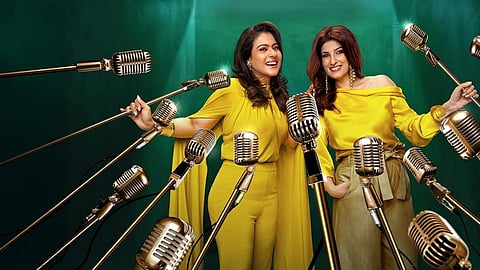


I don’t recommend being hungover watching Too Much, not because of Kajol’s cackle—which can single-handedly bring unseasonable rains—but because the rapid edit of the show, cutting between faces that are speaking and listening with the ferocity of an algorithm worried it is losing its grip over dead eyes, produces a feeling of being churned. In that sense, I don’t recommend being conscious watching Too Much for it replicates the feeling of a head hungover, spinning, with too many voices saying too many things, amounting to, really, too little.
Too Much, the talk-show hosted by Twinkle Khanna and Kajol, streaming on Amazon Prime Video, frames itself as a corrective to the male-dominated field of talk-shows. This is a textbook category error. The problem was not that talk shows were being hosted by men—though actresses like Kareena Kapoor Khan, Samantha Ruth Prabhu, Neha Dhupia, and the OG Simi Garewal have taken on the mantle as hosts—but that talk shows were not able to produce what they promised—intimacy—given the new rules of PR-approved personalities. That fundamental flaw in the design of the talk-show will not be solved by bringing in a diversity in the hosts—but re-thinking the very format of talk-shows, and if it is even relevant or necessary today.
If men produce something tepid, women have an equal right to do the same. While not logically wrong, it is hard to garner sympathy when what one is arguing for is the right to be mediocre.
But the show seems happy with its floaty and banal lib-cred agenda—speak of therapy; bring up the age gap between male and female actresses, not so much the pay gap, but this is a show of appearances uninterested in the material repercussions of these appearances. Strangely, Kajol and Twinkle Khanna insist that they stand apart from patriarchy, as exceptions to its rules. When Salman Khan cracks a WhatsApp-uncle quip about them dominating their husbands—“purana maal” as Twinkle Khanna notes earlier—Khanna replies, “Hamari baat alag hai.” (Our situation is different.)
No one is really arguing for the show to be radical, but even the illusion of being progressive feels exhausting when the show keeps reverting to humour to cut the edge off any fundamental socio-political disagreement. Keep it light if you don’t have the capacity or interest to take a heavy point to its logical conclusion. Genuinely, it is baffling why this show exists—and maybe the following seven episodes produce something more pointed and clarifying. Do we need to know more about people who are uninterested in being more known?
Both Salman Khan and Aamir Khan bring in their contrasting energies—where Salman who is so used to an audience that he has turned the show’s crew into one by turning his gaze on them, looking around distracted, and Aamir making stern and sincere eye contact with the host speaking; one producing the illusion of opacity and the other one of transparency; one looking too comfortable in his kurta and the other too stiff with his bracelet loosely hanging around his wrists, such that every hand movement is controlled to not let it slip out.
No interaction or rip of response shines through, and the games they have designed—banal statements that they must agree or disagree with; fishing words into their basket and discussing if those words apply to them—don’t have the energy or aura to allow a moment of truth to slip by unannounced. The games are not to make time pass, but to produce an alternative space where something strange, at a slight angle to their personas can see the light of day, even a glimpse of it. Here, the games feel like pathways out of longer conversations—which nobody really has an interest in indulging, except, perhaps Aamir Khan.
But what will they really speak of when they can’t really speak of what is really pressing?
In the past few months, two directors who have worked with Salman Khan—Abhinav Kashyap and AR Murugadoss—spoke of how difficult it was to work with him, how he cares so little for the craft of acting, ballooning the impatience of a shoot, preferring a director he can thumb down. Instead, in this show, they speak of how Khan was always late to the sets of Andaz Apna Apna because he was shooting many films, and couldn’t possibly keep track. That is not the case now. Why is he holding onto those habits when those compulsions have left him? Is he not excited by acting anymore, doing it as a side-job to his main gig—stardom? He brings up the stabs of pain from trigeminal neuralgia—why did he persist despite the pain? What does he truly love enough to endure this pain for?
Similarly, when asked about the age-gap between male and female co-stars, Aamir Khan feigns ignorance— “Have I done films with very young heroines?”—when his last film Sitaare Zameen Par had a twenty three year age gap. At that point, during the film’s promotion, when asked about this gap he had mentioned that de-ageing can help bridge the age-gap on screen. The underlying issue remains untouched—and you can sense Kajol’s and Twinkle Khanna’s frustrations in the reaction shots, but you also sense the compulsions with which they pivot away from these discussions.
At this point I blame the show—what do you possibly think they would say that is new or apart from their previous positions? Or is the mere act of asking the question enough—to sate the bourgeois liberal conscience that it knows where its heart is and that performance is enough?
Besides, the show’s concept and conceit is so dated it believes Aamir Khan crying on live television can create a culture of softer masculinity. Therapy is discussed alongside its usual metaphors. Twinkle Khanna gives the metaphor of baggage at the airline check-in counter—“a good therapist helps downsize the baggage so you can stow it in the overhead compartment … of our lives.” Salman Khan responds with another allusion, though I am not entirely sure of the point he was making—something about leaving baggage when on a hike, if it gets too heavy.
Some metaphors are milked before they are even made—and perhaps, some storytelling formats have the same problem.