

One of the strange symptoms of our current climate is an inability to distinguish between ironic and unironic love. When I ask friends who have paid for and partaken in Himesh Reshammiya’s Cap Mania concert, if they are enjoying the music or the performance of a collective exercise in irony, the answers confuse me, because the distinction seems hard to make. The question of what to do with celebrities of irony is itching, because they are people who become known for their upfront, unapologetic silliness. We enjoy their audacity. We cringe at the expression of it. Why do we love Rakhi Sawant? Urvashi Rautela? What primal instinct for trash do they accomplish? Perhaps, trash has a street credit that Satyajit Ray simply cannot compete with, a counter-canon kind of joy that insists on and prides itself in being outside of what is considered tasteful and tactful.
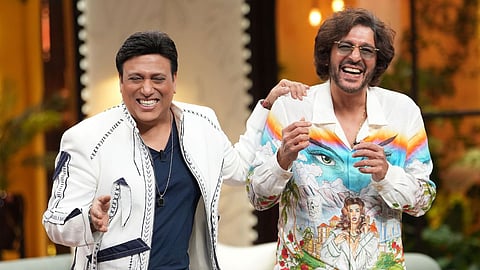
I would have assumed that calling actors Govinda and Chunky Panday, patron saints of the silly, to the couch of Twinkle Khanna and Kajol’s new talk show Two Much, would somewhere be an attempt at trying to make sense of this love, given both actors have not been able to shed the reputation of the colourful, excessive characters they played. For example, when Bhavna Pandey—not Panday—wife of Chunky Panday—not Pandey—noted in Fabulous Lives of Bollywood Wives, how she often felt hurt being seen as the wife of a court jester, it shows how the bleeding between reel and real costs something from those it platforms.
So much time in this show, however, is spent expressing unironic respect, it feels like even the hosts are trying to walk around eggshells. Watching Twinkle Khanna trying to bring up the strange and reactionary comments made by Govinda’s wife, Sunita Ahuja, on podcasts, without sounding remotely disrespectful shows the length to which the hosts will scrub clean their performance of any hint of subversion, grit, or even basic curiosity. (Ahuja’s barefaced responses to nepotism, among other things, were even autotuned into songs, becoming grist for the meme complex for a few days.)
The least they will do is tut-tut—Kajol will yell—when you say men are better drivers than women. The extent of their disagreement is the extent of their feminism—bleak, thin, but enough to use it as a commodity in the crowded talk-show marketplace. “I think god is a female,” Khanna will pronounce as they turn the value of women into points of argument. Maybe if we wrest women from the pedestals, we can finally see them as human—not holy.
The point of having Kajol and Khanna—both insiders with a wide web of affection that they can spread out to catch some guests—was, I would assume, their capacity to push the limit of conversations that say, a journalist, simply would not. That an a priori intimacy might allow for something deeper, darker, perhaps, stranger and more comical to emerge. But nobody takes that first step. They are happy connecting the dots of how they first met, and how one’s father—Khanna’s father, Rajesh Khanna—was the other’s spiritual mentor—Govinda’s. They are happier dancing to Govinda’s showtunes, but all four are facing the camera, standing in a line like kids on a morning assembly stage—they can’t even keep up the pretense that they are doing this for each other.
What does it mean to make a career by turning yourself into a joker for public consumption? This is the question I kept coming back to as the conversation forcefully meandered from one topic to another. At one point, when Panday notes the profusion of “Govinda-themed parties” as evidence of him being loved, Govinda responds, “Directly ya indirectly meri bezzati karte hain,” (Directly or indirectly, they are taking the piss) to which Twinkle Khanna interrupts with, “You are an icon!” and Kajol agrees, and they swiftly move on. What sort of talk show is this that is allergic to the possibility of conversation?
They call Govinda “Global star”, because he did a video with Samantha Fox and Panday is called “Amitabh Bachchan of Bangladesh” because he had a side-career there after his work in Bombay flatlined. They have a segment where they speak of their mothers and wives in glowing words, throwing a halo on them, right after discussing whether women make better or worse drivers than men. I suppose the show thinks of women in two genres—one to deify; one to debate—the modern equivalent of the Madonna-Whore complex. Well, at least the whore is up for debate now. Small victories.