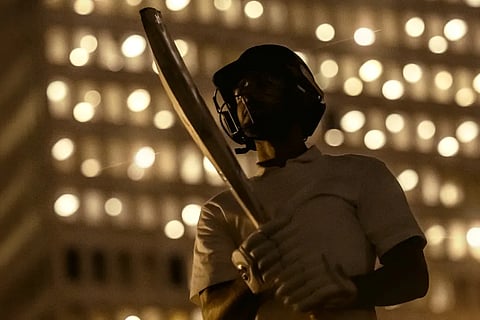


In Indian cricket, as in most religions, the tragedies are as mythical as the triumphs. Certain names become adjectives in the lexicon of the game — antonyms to the gods, like cautionary tales mentioned in the same breath as the fairytales. It’s hard to love Sachin Tendulkar without grieving for Vinod Kambli: two sides of the same Bombay-fabled coin. Similarly, it’s hard to worship Virat Kohli without feeling for Unmukt Chand: two sides of the Delhi-swag coin.
Chand’s story is almost like an alternate-reality version of Kohli’s — a batting prodigy, a dizzying rise as Under-19 World Cup winning captain and star batsman, a lucrative IPL contract, a Ranji knock to remember, unprecedented brand endorsements for a teenager, and suddenly, a failed transition to senior cricket. He left India at 28 after all doors of an international debut were shut, moved to the USA to play minor-league cricket and work towards a 2024 T20 World Cup spot as an American-Indian player. As someone who’s closely followed his career in the hope of a miraculous resurgence, I’ve often found myself randomly googling “Unmukt Chand” to see what he’s up to. There are no ready answers. The fame-to-anonymity curve is second to none; being forgotten is worse than being notorious (public scrutiny is reserved for those like Prithvi Shaw — whose genius as a 12-year-old unfolded in the 2013 documentary Beyond All Boundaries).
Chand’s is a sobering anti-journey of sorts, but one whose latest obstacle is the film-making of Unbroken: The Unmukt Chand Story, a documentary that somehow wastes its remarkable access, conveys nothing we don’t already know, and delivers a surface-level snapshot of the former star. Instead of trusting the nonfiction gravity of its subject, it is more interested in staging his life as a medium of fiction tropes. There are echoey voice-overs, melodramatic recreations, plastic questions from behind the camera (“Unmukt, you were supposed to be the next big thing, so what went wrong?”), playback songs (yes), a corny background score, patchy editing, training montages, fake commentary on real archival footage, and semi-scripted domestic moments. It’s never a good sign when it opens with the hero reading out a philosophical line in an overproduced voice; it’s difficult to tell the truth from its ornamentation.
Unbroken does the conventional thing of shuffling between two timelines. We see a more recent Chand and his wife Simran struggling to adapt to the do-it-yourself loneliness of Dallas in 2023; this is cross-cut with all the highs and lows of his Indian cricket life until he left the country. The camera observes Chand’s face quite a lot, but there’s never a sense that he’s saying what he thinks; he seems to be the character that the film wants him to be. At times, in the American portions, you can almost hear the director yell “action” and “cut” with the couple; even if the banter is natural, the prompts and the general design of their interactions are a bit jarring. This is not the first Indian ‘commercial’ documentary to frame reality as a genre, and it won’t be the last. It tells us everything that happened from different angles, but it isn’t curious enough to investigate the psyche of an athlete whose confidence was ruptured by the spotlight.
None of the talking heads, including journalists, are allowed to explore the question of why someone like Unmukt Chand implodes. There’s an illusion of intimacy — especially when we watch the mundanity of the couple chasing an improbable dream in an alien land. It’s a moving immigrant picture; he transforms from legend to striver, from champion to journeyman, reducing cricket to just another working-class vocation for South Asian expats. But the storytelling is curated to make us sympathise with them rather than understand him; the few glimpses of vulnerability are doused out by the performative mounting of these aspirant montages. Many conflicts go untouched: if fame got to his head, why is there a reluctance to examine the humanity of falling?
It’s also as if the film is refusing to detect that Chand was so used to being the best at a young age that he may not have been wired to handle the burden of not being good enough. As a result, his move to a country where cricket is semi-professional marks a desire to recapture that taste of greatness — it became more about standing out in a weaker field than evolving with the sport that kept leaving him behind. Unbroken, though, remains preoccupied with the ‘look’ of the underdog; making sense of his rejection is not a priority. He is spoken of: by a mentor-uncle, by coaches, by his wife and parents, by people baffled with his downfall, and by the documentary itself.
Much of the film builds up to the announcement of the USA World Cup squad — you can tell that it’s relying too heavily on a redemption arc. When it doesn’t happen, it’s as if the film becomes indecisive about how to end; there is nowhere to go without the cinema of a comeback. There’s no Plan B, much like in the life of its protagonist, and much like a T20 smasher who’s faced with an indefinite future of perseverance and not the instant gratification of talent. There’s a specificity about the courage that Chand shows in continuing his relationship with cricket at a lesser capacity. But his ability to keep going is inextricably linked to his need to be seen again. One can locate this subtext only because the film refuses to. I merely went back to googling “Unmukt Chand” to know what he’s up to. Never mind that I watched nearly 90 minutes of being told what he’s doing — not who he is.