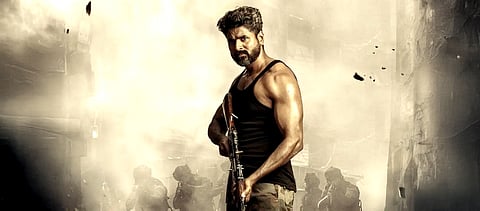


In one of the many interesting segues in Rajkumar Periasamy’s Amaran, an officer talks to Major Mukund Varadarajan (an earnest Sivakarthikeyan) about the Kashimir women these officers refer to as “half widows”, stuck in perennial conflict as they wait for their husbands to return, unsure if they're still alive.
This is explained in a rush, as though someone is reading aloud a Wikipedia entry, but one can still make a connection between these women and the film’s narrator, Indhu Rebecca Varghese, played by Sai Pallavi, who has also spent her whole life waiting. Indhu is Major Mukund Varadarajan’s wife and we learn everything about him through a series of vignettes, or memories, when she travels by flight to collect his Ashoka Chakra, awarded posthumously. The tone, however, isn’t that of a tragedy and the film isn't viewed through the eyes of someone who has accepted defeat. She is strong and courageous, and in moments of conflict, both husband and wife feel like two sides of the same coin, which the film underscores by almost always showing them in split screen. In her words, “we’re constantly in a long distance relationship”.
Rajkumar Periasamy is not interested in the standard-issue biopic about a war hero and his mettle. He wants us to know Mukund Varadarajan the way his wife would have known him, through the different stages of his life and career. In one segue, after the movie skips past several years, we’re told of how Mukund’s first kill and the death of a partner changed him forever. Yet in the very next shot, we see Mukund delivering a speech to his students about the importance of “not taking battles personally”. It’s these contradictions an army officer is formed of, and you see that play out right through Amaran. These are the ideas we, however, seldom see in the war movies of JP Dutta.
Told through the eyes of an Army wife, the story gains a softness and tenderness that goes beyond the black-and-white nature of war. Characters aren't allowed the full freedom to break down. They are told to be strong because they are, after all, Major Mukund’s family.
Periasamy's grasp of action is far stronger than his command over drama. The interval raid, a mammoth, 15-minute-long sequence, involves reams of detail. But it all comes together elegantly to give us one of the best-staged scenes of the year. It's tense, well-paced and emotional. GV Prakash Kumar’s ominous music, Sai’s cinematography and R Kalaivanan’s editing come together harmoniously.
This sequence elevates the film notches above its generic scenes revolving around Mukund’s love story, some stretches of comedy (this is a Sivakarthikeyan film, after all) and his complicated interfaith marriage that deserved more screentime.
That the film feels generic can be blamed, to some extent, on how tricky it is to write a Tamil film with so many multicultural characters. Even the Tamil dialogues, however, feel pedestrian, as though they have been retained from the first draft. This is felt most strongly during a conversation in which officers discuss their favourite movie in the back of an army truck. Even though you know exactly what the scene is building up to, it could have been so much more nerve-wracking.
The decision to attempt some sort of authenticity in terms of language only becomes a distraction. The idea is to make Sai Pallavi sound almost exactly like the real Indhu, a Malayali who speaks in broken Tamil. However, she's reduced to a Tamilian’s idea of a Malayali, with long stretches of awkward dialogue delivery. Would it have mattered if she’d spoken in plain, simple Tamil, at least in the later scenes?
Despite what’s lost in translation through these dialogues and the rush to highlight the immense research that went into the screenplay, Amaran comes into its own during the battle sequences. The film is sustained by the power of its source material and its inspirational hero, rather than its filmmaking.