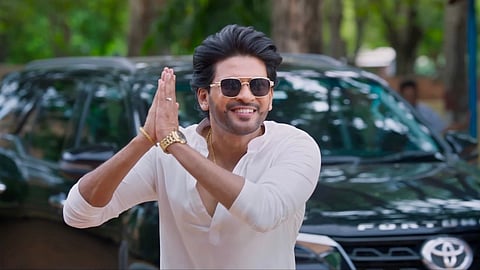


Naveen Polishetty’s latest Telugu comedy is essentially an assembly line of gags. But this observation does not in any way detract from the film, which takes jokes much more seriously than anything else. For an idea like this to materialise engagingly in a commercial movie, the writing and performances need to align to the bone, and it does, quite pleasantly so in Anaganaga Oka Raju.
Written by Polishetty and Chinmayi Ghatrazu, it works to its favour that the screenplay is so singularly focused. The film is held together by various actors, but the script does the smart thing by singling out just about three characters to show us the funny bones of the Peddapalam village. Leading this pack quite vigorously is Naveen Polishetty’s Raju. The ‘Raj’ in his name conveys his image of himself, and further his rich zamindar lineage too. But any other links to nobility end there.
Raju, who goes as far as selling his car’s spare parts to save shame in the village, doesn’t think twice before swearing to turn his life around to a mean relative. In a scene befitting any overripe moment in a family drama, he vows to marry a wealthy woman to rewrite his fortunes. Even if that means lying his teeth to get what he wants. The character’s promise is serious, and so is Polishetty, but the way this scene plays out is comedy gold.
This is essentially what Anaganaga Oka Raju is about; the film underscores every major element in an over-the-top family entertainer with a tinge of parody. It has a rich girl and poor boy romance (Meenakshi Chaudhary plays Charulata, the sweet but incredibly naive daughter of a man rich enough to bet 10 lakhs on a losing card in gambling), an unattainable challenge for the hero to finish, and a coming-of-age as well.
We keep waiting for the film to take a deeply sentimental tone to nudge Raju to change his old ways post-marriage, but it instead doubles down on its silliness and throws us an intermission that we should’ve seen coming miles away. The writing stays inherently light, complementing Polishetty’s acerbic wit. The lines are silly and often a play on the situation itself (Raju comes up with a deft description of his own life: “Lava phone in an iPhone cover”). Polishetty plays this penniless nobleman with the charm of a smooth jester, his timing and meter game for literally any joke flung at any given point in time.
It’s not that Anaganaga Oka Raju doesn’t know where to go with all of this nuttiness after a point, but it does struggle to navigate Raju’s path, once he overcomes the first narrative conflict. Another challenge awaits him in the form of a village president post. While this does offer Polishetty the opportunity to josh around in an empty canvas, the second half takes a sudden, serious turn. When Raju goes from class clown to people’s leader, we understand that it’s the course a film like this must take, but it’s a diversion that the film doesn’t smoothly recover from. Suddenly, the emotional scenes are actually emotional, and Raju actually fights the bad guys.
Despite these final missteps, the film still manages to take us for a largely delirious and fun ride.