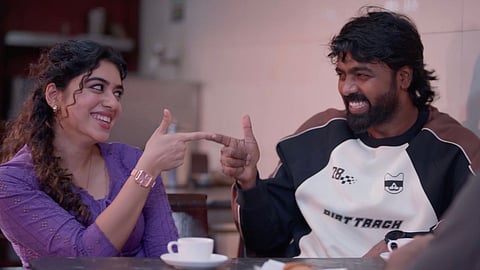


Pari Elavazhagan’s latest Tamil comedy Anbe Diana is a deeply unserious film. The title, a possible hat-tip to Goundamani losing his heart to a funny catfishing episode in Kadhalar Dhinam (2000), follows a romance between two deeply dissimilar people in Chennai. A Tamil boy (Elavazhagan) falls for an Anglo Indian woman (Ramya Ranganathan) in a romance that, at first, seems little different from Goundamani’s pursuits. Through the courtship of this unusual romance, the film also looks to make observations about caste, cultural differences and modern marriage. But Anbe Diana isn’t here to give us a rich depiction of these nuances. It is a film that wears its flippancy on its sleeve and remains largely watchable because of it.
Almost every detail in the film is written for us to lark over. Elavazhagan plays Chirumamilla Sita Krishnan, a man who goes by “CSK” and runs an athlete camp for children. Ranganathan plays Magic Gonsalves, an Anglo-Indian IT professional whose favourite colour is black, a preference the film rather simplistically equates with her attraction to its dark-skinned hero. Parithabangal Gopi is Baba, who speaks a heavily accented Tamil, never letting go of an excuse to bring up his Bangalore roots.
Its idea of an Anglo-Indian person might be breathlessly uttering “bugger” and “child” a million times and putting their leg up with wine. But the film backs up its inane worldbuilding with some semblance of realism by placing it in Perambur, a neighbourhood known for its Anglo-Indian population. The narrator calls the setting, Perambur, a land of love, and he isn’t far from the truth. The film depicts the neighbourhood’s multicultural demographic by telling the story of a Tamil-speaking Telugu man, an Anglo Indian woman, and a Kannadiga best friend who hilariously comes in their way.
The film, like its banner’s predecessors Good Night (2023) and Tourist Family (2025), goes a step further to introspect on dysfunctional family dynamics, which is a large distraction aside from Chetan’s role as the friendly father. Autism and divorce are discussed in the same breath as a largely frivolous romance, not quite getting the nuances that the previous family entertainers got right.
The writing is nimble and on its feet. But what Anbe Diana really needed was incredible comedic timing from its lead to have really made a mark as a coming-of-age romance. Elavazhagan tries to balance his limitations in performance by leaning heavily on Gopi and Ranganathan, who keep the film light and watchable. Roja is aptly cast as the overbearing matriarch of the family who prides over her caste and chastises her son and husband at any given chance. But her character never really grabs us the way it should’ve.
Anbe Diana flirts with reinvention but remains one step short of becoming a truly inventive take on the genre, even as it keeps us rooting for it till the very end.