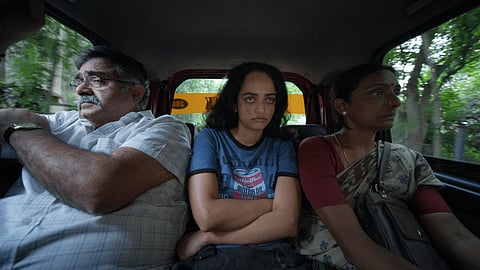


The most terrifying stretch of growing up is between the feeling that you are the only one who is going through life—masturbation, bleeding, heaving, wet dreams, shattered hearts—to knowing, no, there are others, too, who are transgressing.
"Naan yen ippudi irukkein? (Why am I like this?)," a frustrated, teenaged Ramya (Anjali Sivaraman) asks herself as Bad Girl opens, and you think the film will iron out this misconception—that no, she isn’t alone. But Bad Girl’s preoccupation is elsewhere.
The central protagonist of the film, also its central hurdle, Ramya pulls the film from her high-school years, to college, to her early thirties, roughly more than a decade. The film begins frenetically, moving swiftly between her inner and outer world—dialogues delivered in the same decibel—between mid-shots and close-ups, between dreams and reality, life-rooted and life-fabulated. Even the close-ups are wide, rushing the whole world into the image of her face in the trembling foreground.
The cut in films usually gives the illusion of continuity, but debutante writer and director Varsha Bharath prefers a fractured visual language, one that refuses smoothness and cohesion. Every action feels repeated, every movement feels undone. The early stretches of the film have this gorgeous limp-and-kick motion, an assured visual language to give forceful voice to the unresolved feelings of its central presence.
Pimples and periods, Ramya is unfazed by them. There is no shame, even as she is reminded of it by her grandmother and mother, her teachers and her peers. Even her self-doubt has an odd arrogance to it. We don’t see her staring at the mirror, anguishing over her changing body, her face. She only fusses over it when she is applying a face pack or make-up to see her boyfriend.
The constant hum throughout the film is how she stands apart from her mother’s expectations of her—entrance exams, engineering degree, foreign job, marriage. Played by Shantipriya, there is a quiet tragedy in this character, a teacher in Ramya’s school, which the film briefly acknowledges—and when it does, it is piercing and neat, a clarity arrived as though through multiple iterations of psychoanalysis. Why can’t Ramya see herself with the same, therapy-sealed, stilted clarity? Boys and men, instead, dot the landscape of her shattered heart and ravenous appetite, constantly throwing her life off-course.
This coming of age, a cumming of age, even a coming of rage, begins in her high school, Drona Acharya Gurukulam, where Sanskrit shlokas are dispensed in the morning assembly. It is a Brahmin milieu—one that Brahmins on X (formerly, Twitter) took offense with when the teaser dropped, since they see sex and shame as two sides of the same coin, one that Bharath flips here, though strangely, not completely. She does not bring up Brahminism, but she brings up the propaganda that her father consumes as news. She does not bring up caste, but brings up class, when her ex-boyfriend moves onto a “high society” girl. The film questions the rules of modesty and its hypocrisy within the narrow confines of Brahminism, without questioning Brahminism itself—a selective revolt.
In school, Ramya falls in love with a loner (Hridhu Haroon)—slit marks on his wrists, a pot-head, things that would deserve a deeper engagement are left dangling as asides—but that love never bears fruit. We are pushed forward into her late college life, where she falls in love with another man, the college playboy. Then, another. The film isn’t interested in her love as much as her unraveling in it. Desire is equated with doom.
The men in Ramya’s life are written as tentative beings—even as you are introduced to them, you know the relationship cannot last. No declaration of love feels possible or true or convincing. By the time we meet the third man in her life, even the film is exhausted that it begins at the end of that relationship, post-breakup. Quick flashbacks bring us up to speed, but there is nothing here. Cats creep into her life.
Something troubling also creeps up. The film seems to happen only because her desire for men happens. We do not know who Ramya is apart from this desire. We are quickly told, after the break-up with the third man, that she has never been single since her late teens. What of those stretches in between? Why has that been shafted out of the story? She has a job—but that is immaterial. Ambition isn’t part of her life, at least not one that Bharath chooses to tell. Even the sex and sexual awakening feels resolved in the film—there is no trembling, no seeking, no straddling. She wants it. She gets it. The film takes it as given that Ramya performs her desire successfully. Think of the way films like Girls Will Be Girls gave space to desire blooming—one Bad Girl cannot allow for, because it is cynical about the outcome of that desire itself.
The way the genre and current climates of solidarity work, you would think Bad Girl is about Ramya meeting the world, when she realises that she isn’t alone in her feelings, in her actions, in her transgressions. But Bad Girl keeps her away from this union as her reading habits move from Artemis Fowl to Bernadine Evaristo. It keeps insisting that she is unlike others around her—she is unique in her anguish.
Rooted in that opening question is the I-ness of the story. It might feel like a lament, but it is actually a statement filled with pride. That others can never be like her. Bad Girl is a terribly narcissistic film—and it might make sense, because it is about a narcissist, something even her friends poke fun at, but should a film borrow its protagonists’ vices? It has no space for anyone except her—and characters become dispensable and convenient points of contrast, to keep the film’s focus on her unique dysfunctionality.
The film’s motions, even as they have a joyful skip, and thoughtful observations, begin to feel trivial and repetitive, until Bad Girl realises, alongside Ramya, that sexual desire is not, perhaps, the balm to her bane. But it is too late—the cynicism has set in, the knots feel impossibly tight, and any direction towards hope feels like a patch of sunlight, when what the film was after was a floodlit life.