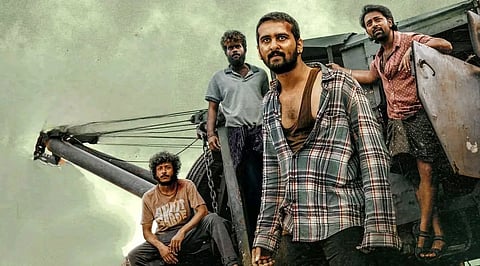


Set in the one of the border towns of Palakkad, bang in the middle of both Kerala and Tamil Nadu, is a surprising film that borrows its sensibilities from both Malayalam and Tamil cinema. The writing, about four young kabaddi players and how they’re slowly absorbed into the world of crime and corruption, feels planted and subtle, like a solid Malayalam slowburn. But the colours of these scenes are dynamic, the sounds loud, and its treatment a lot like that of the rooted Tamil cinema of the 2000s.
On one hand, these boys are faced by a villain played by Alphonse Puthren, the director of Premam. And the on the other, is one of the gods of Tamil cinema, Selvaraghavan, who directed Pudhupettai. But can a film even try to be a Premam letter (love letter) to the world of Pudhupettai?
That’s one way to describe the bi-polar universe of Balti. Heck, even the name of the film’s director, Unni Sivalingam, sounds like it’s been borrowed from both Malayali and Tamil parentage. But the film’s blend of both cultures feels so organic that you’re hardly left with a dull moment in it’s nearly 170-minute runtime. This, in parts, is because of how firmly the film sets us up for heavy drama right in the first few minutes. We see this Gang of Four, led by Shane Nigam’s Udhayan and Shantanu Bhagyaraj’s Kumar, make their way into a home to murder its resident. The cutting is crisp and precise, and in seconds, this gang slowly merges (in an extra wide shot) right into a temple procession. While we wait to see if they were successful in their operation, a temple ritual is intercut with shots of these four slashing at the severed body of their victim. It’s bloody and brutal, but shows signs of a director who has full control of his material.
This sets Balti apart from the other films that's built around a similar trajectory of crime, despite every beat sounding familiar. When we meet this gang, they are not more than your neighbourhood boys that are obsessed with playing kabaddi. They have their own team, but their lives are being run by the menial jobs they do around their town; this includes Udhayan, working as a part-time butcher in the market. They all have dreams, but not a career graph to get them there.
But as efficiently as the film takes us into their lives, it also does a good job of introducing us to this violent town and its history of violence. It’s border location, quite like the Mexico-US border, once gave rise to a blockbuster business involving smuggling spirit. This generation of smugglers also gave rise to a second generation of money lenders, each with their own fronts and modus operandi. If one of them uses terms like 'jumbo' and 'mega' to describe their money lending schemes, another uses sizes like X, XL and XXL to explain how he charges interest. This might sound silly to the reader, but it draws us in deeper into the film.
Balti's high moments are written around well-choreographed kabaddi sequences in the first half, and we gradually see this shift from sports into full-fledged drama as kabaddi makes way for action blocks. But the film’s solid writing isn’t just limited to the dramatic portions of these characters; Balti establishes them as kabaddi players to such an extent that even their fights begin to look and feel like kabaddi matches.
The action blocks are superbly thought-out, each with their own details and specificities. In one, we see a restaurant and the food items in it become weapons, as a squabble evolves into a minor war. A little while later, we see a fight scene set entirely within the walls of a soda bottle factory. But this isn’t an action sequence that happens bang in its centre to justify hand-to-hand combat. Every single prop you’d imagine in a soda factory comes in handy as this fight gets out of hand. And as with each fight, it's never about one man fighting a dozen. It’s always four men who are constantly being made to take on a few dozen opponents, giving us the feeling that we’re seeing it all pan out in hyper-speed.
What works even better is how this plot is tailor-made for a young set of stars. None of these boys, including Udhayan, have reached anywhere in the career graph of becoming a gangster. This makes them mere puppets of bigger, more experienced wise guys who look at Udhayan’s gang as their pawns for diabolical mind games.
In another well-written sequence, we see Udhayan finally waking up to the injustice of what he’s been doing when an earlier opponent is dragged into a money lending case. The drama here is then further deepened when we learn of this man’s relationship with Udhayan. The writing here is so smooth that we do not need a single extra dialogue to explain how Udhayan’s number one enemy in the first half, suddenly turns into an important friend, bringing about his transformation.
Balti then exchanges the sports drama formula for the beats of a coming-of-age drama. Friends do not appear to be just friends anymore and everyone appears to have their own selfish reasons to change their moral standing. By this point, when another wildly mounted fight scene comes into play, especially the one set inside a lodge, it isn’t just for the heroics. With traces of betrayal thrown in, the film asks if all this violence is necessary, bang in the middle of an excellently-staged fight sequence.
It’s a film that continues to surprise you, even until the last frame. It has in its heart the room to build complex characters like that of Kumar and the even more complex bigwigs he ends up working for. In these portions, Shane Nigam reminds you of a young Dhanush from his Aadukalam days. It’s the role of a tragic hero, which he plays effortlessly, that too next to a villain being played by Dhanush’s real brother Selvaraghavan, who also gets a larger-than-life character as Bhairavan, a mega villain with tonnes of screen presence.
But just as you see both Shane and Selvaraghavan do all the heavy lifting through Balti, you’re also guaranteed to feel the presence of Sai Abhayankkar in his first film as music director. He appears to be just as comfortable handling the background score as he is composing a hit romantic song like Jaalakaari. Bang in the middle of a kabaddi scene, Sai manages to incorporate a love-at-first-sight melody so smoothly that you do not even notice this changeover.
The other person who makes a debut just as assured as Sai is its director Unni. Born and raised with the best of qualities from both Tamil and Malayalam cinema, Balti is the work of a director who lives and breathes masala cinema. He’s not trying to be anything more because you see how much he loves this brand of entertainment and is brimming with ideas for what he wants to do with it. It may not be a Subramanipuram yet, but Balti comes respectfully close.