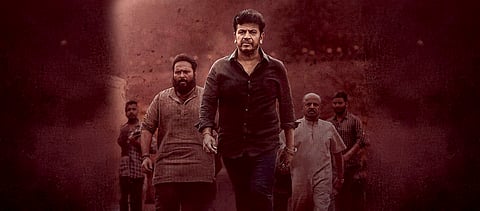

When writer-director Narthan decided to make a prequel to Mufti, one would imagine he had a blank canvas in front of him. The 2017 film introduced us to Bhairathi Ranagal, a crime lord character waiting to be explored further. As a man shrouded in urban mythology, Ranagal was accorded the status of a demigod, operating on a turf he owned and nurtured, wielding power and eliciting fear. A prequel would mean the opportunity to unravel this mystery and exhume its origins, while simultaneously recognizing the soul beneath the skin of that necessary evil.
Bhairathi Ranagal, the movie, duly starts with a bang. We are introduced to the fictional desert town of Ronapur where water has been scarce for many years and Ranagal’s father has been fighting this battle on behalf of its folks. He not only has to contend with systemic negligence, but also government officials who consistently turn him down and disparage him. Although only 12 at the time, the film’s hero is moved by his plight, willing to take matters into his own hands and deliver justice one way or another. If Ronapur cannot get even the basic necessities , he reasons that the Taluk office in charge should be bombed to send out a serious message — that there is someone who wouldn’t mind getting blood on his hands for the sake of his people. The kid is sent to prison, where he channels his rage and grows up to become a righteous lawyer before returning home.
In the present day, the owner of crooked steel company Parande Steel (Rahul Bose) grossly ill-treats his vast labour force and his firm has even stealthily robbed many of them of their hard-earned land, from which iron ore is then mined. The labourers, led by Varade (Gopalkrishna Deshpande), have no option but to consult Ranagal, who must then muster the courage to battle the mining giant and also offer shelter to 2,000 labourers and their families. If push really comes to shove, he will also swing the machete.
But before the bloodshed, Bhairathi Ranagal first takes the shape of a courtroom drama, and it is here that Narthan pleasantly surprises. These portions strongly suggest that he has evolved as a filmmaker since his debut seven years ago, and even though the tone and the pitch of his new film feel dialed up to melodramatic levels, he ensures that he maintains a sense of nuance and composure throughout. His protagonist is calm, clinical and strategic against his diabolical opponent and even when Parande’s kill-machine Ghatta (Shabeer Kallarakkal, in a surprisingly one-note, underwhelming role) resorts to savagery, he employs wits and not violence. While Dr. Vaishali (Rukmini Vasanth), the new doctor at Ronapur’s only hospital, complements Ranagal’s amiable demeanour, how long can she help hold off the monster lurking within him?
The scene just before the interval block becomes a crucial narrative choice. Following the massacre staged by Ghatta and his men, Ranagal is forced to unleash himself and assume the identity of the anarchic gangster. The stage seems set for the trademark black shirt and grey panche (loincloth) ensemble to be worn, for the signature wooden stool to find its place in the middle of a barren, flat land and for the iconic poster moment to be created. But as whistle-worthy as that moment might be on paper, could it be that Narthan has played his hand a little too early?
In the larger scheme of things, the answer is yes, because the film is now in need of a bigger and better conflict to make up for the glaringly vacant second half. As a prequel, Bhairathi Ranagal could have either been a document of the making of its protagonist or simply a show of his rise to power as a benevolent anarchist. Cracks start to appear in the film when it chooses to be the latter, by not wanting to be the origin story it could have been and instead becoming a straightforward backstory of sorts. Instead of showing us how Ranagal spent his time in prison, the film starts to tell us how he took on a minor villain like Parande Steel. Instead of showing us how he managed to stave off his penchant for violence and how he grew in respectability, the film starts to introduce newer nemeses that feel largely redundant. Instead of digging up the past that audiences haven’t yet been privy to, it starts to elaborate on the present that Mufti already familiarised us with. It might seem like these choices are a lot to expect from a big-ticket film, but a prequel could certainly afford a few more risks.
Consequently, the second half of Bhairathi Ranagal starts to feel like a longer recap and almost every character brought into the mix at this point struggles to forge an identity. Despite Rukmini’s sincerity and charm, Dr. Vaishali is made to slowly fade away into insignificance and Rahul Bose’s antagonism isn’t as delicious as it ought to be. The story also reacquaints us with Ranagal’s sister Vedavathi (Chaya Singh), Devaraj’s menacing politico Raghuveer Bhandari, Madhu Guruswamy’s Singa and Babu Hirannaiah’s Shabari, but all these players remain as unexplored as in Mufti.
There’s no doubt that a character like Bhairathi Ranagal comes with tremendous promise and as much as Narthan has a good go at augmenting his mythos, he falls short at being inventive. Prequels have historically been tough to nail but a film like Godfather II (1974) proves that new dimensions - in the characterisation, physical settings, time periods - could always be employed to great effect. Give this film a chance if you want to see Shivanna exuding his characteristic panache and having a ball of a time.
