

Maybe the Polish poet Czeslaw Milosz was right—“When a writer is born into a family, the family is finished.” Artists look at their past as grist they can reframe on their terms. And this anxiety of re-writing one’s personal history sometimes shines through—the best memoirs are, after all, shameless and transgressive, and timid are those that cave under the weight of this trespassing anxiety.
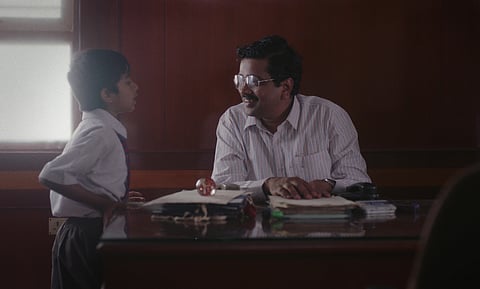
For writer-director Anoop Lokkur’s debut Kannada feature Don’t Tell Mother, which had its world premiere at the 30th Busan International Film Festival, this anxiety has been swept aside and muscled under by nostalgia. Set in Jayanagar, Bangalore in the 1990s—a significant Brahmin bastion—the film follows two siblings, Akaash (Siddharth Swaroop) and Adi (Anirudh P. Keserker), young boys inching towards self-hood, as they make space for their childhood alongside punctures of parental influence and interference, school-day routines, classmate cacophony, and the sudden calls and catfights with neighbourhood friends. They live next to a mosque, so the azaan becomes part of their life’s sounds—one the film makes forceful, by cutting to images of the chanting minarets. (In a post-Babri 1990s, when the Infosys IPO is being launched, you feel the film will say more about this, but it doesn’t, and lets these images, like that of Muharram, puncture the proceedings as a form of spectacle without discourse.)
The film is told, largely, from the perspective of the children—the mother and father are referenced as amma and appa, played by Aishwarya Dinesh and Karthik Nagarajan; we only hear the mother’s name when a distant friend calls at her in the vegetable market, or when they are speaking to others about their spouses.
There is a strong desire that runs as a vein through the film to return to the rhythms of this world, its boredom and aimless abandon, where time’s footprints were gentler. It is in the soft framing, the strums of the guitar, the languour with which life is lived and captured.
But Lokkur’s nostalgia is not entirely forgiving. Violence is ever-present. Akaash’s mother whacks him on the calf when he is not studying. (Adi, like most younger siblings, is largely spared such horrors, and given cashews and candy instead.) His teacher can be violent, too, leaving marks on his body that he tries to hide from his parents. Even he knows, some violences are greater and more punishing than others. His father, too, can be brought to the threshold of violence. But this is not the kind of violence that Lokkur wants to spin into trauma, and look back with fatalism or favouritism, but frame it as part of a world that was, by and large, kinder. Regarding the flaws—no one knew better. It doesn’t forgive them, but neither does it fix them into it, as fate.
So even though the film starts with Akaash kneeling outside his classroom in punishment, eyes damp from tears, looking at monkeys, the next scene is his younger brother, Aadi, yawning, waiting for Akaash to come and walk home, take the auto together. Every sadness is immediately undercut by sweetness. Lokkur is careful that the film never tips into the saccharine or the strident. It gently opens up, a gentleness that feels arbitrary, but is the sign of directorial control.
There is a delightful digressive movement in the film. Aadi and Akaash have their grandparents living nearby. Their mother tells them to get their mail from that house—it was delivered incorrectly to the grandparent’s address. They make a race out of it—Akaash jumping through the roofs; Aadi on the road. The sense of a neighbourly commune rips through—old, creaking people in veshtis and saris asking the kids where they are running off to. Akaash reaches first, meets his cousins who are at the grandparents’, about to leave to check out a new house. He hops into their car, fights with them about who gets to sit on the window seat and zooms off, and while Aadi reaches later, thinking he came first, his grandmother asks him what he wants to eat, and he replies, as always—cashews. Was the mail gotten home? Who finally handed it over to the mother? These are irrelevant questions to a film whose preoccupation is not the road but the detour, one that delights in branching outward. Life’s movement isn’t linear, but diffuse.
Though the film is predominantly about and around the children, it gives space for the parents’ anguish, too: the mother’s sense of lapsed ambition post marriage, the father living under the shadow of his father, both mother and father staring at Akaash, poking gentle fun at his desire to learn karate—“that stick insect won’t stand a chance”.
So, when the film’s language becomes more forceful—when it asks you to pay attention to its narrative choices, when a scene begins to feel like a set-up, when it uses the cashew as a Chekhov’s gun, producing a strange neatness in the final act, the film betrays its tone, suddenly on the verge of a moral resolution. This is because this neatness in a largely autobiographical narrative can feel like a forgiving nostalgia.
But ultimately, what makes Don’t Tell Mother a cinematic triumph is the easy presence of all its actors—the mother doing aerobics from a cassette, the father hunching his pose in front of his father, the kids who are so caught up in their immediate desires and responses they are uninterested in stepping back, but not insensitive to it. When Akaash is called to play cricket by the neighbours and he leaves, Aadi runs and waits by the doorstep watching his brother leave. Is he waiting to be called to join in? Lokkur, uninterested in over-sentimentalising this gaze, immediately shifts to Akaash and an older boy in the neighbuorhood watching a girl go to the washroom from the slats of the window. A world whose violent possibilities are just as easily accessible as its softness, told through a movie that doesn’t want to lean too strongly in either direction, but also wants to make sure what shines through, despite the wounds, is love for a world that no longer exists, except for, perhaps, art. Maybe, then, Milosz was wrong—when an artist is born into a family, the family is rendered eternal.