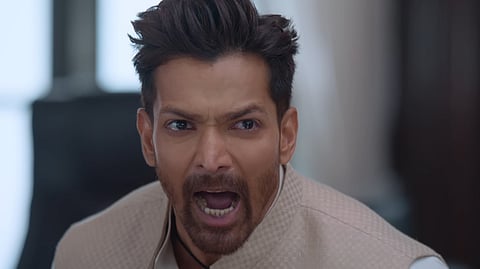


It’s a miracle that a movie named Ek Deewane Ki Deewaniyat exists. It’s like watching a 141-minute music video of tight reaction shots, slow-mo emotions, designer entry shots, personality twists and lone tear-drops. It’s also like watching an injured middle finger to a digital generation that equates love with consent, respect and dignity. If the movie were a person, it’d be a Sanam Teri Kasam stan who was once a Tere Naam devotee who became a Kabir Singh fan who became a MeToo apologist who then decided to explore wokeness within the realms of toxic masculinity. I’d be worried if this were a competently crafted film. Fortunately, it has the emotional intelligence of a soggy peanut. A visual transition early on hints at a self-cannibalising Bollywood story: coins thrown at a sultry single screen (because “mass” is the genre) match-cut to coins paid to a washerman by the humble siren from the screen. As the Scorsese meme goes: Absolute Cinema.
Ek Deewane Ki Deewaniyat is supposed to be a cautionary tale about one-sided love, but it naturally becomes a musical ode to male suffering, victimhood, ‘honest’ obsession, heartless women and all that (warped) jazz. It has the audacity to frolic into “No Means Yes” territory like a frisky labrador waiting to be adopted. Let me explain. The film revolves around a golden-hearted political prince, Vikramaditya Bhosle (Rane), who becomes a sympathetic (or ‘simp’) sociopath once he falls for Adaa Randhawa (Bajwa), a superstar actress who is repulsed by his entitlement. Lest we complicate his nature, we see him promising to take care of a young street-vendor while simultaneously threatening an industrialist named Raheja at Bandra Fort promenade; the kid promptly goes back to selling peanuts, and nobody from Vikram’s team seems to care for his details.
Moving on, Adaa quickly realises that he’s a delusional twerp (during an armed forces’ visit because is it really romantic if there’s no patriotism?) who is already planning a wedding and happily married life with her. Forget taking No for an answer, the guy is an Anjaam-styled villain who thinks he’s an edgy anti-hero. The more she resists and insults him, the more he threatens her family and livelihood and mental health, even sending political goons to halt a screening of her movie for hurting religious sentiments. So far, so woo-woo. All of this is executed with not a single interesting frame, aesthetic or original note; the Mohit Suri Lite soundtrack entirely replaces things like speaking and expressing and dialogue after a point.
The interval block is one for the ages. Driven to the brink by his antics, Adaa switches from pristine white clothes to fatale-red and gatecrashes his rally to announce that she will sleep with any man who kills Vikramaditya before Dussehra. This is on live television, thank god, because she’d have been cancelled if she had written this as a tweet. Scripted reality shows are so yesterday. Apparently, this is a defiant woman’s “sanak” (madness) — the film’s version of female agency, and her weaponisation of the very masculinity he subjects her to. He doesn’t get the message, of course. His sad-boi and tone-deaf heartbreak (“you are prepared to sleep with a stranger but not me?”) means that he spends the next hour (or eternity) tearing up every time she humiliates him further. I wish I were making this up. Remove the slow-mo intros and her unimpressed glances (does that make her the ultimate ‘hate-watcher?’), and the film would be two hours shorter.
But you see, his willingness to die for her is the clincher. The film insists that he’s a broken monster who’s scarred by the childhood trauma of ‘killing’ his mother at birth, but the film-making cannot stop itself from fetishising and admiring his penance — and present Adaa as the cold one. It pushes the audience to be impatient with her rage. He punishes himself to soften her, and at some point, it feels like a secret kink that the screenplay is too shy to confess. It’s kind of insane that I’m typing this with a straight face. Not as insane as the characters and their ideas, but still. Also, why is it that everyone stops having a career once they enter this contest of who the worse person is? She even flings photographs of him around an empty funeral pyre to demonstrate that she is turned on by the prospect of his death. No prizes to guess what happens next.
Harshvardhan Rane does everything to capitalise on the re-release success of Sanam Teri Kasam as the self-destructive alpha with the belated capacity to show remorse. There’s something about him (not in this film), but his Vikramaditya is everything that’s wrong with the cultural relationship between pain and love. Sonam Bajwa is reduced to a series of displeased poses and ramp-walks as Adaa, a woman whose hate becomes a covert love language; a star who is being wooed under the pretext of being terrorised. Watching a film like this also makes you appreciate the tightrope walk of similarly-themed narratives like Haseen Dillruba, Saiyaara, Rockstar and Manmarziyaan. None of them are perfect, most are divisive, but they avoid the steep falls that tend to define this boom-or-bust genre.
Midway through, a cross-pollination of Diwali releases happened in my head when Adaa intentionally drops a pint of his blood during a donation drive (needless to say, he orders the nurse to draw out more blood). Where are the vampires of Thamma when you need them? Given that they feast on questionable humans only, Vikramaditya and Adaa would have been the tastiest milkshakes. Actually, scratch that, they’re the sort of couple that prompt vampires to ban human blood from their diets forever. This is technically the horror movie of the week: haunted by the ghosts of mediocrity, misogyny, massy excuses and phantom wokeness. In a parallel universe, Ek Deewane Ki Deewaniyat would inspire a generation of stunted Indian boys to stalk girls, offend them and romanticise their revenge; to pursue a “pure” and reckless love that’s different from lust. But in this universe, it inspires no more than a splitting headache. That’s the best-case scenario.