

Great cinema has a way of undoing our expectations of it. At its most potent, Malayalam cinema can feel pungent, thick with characters, who are full of life, and by life I mean the small details and throwaway actions that accumulate into character, characters that congeal into narrative, and narratives that shape into cinema. It is this thickness that allows conventional demands made of it—radical clarity, a three-act structure, neatness of cause and consequence, efficiency, plot—to wither away under its strong portraits of specific lives being lived. Often you wait an hour into the film to truly grasp where the film is heading, or what its central drama is. Life can feel like a delaying device to plot. Immersion, then, becomes key.
Director Dinjith Ayyathan and screenwriter-cinematographer Bahul Ramesh wove Kishkindha Kaandam (2024), whose unsettling aura in the initial hour gave way to curiosity, and finally, clarity, try and chart a similar path in eko, but instead of arriving at clarity as an all consuming explanation, prefer arriving at through theories, perspectives, and possibilities floating into a moment that becomes, ultimately, a gesture at an answer.
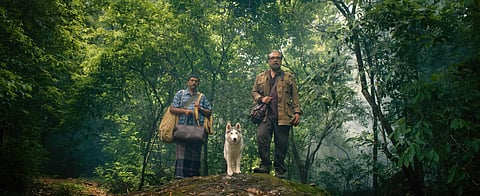
At the center of ekō is a Kuriachan (Saurabh Sachdeva), a figure of smoke and mirrors. He is wanted by the state and Maoists, alike, by a past, grudging friend and a present, longing wife, but has not been seen for years. A dog lover and dog trainer who has traveled across countries pursuing pure breeds to lasso back home, his personhood emerges from fragments shared by people—fragments which can feel unstable, given the various perspectives doused in various degrees of love and lament.
The present wife, Mlaathi Chetathi (Biana Momin)—one of many wives, but also one above many wives, a woman Kuriachan got back from his Malaysian sojourn during the World War—lives in the hills of Kaattukunnu, which itself is shrouded, curtained by mist that keeps swiping the mountains into blank slates, on the border between Kerala and Karnataka. Aging, and agile in the mind, she is taken care of by a young man, Peyoos (Sandeep Pradeep), whose intent begins to feel deeper, and thus more suspicious, than initially assumed as the film progresses.
A central question is left looming over the narrative—why are so many people so insistent to find him and sever his head from his body, his life from his mythology? They keep wading to the hills to interrogate Mlaathi, who answers with the same deadpan shrug. Her stoicness in the face of the agitation of those around her feels like the only solid ground the film can rest its weary feet on. When this resolve of hers is tested in a scene and her eyes well up, the film too collapses from under your feet. This is landslide territory—nothing is permanent, not backstories, nor intentions, and certainly not allegiances. In the final pre-climactic fight, you are unsure of whom you want to win, as the men pummel in waterfalls and through forested hillsides. The fight itself is the point of such scenes, and not the desire for a victor to take his stake.
A film like ekō thrives on the details, and if god is in the details, ekō is an act of faith, because it is full of God. But God shifts when the light shifts. Mlaathi drops some of her milk onto the table—and you wonder why—and she places a nearby ant onto this skein of milk—and you think it is her love for the creatures around her—and you hold that detail, only to slip into the next scene and realise she does this to test if she is being poisoned by Peeyoos. A detail whose ‘why’ keeps turning, till the act itself turns into a kaleidoscope of possibility. If storytelling is about building, here is a fine example of fracturing as storytelling. Similarly, when you first see the Peeyoos laying out his bed, he extracts from under it it to a few porn magazines—and you think this is how he cures the montane, mist-struck loneliness, or he is just being a horny man—and then he opens the magazine and you see, instead, a white sheet of paper on which he has written prose, and you wait a scene later, to realize, he writes smut, and posts it out. At every level, the detail builds, till the seed of the detail itself becomes irrelevant as what it exposes, instead, becomes more tantalisingly clear.
Knowledge is a fragile thing in such a movie, because it keeps flirting with ignorance—to know more can sometimes feel like knowing less, because with more knowledge comes the sense that the world is bigger, and each shred of evidence is actually a pinprick in the haystack. A frog in the pond, versus a lion in the wild sort of thing.
What keeps the film propulsive, then, apart from the constant fragility, is Mujeeb Majeed’s score, which swells you into feelings, sometimes even before the feeling has been narratively wrought. You don’t mind it so much, because after a point, it begins to feel like a reliable narrator, dragging you into recognition.
Perhaps it is the verbosity of the dialogue, which becomes blocks of text as subtitles that have to be rummaged as images that made me dizzy, as though having emerged from an hour of speed reading. Is brevity possible? What this verbosity does is leech the film of any mystery. In the beginning, we see Mlaathi place a lamp in front of a portrait of her as a young Malay girl, and this portrait has a strange power of summoning a past without stating it. But the film chooses to state it, instead, in a detailed flashback, and use the stating to embed a clue that will only unravel in the climax, a clue that yields the film’s central moral—that protection can feel like restriction.
What, perhaps, hurts the film is Sachdev’s performance as Kuriachan. He is supposed to muster the kind of mystery, charisma, charm, and wile of someone who can command the affection of so many women, so many disciples, and the distaste of so many factions, so many ideologues. Did the makers want to build that myth at all through his performance, or use his performance to unmake the myth that people around him wove? Often I felt the Kuriachan spoken of and the Kuriachan we get to see glimpses of were at odds. In the sections in Malaysia, particularly, the more Kuriachan speaks, the less the enigma, the chase makes sense. Was this intentional?
Such films could also thrive on the ellipsis—on what is left unsaid, but provoked through imagery, or mere resonance. The flipside of making a film that says too much, is perhaps, a film that offers no space except for its cluttered surface, a clutter that is as translucent as it is immersive, as accomplished as it is unresolved.