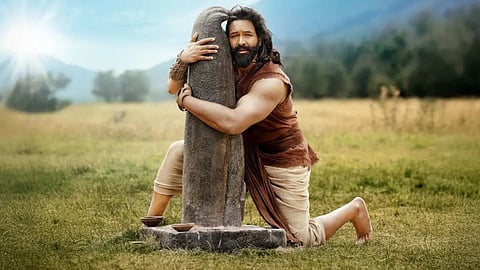


It’s not difficult to see what drew Vishnu Manchu to the story of Kannappa. The multilingual film details the legend of the second-century Shiva devotee, a hunter whose unconventional yet unconditional devotion overwhelms his god. This is also one of those legends from Hindu mythology that promptly finds a place in the story roster of any believer’s household from the south. But what really lets down the film is perhaps a lack of imagination — a trait that is sacrosanct to the genre.
The interesting part about exploring the contours of such a popular story is the canvas to dig deep and flesh out roles — especially when it comes to a hunter like Thinna (Vishnu Manchu), who goes from being a committed atheist to a devout believer. Talk about rich character arcs. So, there is room for a lot of deep character development in Kannappa. We see glimpses of this in a young Thinna and how he comes to associate resentment with faith. And as he grows up, we see him dispel any form of superstition that people in his clan pride themselves on: “Why do you bathe stones that don’t sweat?” he asks at one point. But the film doesn’t linger on Kannappa and his psyche beyond such basic observations.
A big part of the first half also revolves around the fight for the pious Vayulingam, between the evil Kalamukha (Arpit Rankha), who wants to steal the shrine to “revive the dead.” This ends up leaving Thinna to gather his clan and fight a bigger battle, even as the more interesting battle is the one in his head. There is plenty of meandering in the first act, including a romance between Thinna and Nemali (Preity Mukundhan). While the actors themselves are sincere, the romance (steeped extensively in the male gaze), which starts as a seemingly harmless one, begins to take on a more titillating and exhausting role as the film progresses.
Any time we’re close to understanding Kannappa’s perspective, the film takes us further and further away with the help of overcooked romance and action sequences. While the film captures the essence of the forests in their pristine glory by filming in New Zealand, the VFX proves to be a little jarring. We have random blurring of shots and digital colour correction to gloss over its shortcomings, especially in fights, but again, why does the film have so many action set pieces? At one point in the film, we jump from Kannappa’s intense sermon against human sacrifice to a garish duel between two men to win over “their women.”
Kannappa, at times, also confuses us with its ideas. We have Prabha’s character of Rudra tell Nemali, in a thoughtful dialogue, how one can never force devotion onto someone. But then we have someone else equating married women to mothers, as if that’s the only way the female gender can be allowed to live with any decency. Some of the characters, who help nudge Thinna along the path of devotion — Rudra (Prabhas appears in a pleasant cameo, even if it’s a little too late), his father (Sarath Kumar), the mysterious Kirata (Mohanlal), and Lord Shiva (Akshay Kumar) himself — all have moments of meaning in the film. But much of this is diluted by the film’s obsession with a sense of “largeness”.
The film’s climax touches on the simplicity of devotion and the discrimination faced by a rugged hunter in orthodox, religious spaces, but by then, the interest in the story has halved. The film also needed to have spent enough time behind Thinna’s transformation, but we’re asked to fill in the blanks. While followers of Kannapa’s story might do in their heads anyway, the film ends up leaving much to be desired.