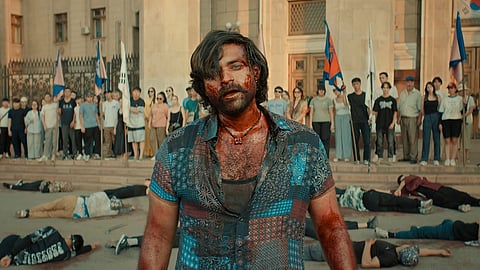


Merlapaka Gandhi’s Korean Kanakaraju has a near-perfect premise for a horror comedy. The spirit of a South Korean kingpin finds his way to Anantapur in Andhra Pradesh and possesses an unassuming but temperamental Telugu man (Varun Tej). A comedy of errors that spans the distance between Seoul and Rayalaseema might sound wild on paper, but the reality is more of just an excessive, reductive repurposing of ideas and action set pieces we’ve seen before.
Kanakaraju (named so perhaps just for the quirky alliteration), played by Varun Tej, is a Bhajan troupe singer whose day begins at the temple and ends at the bottom of a bottle. His friend Kistappa (Sathya) is a happy accomplice who runs a photo studio and distances himself from his shaman father (Muralidhar Goud). A detached addition to this village is Chaitra (Ritika Nayak), who speaks fluent Korean, prefers K-pop to local folk and names her Shih Tzu after an indelible Korean pop star. Chaitra forms Kanakaraju’s first real association with South Korea. The makers connect the actual Anantapur KIA plant in the town to Chaitra’s obsession, establishing a small glimmer of authenticity that takes this detail beyond random narrative novelty.
Kanakaraju’s second connection with Korea is, of course, the writing on the wall. It’s interesting how the writing approaches this particular section of the film. The ashes of South Korea’s most perilous gangster gingerly change hands and take flight from Seoul to Anantapur in the most ridiculously campy manner, which almost makes us look forward to what the film’s absurdist sensibilities have in store. But this tension dissipates almost as quickly as it takes shape. The writing instead spends the first act on a romance that veers off course and into almost problematic territory (especially when the courtship involves almost immediate stalking and bloated entitlement).
But the biggest injustice Korean Kanakaraju does to its own subject is to not own its incredibly absurd Korean crossover. Sathya’s Kistappa leverages the communication gap between the Korean-speaking ghost and the Rayalaseema Telugu clan, and some laughs ensue organically. Kanakaraju’s slow but feral transformation gradually shows some teeth before the interval, leading to some interestingly choreographed action sequences. But the little novelty that the film does end up creating goes kaput when this ghost is actually given an identity. Because once the monster is revealed, the intrigue is lost, and the film switches gears and rides on the coattails of every formula-centric action drama we've ever watched.
Kanakaraju skips long VFS queues and jumps on the first plane to South Korea to take on this ghost, visa hurdles conveniently forgotten because no one's got the time for that. It is also when the film leaves for Korea that the little interest it managed to generate crumbles into dust. VTV Ganesh and Master Revanth make listless appearances here. The action here moves from absurdist horror to inane revenge incredibly fast, and we're left wondering how we got here. There's a Korean flag in almost every scene to remind us how far the ghost drags Kanakaraj, and Sathya is suddenly almost always in a Kimono (it matters little to the film if the garb is from Japan or South Korea). As Kanakaraj and co. race against time to get home, it's hard not to wish we could do the same.