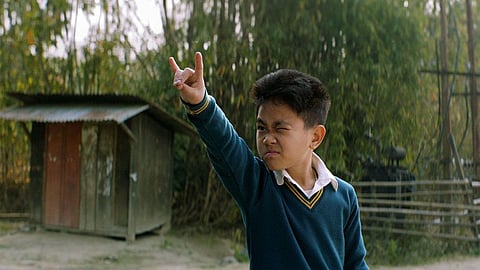


Boong tells the story of little Brojendro “Boong” Singh (Gugun Kipgen), a naughty Manipuri kid from Imphal who sets out to search for his absent father in the bordertown of Moreh. It’s been years since his dad left home, phone calls have stopped being returned, but young Boong wants to surprise his single mother Mandakini (Bala Hijam) with the ‘gift’ of the man’s return. He leaves him voice messages to no avail. Their village mysteriously receives news of the man’s death, but Mandakini refuses to believe it. Boong notices her distress, so his journey with best friend Raju (Angom Sanamatum) into the unknown — into neighbouring Myanmar, even — is framed as a bittersweet Home Alone-coded adventure. The two boys reach their destination by hiding in a wreath next to the corpse of a friend’s grandfather in a hearse.
Lakshmipriya Devi’s film might be about a child, but it is far from a children’s film. The backdrop is normalised — ethno-racial tensions, a separatist movement and symbols, insurgency news, the ban of ‘mainland’ culture (including Hindi films), the stigma of single parents, the aspiration for English-medium education — because the gaze is that of Boong. From his perspective, the complex setting acquires a more quotidian and matter-of-fact rhythm; the bigotry, patriarchy and identity politics bleed into everyday moments without the burden of being moral statements. For instance, Boong’s mischief reflects the environment. He gets himself expelled from a local school for his deadpan recital of Madonna’s ‘Like a Virgin’ as the morning prayer; he does this minutes after making the name on the gate to read ‘Homo Boys School’. When he’s admitted to a fancy convent, he refers to the rich English-speaking bully as “second-hand foreigner” after she mocks his friend by calling him an outsider and a “blackie”.
When Boong isn’t around, the prejudice is more pronounced. Raju and his father Sudhir Agarwal (Vikram Kochhar) are warned to stay in their lane and not meddle in local affairs after Sudhir helps Mandakini confront the village chief. Their Marwari heritage is cited to discriminate against them, despite Sudhir being a third-generation Manipuri businessman; the act of marginalising this family for the same reason North-eastern migrants are marginalised in the rest of the country more or less explains India and its abusive relationship with diversity. Almost everyone is treated as a minority in a region torn between autonomy and belonging — Mandakini for her quasi-widow status, Boong for his fatherless behavior, Raju for being a Hindi-speaking mainlander, a flamboyant dancer for being a trans entertainer, a Tamil trader for running his own hustle.
I like that Boong trusts its personal story to convey the history of a place without exoticising it. It’s a simple film, the craft is raw in parts (like a child lyrically saying “my gift to her is a new beginning”), but the focus remains on the incomplete family. Mandakini admits that she didn’t know her husband beyond his love for Madonna and Bollywood, and Boong’s longing is rooted more in the naive perception of what joy (also his father’s name) should look like. He has a main-character energy of sorts, until he realises that even Raju is missing a parent in a place where nobody looks like him. As clumsy as some of the film-making is, the resilience of their friendship — they keep falling out and reuniting — shapes the nostalgic undercurrents of the film. I also like that the fate of the father toys with our notion of how men on the margins disappear — there are hints of a revolutionary-outfit past, of death, of radicalism, of sinister designs, of a deeper and secret connection to Manipur.
But the actual revelation implies that average dysfunctionality often gets concealed by the social discord of a region. We’re so busy expecting extremes from characters in troubled lands that we rarely imagine that everyone is fundamentally similar. We are wired to use communal trauma as a crutch to cushion more grounded truths and failures; if a family is broken, it need not always have something to do with where or who they are. The backstory need not always be dramatic. That’s why the setting of Boong plays such a key role as a smokescreen; it feeds our primal impulse to fetishize conflicts by reducing people to the plurality of the borders and boxes that define them. The point being: the film forces us to remember that Boong and his fellow characters are humans before they’re Manipuri, Hindu, invisibilised or Indian.
It’s tragically ironic, then, that Boong finished shooting a week before ethnic violence erupted in the state in 2023. The bloody war of identity that followed further mythologises a movie like this for the Manipur it once symbolised. It speaks volumes that the spunky child actor, Gugun Kipgen, is a Kuki-Zo tribal boy cast as a mainstream Meitei character — the two sides of the xenophobia-fuelled historical conflict. But his identity in the film is adolescence; his religion is boyhood. In a way, Boong is to Manipur what Lagaan became to its locations in Bhuj after the 2001 earthquake. In both cases, cinema endured as poignant proof of a region being alive before disasters reduced them to rubble. It mirrors the story of a little boy enduring as proof of a family being alive before a ‘manmade’ disaster broke them into pieces. After all, one Indian’s act of god is another’s act of faith.