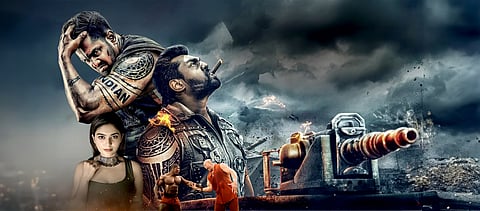

Watching Martin is perhaps the equivalent of getting screamed at for nearly 150 minutes at a stretch. From the word go, the A.P. Arjun film makes the dire mistake of confusing intensity for irascibility, and it doesn’t bother to pause even for a moment to catch its breath or give the viewer the slightest chance to feel comfortable. The film trots across countries; it centres itself around sophisticated ideas like arms and illegal medicine trafficking, and incessantly invokes jingoism. But none of the schemes works because it is simply hell-bent on being big and monstrous for no reason whatsoever.
The nucleus of it all is the lead star, Dhruva Sarja, who pulls mean faces and grunts like an animal (an angry elephant, as the film itself puts it) throughout to only confuse us further. Dhruva may not be held entirely accountable for the "choices" he makes as an actor, mind you, given that he was "directed" by an experienced filmmaker, but something about the pitch of his performance and the entire film, in general, feels incredibly appalling. One might be tempted to refer to the K.G.F.-induced hangover to explain why big-budget Kannada films of late are so willingly single-toned and nauseatingly violent, but that is an excuse that has long run its course. If anything, Martin proves just how tough it is to put together a self-aware masala film like K.G.F., and just how important it is to have a charismatic actor like Yash leading from the front.
That said, giving some credit where it is due — and I am being very kind here — the film has an exciting story to its name, except that it is gloriously squandered. An unnamed man gets gravely injured in a shootout in Pakistan (of all places) and is apprehended by the cops, who chain him like a beast before putting him in a maximum security prison. For some reason, everyone — from the police themselves to the inmates of that prison — is super intrigued by him, and in John Wick-style, he is referred to in the third person with superlatives oddly ranging from “criminals ka baap” to “he is as strong as 10 elephants”.
Simultaneously, noteworthy people from across the world (a lot of white folks) are being shot specifically in their left eye and killed, so there is a chance that this beastly man is linked to all the mishaps, until the catch arises. The guy is heavily tranquillised and amnesiac at this point, and all he can say, while constantly beating a few dozen dudes to a pulp, is, "Who am I?" And to announce the film's pan-India ambitions, he utters the line in multiple languages, including Kannada, Telugu, Tamil, Malayalam and Hindi.
Yet, despite these inexplicable vagaries, you sense that something's brewing here, and what better way to start a big-ticket film with a 'hero' who must trace his identity back? Martin soon begins to function like Jason Bourne on heavy steroids, and a sense of a plot enters the fray to make things interesting. We have two possible identities attached to the guy who could either be Arjun — a staunch patriot, soldier and also a righteous customs officer (phew!) — or Martin, a most wanted criminal and gangster with a penchant for the most cringe lines. Every new encounter he has along the way in a foreign country opens the door to a little more clarity.
Dhruva Sarja cuts an impressive frame with his bulky physique and looks the part, but his control over the character is severely lacking as he needlessly scowls, gawks and postures for the full length of the film. Still, the screenplay written by his uncle and actor Arjun Sarja (also the story writer) gains enough traction in the first half to keep us moderately hooked. The film even throws up a twist or two to up the ante and set up for a worthwhile pay-off post-interval.
Right on cue, however, as though a result of a self-destructive desire, Martin starts to dismember. Director A.P. Arjun straddles two intentions of surrendering to the script offered to him and also indulging in the now-common fantasy of making the next big national-level Kannada film. The problem, though, is that he does justice to neither. On the one hand, he tunes the film to a completely ill-suited scale. He lets his leading man have the free will to go over the top but doesn't ensure that he also reins it in from time to time as the blaring background score (by K.G.F composer Ravi Basrur, no surprises there) adds a level of cacophony of its own on the side. Just when you feel you are growing invested in Dhruva Sarja's on-screen duality and the delicious proposition it comes with, the film ends up going berserk with all its strange, uncatchy one-liners and one silly conceit after another.
On the other hand, A. P. Arjun also lacks the composure or sensibility to handle the material of decent girth. The director's wish to stir up patriotism and similar sentiments never hits the mark, and all the characters — both central and peripheral — are consequently rendered unbelievable. Take how the first meeting between Arjun and Preethi (Vaibhavi Shandilya) is executed: the former saves the girl from a deadly avalanche somewhere in the Himalayas, and following a few snarls exchanged, they realise that they share the pure love and respect for their motherland India. It's an age-old trope, no doubt, albeit with a lot of promise. But A.P. Arjun stages it poorly. The repartee between the characters, the exposition of their true selves and the overall impact of the scene on the viewer do not get actualised, and, in turn, they only stretch the runtime a little. Shandilya and all other important characters — such as Nikitin Dheer as the evil black market dealer, and Anveshi Jain as the gangster/vamp — are dealt with with an absolute dearth of imagination.
Ultimately, Martin becomes a turgid affair that tries to salvage all its countless shortcomings with a strong dose of VFX and bad, repetitive action blocks. The writing, too, runs amok sooner than later, and all the fuss about transnational villainy is lent the most banal rounding.
As the bloated climax unfolds at its own tiring pace, you realise that most plot points in the film were of little to no value — neither the amnesia bit nor the need to feature Pakistan in the storyline boasts any significance, and at one point, the film even brings in ailing kids to stuff something in its depressingly shallow emotional core. The film also depresses on several counts before announcing that there's a potential sequel in the offing. As you walk out of the cinema hall feeling your mind numbed to a mush, almost any kind of assault seems acceptable because Martin sets you up well to face all the travesty life throws at you.
