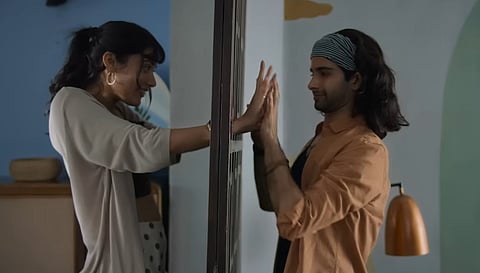


It's tempting to like a movie like Max, Min & Meowzaki for its many progressive ingredients. The title refers to a young couple and their cat. Or more specifically: a young interfaith couple (‘Max’ is a Tamil-Brahmin named Mahesh and Min is a Muslim named Minara) going through a breakup; they debate the custody of their cat named after iconic Japanese animator Hayao Miyazaki. The film opens with their ending. Production designer Min (Medha Shankar) is already in a relationship with an older Bengali director she works for. Ad-jingles composer Max (Siddharth Menon) goes on a date with an influencer-coded girl who parrots the language of WhatsApp-university forwards (“there is no such thing as Hindu extremists, okay?”) and right-wing algorithms.
The story is evidently alive to the India it occupies. Max’s distant dad, Ramesh (Adil Hussain), is a newly widowed traditionalist (“I told you not to date Muslims; this country is returning to its roots”) and businessman with more faith in the government than in his own family. He has lived his life as a stubborn bigot. The man seeks therapy, of course, because he's struggling with this strange thing called grief. The other characters in the film do not exist in isolation either. There’s Max’s old grandfather (Nasser) in a retirement home, Max’s new friend and cat-sitter Carol (Vidhatri Bandi), Carol’s Alzheimer’s-afflicted grandmother (Nafisa Ali; extending the Life in a Metro connection) who reads newspaper headlines about farmers’ protests and activists getting arrested (“why are they beating up our children?”), the camera-shy cat (Radha), and Ramesh’s therapist (Mandira Bedi) who has the patience of a monk. On paper, these personalities are written with a directness that’s rarely seen in modern Hindi cinema. Which is why you’re nearly guilted into admiring the film for baking everyday social anxieties into its backdrop.
But is that enough? The problem with Max, Min & Meowzaki is its impressionable film-school-like approach, and the fact that it flaunts its wokeness. It uses aesthetics (endless montages) and cinephilia (if I see one more indie using In The Mood For Love as a reference for its score…) as crutches to offset a lack of depth. Take this exchange of Max and Min in happier times: he proposes in a movie theatre (in Japanese), and she replies with “I don’t believe in marriage, let’s move in together instead?” as if they’re on a first date with zero knowledge of each other. Why do so many movie couples speak to one another like they’ve never interacted before? Surely there are smarter ways to inform the audience of their dynamic.
There are more signs. During their split, Max taunts Min with “one doesn’t outgrow Miyazaki, one just stops believing” like a pretentious film redditor who is destined to be single. Max’s chemistry with an aloof Carol tries too hard to be cool and meaningful at once, and Ramesh’s transformation in therapy is too convenient. These are the kind of exchanges and arcs written for the sake of rounded storytelling — where all conflicts must have feel-good resolutions, where all fractured bonds must be mended, where every thread is neatly tied together in the climax. It’s product-oriented filmmaking; the characters become branded echoes of the humans they’re supposed to represent. The screenplay already knows where it has to reach, so all the obstacles and epiphanies feel like a formality. There’s nothing and nobody that cannot be solved.
As a result, even a merit of the film — like its refusal to judge any of the characters (especially Min and Ramesh) — looks a little performative. It sees everyone as flawed and worth redeeming, but it’s a version of a social media activist that makes a career out of saying the right things. There’s also something uncomfortable about the female characters in the film. Womanhood is seen as an exotic human condition rather than a natural identity. It’s like they have to ‘prove’ their brokenness and dysfunctionality harder than others. Min is in a rebound relationship with an older man whose teen daughter hates her. Carol has been dating a married man for years. Ramesh’s therapist is not only revealed to be a lesbian, but her partner is also a deaf-and-mute painter. Even flashbacks of Ramesh’s wife suggest that she used her cancer as a device of liberation. All of them exist only through the eyes of men. Are they even real if they aren’t damaged?
At least furry Meowzaki is a male, just like the three generations of Max’s family who find themselves adrift without a suffering lady next to them. Even in the cast, only Siddharth Menon, Adil Hussain and Nasser are afforded enough space to land a performance — in contrast to Tamil romcom Thiruchitrambalam, where Nithya Menen’s role breaks the stranglehold of the son-father-grandfather equation. I get that the title is misleading because it’s meant to reflect the life Max probably envisioned for himself. But in keeping with the film’s priorities, maybe it should’ve been Mahesh, Ramesh & Sridhar. Never mind that they sound like a bumbling trio created for an Indian chocolate ad.