

It is irritating when religious people use science to explain faith—the language of energy, Einstein, vibrations, frequency etc. to rationalise how blessings and prayers work, for example. (If your prayer is an action, the blessing is the equal and opposite reaction, so the lore goes) Faith operates on a logic that is different from science, and appropriating the language of reason to express the contours of belief, is like demanding the heart to breathe. It is also why the religious film and the science fiction film have been kept apart, because their pursuits, pitch, and parlance seem to walk in different directions. That was until Hanu-Man starring Teja Sajja last year blew those borders apart, to tell a story that, though riddled with the flaws of both genres—too much faith, too much reason—was also packed with the joys of those genres—the joyful imagination, the pungent staging. It built its mythical world on the quirky possibilities of our present, remember the women pickling in the backdrop of a pulping?
With Karthik Gattamneni’s Mirai, also starring Tejja, the genres seem better apart. At one point, Agastya Muni—you can call him AG—rationalises his abilities in what is supposed to be a punch-line, but what ends up being a punching bag for both faith and reason, “Spiritual physics”. That means nothing, and it says nothing, but is built on the posture that somehow spirituality can nudge and shove its way into the principles and properties of science. When a character says, “Atom bomb se zyada kharatnaak hai aham,” (The ego is more dangerous than the atom bomb) all semblance of rot has borne fruit in this two-hour-fifty-minute drudge.
Worse, Mirai mixes not just science and faith, but history and myth, too, in this meek, oversmart, underwrought manner. After introducing us to the concept of itihasa — a genre of storytelling, which the film prefers to think of as history — it begins with Ashoka after the Kalinga war. The transformative moment where he takes up Buddhism, and begins to propagate it has been replaced by something straight out of the Horcrux manual of Harry Potter, where Ashoka, seeing how his power caused mass destruction, transfers it into nine scriptures, eight of which he distributes to his soldiers, giving the ninth scripture to a rishi to guard it. It is a symbol for the spread of Hinduism across the world, overwriting a story of Buddhist expansion, where Ashoka used missionaries and merchants to swell the word of Buddhist thought across the world, sending his own children to Sri Lanka.
Flash forward to 2000, where the ninth book, which covers the possibility of immortality, is in Ambika Ashram, and Ambika (Shriya Saran) gets a dream—a dream, which is a premonition, which is also a prediction that cannot be tampered with or reversed—that the devil-incarnate Mahabeer Lama (Manchu Manoj), who heads Black Sword, a ruthless group, will snatch all eight scriptures. She sends pigeons with messages to the eight guardians to summon and warn them—but men being men, they ignore her. Heavily pregnant, she decides to climb Kailash, to meet Agastya Rishi (Jayaram) who can help her protect the ninth scripture. Once Mahabeer gets all nine scriptures—it is doom. The Black Sword operates from what looks like a church with stained glass, with a polished desk at the center with the eight books, awaiting the ninth. Architecture is an essential part of this film, for a major showdown takes place in a circular open theater, with pillars, like the bare bones of a Yogini temple, an amphitheatre.
The child in Ambika’s womb is Veda (Tejja), who will grow up to fight Mahabeer and his Black Sword group. Ambika has to abandon Veda as a child, hoping his destiny will float him towards victory. 24 years later, Vibha (Ritika Nayak), a student at the Ambika Ashram, goes in search of Veda, to elbow and tickle him towards taking up his destiny.
But first, Veda has to be convinced—as an adult who was orphaned as a child—that he is special, and needs to take down an existential threat. While the film is trying to convince Veda that he is, indeed, ‘the chosen one’, it is also trying to convince us, for neither in physique, charisma, wit, or stature does Veda seem like the kind of man on whom the safety and security of our world can hang. It is such a vaguely written heroism, that is forcefully persuasive, with Gowra Hari’s ear-splitting score, after a point it is better left as given, to keep the film from snagging at your patience at every corner. Similarly, Mahabeer’s villainy is overwritten, with a backstory that is quick to reach its conclusion, but the presence is mild and infuriatingly dull—he is going to destroy the world?
Soon, Vibha becomes a peripheral presence, her most staining moment being when she confronts police officers with legal codes to release Veda. That kind of legal heroism gives more relief than any muscle in this movie can offer.
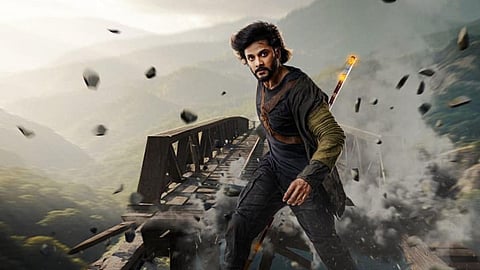
Not just the intersection of Hindu mythology and Indian history, but also Telugu mediocrity and pan-Indian delusion, Mirai is a strange film, because it keeps pitting Veda against people who are technically stronger than him, and he keeps getting pulped, and it is only when he gets the magical stick—the Mirai—from the bowels of the Kailash, that he is able to ward off the enemies, and sometimes, not even then. This stick, like the guns of Kalki 2898 AD, is flimsy and snappable, with an orange glow at one end, that even belief begins to break a sweat. If you push logic to its breaking point, you reach faith. If you push faith to its snapping point, you arrive at logic. And if you push both far enough, a Mirai pushes its shoots.