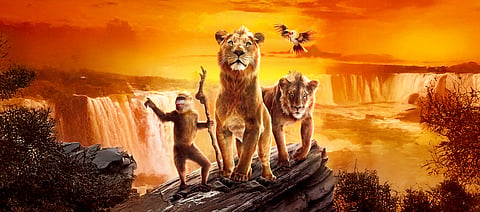


Where do lions go for advice on love? If you watch the Hindi version of Disney's latest musical drama Mufasa: The Lion King, the answer stretches its hypothetical arms in every frame: Shah Rukh Khan.
Serving as both a sequel and a prequel to The Lion King (2019), filmmaker Barry Jenkins (Moonlight) anchors the wonderful origin story—of how an orphaned cub, Mufasa (Shah Rukh Khan), became the king, and why his 'brother' Taka (Meiyang Chang) turned into the menacing Scar—with his deeply-felt dramatic notes narrated through photorealistic animals, which sometimes feel too glossy to be personal.
Yet, Jenkins has fun piecing together the legend, including the formation of Pride Rock, and foreshadowing the ultimate showdown between the two brothers, slowly revealing the wounds that will eventually leave scars. When a young Taka digs his claw into Mufasa's flesh to save him from drowning, you know the callback to it later will be rewarding; Mufasa: The Lion King struts alongside the digital talking animals, stunning imagery, and humour with the awareness that at its core, its strength lies in its heart.
This is where, crucially, the Hindi dub of the film becomes a different beast. There is something quintessentially desi about the way the Hindi version of Mufasa: The Lion King leaps at you, majorly because of how the impressive voice work is wonderfully married to the magnificent saga.
The beats of a Bollywood film are omnipresent— there is love and longing, betrayal and hope, affable sidekicks (Pumbaa, voiced by Sanjay Mishra and Timon, by Shreyas Talpade) interrupting a story with punchlines, and musical numbers, which suffer from being lost in translation. There are fathers lost in power or tragedy, and mothers awaiting a miraculous reunion. The film doesn't hold back, neatly placing itself as exuberant.
It is impossible to separate the Hindi dub of the film from the elevation Khan brings to it. When a character says Mufasa doesn't have royal blood and yet he is the outsider destined to be the king, Khan's career winks at you. Or when Mufasa misses his parents and in his deep baritone, says, "Kabhi kabhi ek khushboo aati hai...Ghar ki," Khan's history makes it deeply personal.
In some scenes, the hat tip is more obvious, for instance when Mufasa saves Sarabi (Mamta Gurnani) from near death and gently whispers, 'Main hoon na,' or when he is asked how to impress a lioness and Mufasa simply says: Be a good listener to women.
After a while, it is impossible to divorce Khan's towering public aura from the king-size fabled shadow of Mufasa. Our engagement with Khan over the decades significantly alters the experience of the Hindi version of the film, which wouldn't have had the same punch if the history behind the voice didn't matter.
On paper, Mufasa, the character, lacks any sweeping arc and it is Taka's origin story that has more material. A loveable cub, who doesn't fancy power and finds the brother he always wished for, only to turn against him, is more cinematic than a loyal Mufasa, in denial of his greatness. The voice cast matters because if Khan were to voice Taka, the tables would have turned; it would have been the villain's origin story where everyone, including Mufasa, would pale in comparison.
Ultimately, Mufasa: The Lion King consistently remains an enjoyable origin story with crackling lines (at one point, Talpade's Timon says he has 'dard ka dukaan, ghaav ka godown') and outstanding set pieces. The music in Hindi doesn't always land though and one wishes the film would jump right back into drama when Timon and Pumbaa interject. But when it stays on track, the film is a glorious family drama, in parts Kabhi Khushi Kabhie Gham and Deewaar. Khan's younger son, AbRam, voices the young Mufasa and his first on-screen word is literally... Maa. Get the drift?