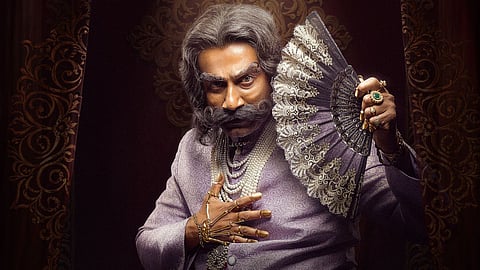


It wouldn’t be too far from the truth to call Rao Bahadur a haunted house horror. A washed-up aristocrat (Satyadev) is kept up by relentless visions of the past every night. His palatial abode, a house of mirrors, seems to house a secret in every room, with the biggest one nestled in the chamber of a wife who hasn’t stepped out of her quarters in the last eight years. There’s a demon lurking in the musty corners of the house. One that has rattled the house and its fortune for years. But this isn’t any normal spirit. Rao Bahadur battles the demon of doubt. One that settles deep into his gilded brain in this superbly designed and written psychological drama.
Ramappa Rao Bahadur (Satyadev) is quite literally hanging between life and death when we meet him. The ageing alcoholic nobleman is diagnosed with terminal liver cancer. Having outlived his prognosis, Bahadur struggles most with another undiagnosed illness — of the mind. A tragedy shakes his faith in himself, his family and his mental capabilities. It brings to frenzied focus unpleasant memories of a failed romance, fraying family relationships and his own acts of cruelty. Throughout these dizzying hallucinations, Ramappa clings to life to learn the answer to one question: who is the father of his son?
The film unfolds mainly in two chapters, detailing two formative periods in Ramappa’s life. The first is the roaring sixties, spent dancing with women in clubs, moving back home from travel, falling in love with a woman, and facing rejection for the first time. The second is the eighties, when marriage and children bring immense wealth, a new career, and an ugly doubt that refuses to go away. Venkatesh Maha, who has written, directed and edited the film, slips through these two chapters with a gentle yet firm grip, piecing the puzzle together as we watch with bated breath. This is in part achieved by meaningfully written supporting characters.
We see much of Rao’s life unfold through his conversations with his childhood friend Dr Achari (Vikas Muppala), who is relentless in his pursuit of challenging him when he’s wrong and comforting him when he grieves. There is also this odd competitive energy between the men, and it’s intentionally hard to read this friendship. Maha makes us spend a lot of the film suspecting a possible twinge of jealousy in Achari. The seeds of doubt aren’t just sown in Ramappa’s head but also in ours.
Deepa Thomas plays the resplendent Renuka, whose sweet kindness gives a lot of light to the film’s moody setup. There is an in-house maid whose blunt honesty makes us cackle, an elder son weighed down by a family tragedy, and a younger son yearning for the love of a father he never truly receives. All of these characters meld beautifully with the film’s almost Gothic sensibilities, evoking the moody whimsy often associated with Tim Burton’s films. The film is as much cinematographer Kartik Parmar's and production designer Rohan Singh's as it is Maha’s. The changing lenses and depth of focus detail every character and every inch of the Rao Bahadur palace with dazzling impact. The house is designed so as to evoke a deep sense of discomfort, changing light and atmosphere according to Bahadur’s own seasons of life.
Rao Bahadur is also a very literal film. This leads to some particularly charming sequences. When the maid struggles to figure out what black coffee is, we actually have a scene explaining her misconception, having her pour different kinds of milk into coffee to make it dark. When the great-great Rao Bahadur king wants to intercept and condition his descendant’s brain, he literally “conditions” his head to a song about “conditioning”. But a lot of this also blunts the effect and sometimes our attention.
Holding the film together and rewarding our patience, however, is Satyadev. The actor terrifically embodies the mind and body of a man who is forced to reflect on the demons of the past. One pitch askew, the depiction, especially of the older obnoxious Ramappa, could've been comical. But the actor is measured in Ramappa's braggadocio and incredibly moving in his inadequacy. It is a performance with staying power in a film that offers much to remember.