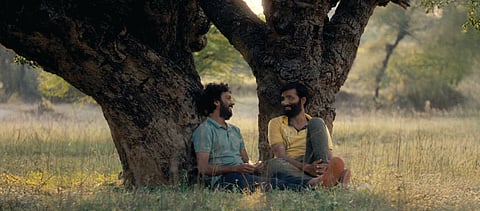


A weepy gay man is a genre unto himself, moping throughout, a smile as though kryptonite, whose relationship to life is mediated by melancholy and self pity, a melancholy and self pity that gushes from the wellspring of his wounded sexuality. Valid or not, this misery is templated. Writer-director Rohan Parashuram Kanawade’s Sabar Bonda (Cactus Pears), the first-ever Marathi-language feature to premiere at the Sundance Film Festival 2025 as part of their World Cinema Dramatic Competition, both deploys and destabilises this genre. Here, the melancholy of Anand (Bhushaan Manoj), the queer protagonist, is actually grief — his father passed away, and it is under the shade of this grief that the story of his sexuality stretches itself in a quiet, twilled yawn.
Anand works in Mumbai, in a call center job that gives him the financial security to not only carve out his own private space in the city, but to come out to his family. Sabar Bonda is insistent on financial security as a prerequisite for an open, queer life. Anand and his mother head to his ancestral village with the corpse of his father. Rituals take up the oxygen that would otherwise allow for grief to languish in. Sabar Bonda, based on Kanawade’s grieving of his father, too gentle a film, never justifies these rituals. In fact, it has a thin veneer of judgment, which is expressed through comedy. But it also shades this judgment. We see his relatives bickering over mindless details, providing mindless reasons to how Anand ought to grieve — what and where he should eat, where and how he should be — and it is both playful and pathetic.
For example, Anand is with his mother in the hospital, silent and exhausted. When Anand goes to the hospital’s gate to let in the relatives, and brings them to his mother, suddenly, socialised to communal grief, she erupts into tears. When the ambulance with the body approaches the village, it is met with a chorus of wailing women. Do they really miss this man? Do they have to really miss this man?
The camera is mostly distant, no close-ups to detect a performance, a twitch in the face, for example; the background score is entirely missing, no clues to detect a farce, a string in the score, for example. The film’s imprint is too light to make any emphatic statement — and it is one of the most assured things a debut feature director could do.
The titular sabar bonda, a thorny fruit, that is de-fanged and gifted to Anand by Ballya, (Suraaj Suman), his neighbour who has his own complicated relationship to his family, to his future, does not lend itself to metaphors — if it does, it is a rather trite one I don’t want to replicate here — or mess or a stronger presence that justifies its titularity. When Anand opens the fruit like Elio, the peach, you wonder if he will stick his dick into it, too. Cinema corrupts us. Anand fingers the fruit through a slit and licks the flesh. It is almost heterosexual. But what brews between Ballya and Anand is anything but.
Even the words 'gay' or 'queer' are never used, instead “khaas dost” is thrown around, whose implication is clear. When Anand’s mother asks him about Ballya, she questions him, “He also doesn’t want to get married, right?” On the one hand, these might feel like a culture struggling with queerness. On the other hand, these might be precisely how a culture contends with queerness — to speak of its material consequences, its emotional textures, and not of it as a stable identity marker. That of what use is the word gay if it does not express the consequences of it, too. What would the word for straight be?
Shot by Vikas Urs, the edges of the frame are not pointed but curved — a style he used in his previous film, the short U For Usha (2019) — and the colours have a metallic wash — see the flaring reds of that earlier short film, which has been tamed under a more wintry colour grading here. Kanawade notes in an interview that these edges are a nostalgic reach for watching films in the theaters as a kid, how the bad projection would cut off the corners. That something so abrasive in the past has been rendered so smooth in the present is nostalgia’s polished and needy presence. Sometimes, films are better off without it.
Kanawade’s assurance as a director stays the meandering film’s course. We never see the city as a contrast to the village, except as fleeting by the window of their ambulance or the sounds in the climax. The film is staunchly set in the village. With no background score — only a sound design by Anirban Borthakur and Naren Chandavarkar where every chew is cleanly transcribed — the film turns into a sonic embrace, like a chamber of Kanawade’s past. As assured as it is fragmented, in Sabar Bonda we often do not see questions answered, flare ups resolved, or gazes met. The cuts are sudden, like jerks. The film keeps fracturing as it proceeds. It gives the languorous world a kind of kick, even as it leaves more wonders than clarity in its wake. The film floats.
These fractures are more pronounced when it comes to intimacy, where the camera disembodies the men into their hair, one eye, half a face. There is a shot of the back of Anand’s head, his curly hair against lush greens which perm into bokehs, and it is like his hair is reproduced in the world, and this sense of desire, where the self expands, is literalised. The film keeps throwing such moments, and it feels like bread popping off a toaster — something crisp leaps at us, in the pursuit of which we patiently endure, and in the aftermath of which, we delight.