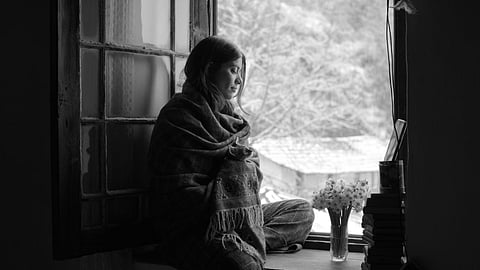


Grief is too absolute an entity in cinema. Like joy, disappointment and love, it’s often treated as a ‘phase’ in a story: a striking part of a whole. It is seen and staged, either as a brooding montage or an atmospheric song or a transformative conflict or a sullen flashback about a character’s retreat from civilisation (think mainstream movies like Jab We Met). But grief — or its more familiar version, heartbreak — is actually a part of a hole. The pain is abstract, undefined, still, and often, violently simple. In Subhadra Mahajan’s Second Chance, this simplicity is laid bare. It’s not a time in life but life itself. It’s not a phase in a story but storytelling itself.
Nia (Dheera Johnson) is a young woman who’s privileged enough to subscribe to the main-character energy of heartache. Her boyfriend has ghosted her, she’s had to deal with an abortion on her own; the film opens with Nia already recovering in her cosy family cottage in the cold mountains. She’s here for some “alone time,” away from her distant parents and preoccupied city friends. Her meals are served, but her cell-phone has no signal. You can tell she’s been so sheltered that her idea of breaking and healing has perhaps been derived from the aforementioned cinema and other artforms: an exotic getaway, packs of cigarettes, a bottle of vodka, lonely naps, a lost appetite, a cry by the stream, a whisper to the rocks. Even the film being black and white speaks to Nia’s inherent romanticisation of suffering. Cinematographer Swapnil Sonawane does well to express her urban gaze without letting it hijack the sensory language of the film.
Second Chance revolves around this movie-sadness of hers maturing in the company of its adult version: the Himachali family of caretakers for whom grief is a luxury they could never afford. For old Bhemi (Thakri Devi), her naughty grandson Sunny (Kanav Thakur) and her son-in-law Raju (Rajesh Kumar), moving on from the death of Sunny’s mother was less of an aesthetic and more of a working-class truth. Nia’s escape is their reality; Nia’s break is their linearity. Caring for a broken Nia goes from being Bhemi’s job to being her reckoning: Nia becomes the missing piece in the local family’s fractured puzzle, while they make her feel like a daughter she tried to be and the mother she chose not to. Bhemi looks after her like a parent, and Nia entertains Sunny like a parent — it’s the confluence of two streams of grief that somehow completes the circle of life. The arrival of a frisky cat is a bonus, of course.
The title is a clue to the film’s democratisation of the human condition. It alludes to the presence of a protagonist looking for salvation. But both Nia and the family are protagonists who get a second chance to live on their own terms. Bhemi realises that she need not be shackled by responsibility in her twilight years; her track with a flirty shepherd (Ganga Ram) is one of the most disarming elements of the film. Nia searches for an identity beyond her status as a daughter and girlfriend in Delhi; even her career involved rich-person projects (vegan night-suits, tea curation) suggested by her mother. Her repressed passion for dance could’ve come across as pretentious — visually, culturally, narratively — but it’s pronounced by her struggle to reclaim her body after a bruising experience. Early on, it’s almost like she’s punishing herself — smoking too much, drinking, getting stoned, starving — to acclimatise to the pain. It’s a classic reckless-recluse trope. But as the two sides bleed into each other, Nia forms a healthier bond with her body. The confidence expands. The fluidity returns. It’s far more subtle than a city girl finding herself through the roots of ‘the other India’.
I like the way Second Chance is written. It all quietly comes together. Little Sunny’s imagination — his obsession with Superman, his Calvin-and-Hobbes-coded creativity, his desire to fly to the moon — emerges from a child’s refuge in fiction. Nia is almost inspired by his coping mechanism, which is more original than her instinct of emulating fiction. Nia’s guilt of aborting her baby acquires a sense of agency when she learns that Bhemi succumbed to her patriarchal conditioning and chose the birth of a boy at the cost of her daughter’s life. It’s why the old woman’s reaction on seeing Nia bleed in a bathtub makes sense; she knows what to do because she’s seen this before. There is space for everyone to be the central character: Nia is a mute (and amused) observer when Bhemi banters with the shepherd or chastises Sunny; Sunny refuses to mind his own business when he sees Nia in trouble with a visitor. No single state of existence — and grief — is greater than the other. They borrow each other’s language. Nia learns to keep moving while the family learns to pause a little.
There are no lofty proclamations of feminism and social enlightenment; it’s just a bunch of wounded hearts finding each other at the right time. The editing (by Tinni Mitra) nails the emotional rhythms; it’s almost as if Nia wants the scenes featuring her to be slower and heavier, but the shots keep cutting, time keeps passing and the world keeps threatening to leave her behind. Towards the end, Bhemi and Sunny get scenes rather than fleeting shots, the camera stays on them longer, implying that they can perhaps afford to take a breather and sample a more cinematic grammar of existing. The cast, all first-timers, is indistinguishable from the setting. Kanav Thakur as Sunny is a born scene-stealer, while Thakri Devi infuses Bhemi with a disarming cocktail of experience and fragility. Dheera Johnson (as Nia) has a remarkable movie face, which supplies the film’s underlying theme of two volumes of heartbreak meeting.
The tenderness of Second Chance also lies in the eyes of the beholder. As a viewer, for example, I found it difficult to empathise with Nia in the beginning. Much of this stemmed from the fact that, like others in my economic bracket, I’ve often fantasized about getting away and recovering in the Himalayas. The resentment for those who can do that is natural, and it’s catalysed by stories that open with a griever expecting nature to give them a hug. But as the perspective shifted between the dimming idealism of Nia and the dimming pragmatism of the family, the film offered me a second chance to see the grammar of trauma rather than the vocabulary of healing. I found myself situated in the middle, looking both sides, and empathising with their courage to rebuild. Most of us have to keep working, keep paying the bills and keep surviving without tending to the fickleness of pain. But we can watch movies like these, and feel the best — and worst — of both worlds. And we can watch life itself through the lens of such movies.