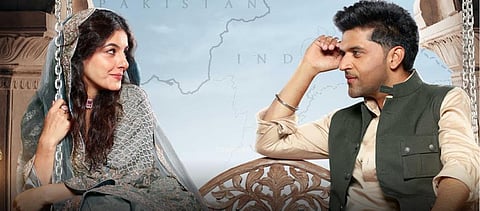

Beyond religious divides, cross-border love is not new to Hindi or Punjabi cinema. Back in 1999, the National Award-winning Shaheed-e-Mohabbat Boota Singh was set in the backdrop of the Partition. So, can the controversy of Shahkot being pro-Pakistan — which also follows a theme similar to Shaheed-e-Mohabbat Boota Singh — be put to rest?
However, haters will be haters, and the detractors who whipped up a storm before Shahkot’s release might continue to spew venom. Only as popular singer Guru Randhawa makes his acting debut in Pollywood, his launch vehicle steadfastly refrains from hatemongering or demonising Pakistan and Pakistanis.
The period the film refers to is uncertain — mobile phones are not yet in vogue, and the relationship between India and Pakistan is not hunky-dory. But, for this detail, the timeline does seem contemporary, yet quite in sync with the milieu of Pakistan it cares to depict. Director of Photography Vineet Malhotra, rises to the occasion and captures the time aesthetically.
The film is set in Pakistan, where our hero lands after his botched attempt to migrate from India to greener pastures the Dunki way. En route to his misadventure, he has already made friends with a Pakistani named Sharafat (Gurshabad Singh), who eventually proves to be a friend in need. The bonhomie between these two characters is indeed the backbone of the story, and if you think that is blasphemy, then the film does take extra care not to paint Pakistanis as monsters. Even the policeman (Hardeep Gill), who lets our hero off after mistaking him for a Pakistani because of his name, Iqbal, is later in fervent search of him and is not painted as evil. He is undoubtedly corrupt, but as his wife demands a washing machine and his son a motorcycle, the audience is shown the humane side of him. Abbaji, played by Raj Babbar — the seemingly authoritarian father of the heroine — is more humane than one thinks he is.
With Shahkot, Babbar is seen in a Punjabi movie after a gap of many years. Fairly impressive, he is depicted as a political leader of sorts, but not the despicable villain kind that we fear he might turn out to be. The relationship he shares with his daughter Maarvi (Isha Talwar) brings out the tender side of a man who otherwise rules over his people.
The moment Talwar appears on screen, the lines, “Kade kade daana paani hi nahi ishq vi bande nu le aaunda hai..(it’s not just fortune but love too takes you to new places),” begin to acquire flesh and blood, even if not a beating heart. Romance is in the air and is tender, too. Talwar sinks her teeth into her role as a woman-child who appears socially maladjusted, but we are spared any backstory for her strange behaviour. Iqbal, though, tells us that she is indeed an innocent girl with a heart of gold.
Love blooms in this haveli against Iqbal’s wishes, but more importantly, against his friend Sharafat’s better judgement. One could argue that given the social structure of Pakistan, domestic helps having such easy access to a wealthy household with a daughter does seem a little too outlandish. How the duo find employment in the haveli guarded by gun-toting men is also a contrived fact. But all is fair in the larger scheme of story-telling.

Director-writer Rajiv Dhingra does not care to move into choppy waters or address thorny issues, as acerbic politics is not the thread here. Yet, it makes a statement on collective heritage. Shahkot, incidentally, is a small city near the district of Jalandhar in Punjab. It is also the name of a city in the Nankana Sahib district of Pakistan. In fact, there’s a scene where we catch a glimpse of Waris Shah’s eponymous epic poem, Heer Waris Shah, which both Punjabs deeply admire. But all of this is done subtly, too subtly, perhaps.
The film, therefore, can be accused of being a little too sedate. Even as it takes us to Pakistan-occupied Kashmir, it remains mum on the conflict between the two countries. All is beautiful — very antiseptically so — and we are led to believe that even the Pakistan part of the picturesque Kashmir is jannat.
On the sunnier side, the film does not follow the overtly melodramatic route, which is the bane of many a Punjabi film. There is no slapstick comedy, only cheeky humour. The dialogues are sharp, often intelligent, and make you chuckle with the writers getting the hang of a delectable Pakistani-Punjabi with its distinct flavour. Besides, there is no unnecessary fluff or naach gaana. Melodious songs are an integral part of the film. Music by Jatinder Shah has the requisite other-world charm. But Dhingra resists the temptation to encash upon his hero’s singer image. Randhawa, whose songs have already struck a chord in Bollywood, gets to sing along with others, especially the enchanting ‘Dil Mera’ and ‘Ve Bhedya’, even though you don’t see the singer-actor bursting into a song or dance at the slightest provocation.
One could argue that harsh realities are glossed over, but the film — even without the bombastic moments like in Gadar — touches you. The bond between Iqbal and Sharafat, in particular, has more than one moment of emotional spectacle.
The film, despite flaws, redeems itself on many counts, especially with its poignant climax, which is clearly not predictable. How do you reconcile conflict in a world divided by human-made boundaries? Let it be said in no uncertain terms that this is no Gadar, nor is it Veer-Zaara (2004). But in an industry that thrives on perpetuating stereotypes, it does knock down quite a few, and dare we say, that is more than heartening. Building bridges in times of divisive politics and hatred is a far tougher choice than burning them. Makers can pat themselves on their backs for walking the path of love and friendship.