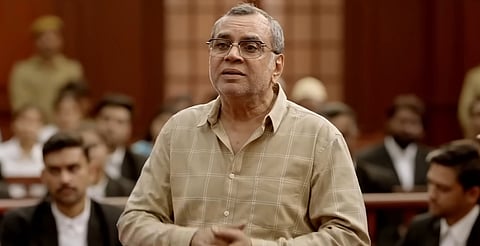


Bullied and boycotted for his fanciful claims about the Taj Mahal, Vishnu Das (Paresh Rawal) approaches a lawyer, who is played, in a blazingly inventive feat of casting, by Brijendra Kala. Das harangues him to file a PIL (Public Interest Litigation) about the origins of the Mughal mausoleum. The year is 2023, and six previous appeals have been rejected or deferred by the legal machinery. The lawyer toys with him, advising him to gather some concrete evidence before approaching the courts. "Next up is Qutub Minar," he jokes exasperatedly.
Or is he joking?
A sense that history is up for grabs—that it can be moulded, manipulated and minced like clay dough—permeates Tushar Amrish Goel's The Taj Story. The title itself should serve as a warning. As any watcher of the Hindi cinema of the past six years will attest, one way to peddle misinformation is to make it sound like information, to give it curt, clipped, officious-sounding names, usually ending with 'Files’ or 'Story', like a sheaf of papers marked 'top secret' and tucked into a briefcase. The audience is made to feel privileged even as they are played.
Vishnu Das is a tourist guide employed at the Taj Mahal compound, regaling visitors with stories of Mumtaz and Shah Jahan. Secretly, though, Das's convictions point determinedly rightward: according to him, the Taj Mahal, a UNESCO World Heritage Site, was not built by the 17th century Mughal Emperor but is actually a pre-Islamic structure, possibly a Hindu king’s palace or a Shiva temple (more on that later). When a drunken video of Das demanding a 'DNA' test of the monument goes viral, he petitions the courts to intervene. The theories he presents regurgitate the writings of PN Oak, who passed away in 2007 and is thanked in the opening credits (mercifully, the film sidesteps Oak's outlandish claims about the Vatican and Westminster Abbey, limiting its purview to the Taj).
"This is not a Hindu-Muslim issue but a matter of our heritage," Vishnu Das assures reporters. He is fooling no one. You do not need to carbon test a film like The Taj Story to determine its communal vintage. All the characters opposing our protagonist's righteous crusade and visiting harm upon his family are evidently, cartoonishly Muslim, complete with skullcap, long beards and a duplicitous manner now synonymous with the onscreen Muslim. Das's opposing lawyer in court is one Anwar Rashid (Zahir Hussain)—a contender for the Muslim-est Muslim name in a Hindi film. Whenever Das says something noteworthy, a pious sitar plays in the background, a contrast to the Middle Eastern-sounding strings that accompany the film's villains.
And yet, for all that, The Taj Story lacks the courage of its convictions. The film can't decide for certain if the Taj Mahal was indeed a palace or a temple, and thus keeps both possibilities open. An unusually long disclaimer urges audiences to "verify facts independently", before the film hammers them over the head with its singular version of the 'truth'. One moment Das is quoting from the Badshah Nama, the official history of Shah Jahan's reign, and in the next moment, decrying all official accounts since c.1400 as fabricated 'propaganda'. The film's clinching argument rests on a Carbon-14 dating test of a piece of wood purportedly done by an American archaeologist in the late 1950s, yet it furnishes an entirely made-up name (Peter Williams) and no citations for said archaeologist.
The Taj Story would be an irredeemably bad film even if all its historical claims check out. Even by the standards of this genre, the filmmaking is embarrassingly inept. Much of the shooting appears to have taken place before a green-screen, with the Taj Mahal and Mehman Khana pencilled in digitally. Goel guiltlessly uses AI for cringey historical recreations—a portent, I suppose, of sights to come. It's sad to see Paresh Rawal (who once starred in delightfully probing films like OMG and Dharam Sankat Mein) hawking this hokum. Even the usually dignified Namit Das seems lost, cast in the role of Vishnu Das's mind-mannered son.
Has the commercial ship sailed for a film like The Taj Story, slow-paced and bird-brained throughout its 165-minute runtime? Or is it possible that, come 2026, we will get a Qutub Story and Red Fort Files in theatres? I cannot say for sure. As Vishnu Das reminds his family in a scene, in our country, we waste time instead of discussing pressing issues. For once, I was in complete agreement with the man.