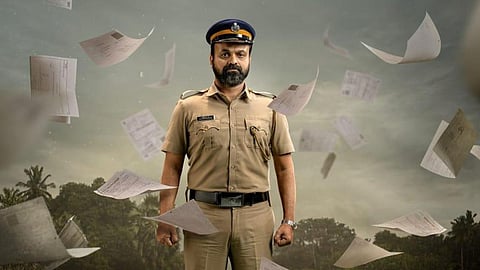


There’s a clever bit of lampshading in Kiran Das’ Unmadham that lets us in on the approach the film’s going to take later on. It’s a film that’s about a police constable named Shelly (Kunchacko Boban) who hates his job and aspires to become a screenwriter someday. As he takes a break from work, we see him catch a YouTube interview between film journalist Maneesh Narayanan and director Sibi Malayil in which they discuss the classic Manichitrathazhu.
Narayanan asks Malayil about the writer’s decision to sidestep scientific reasons to explain Shobhana’s mental illness in the film, choosing instead to go with a climax that relies on black magic and the supernatural. To this, Malayil explains the need for the climax to have distinct visuals and how the audience (at least of the time) may have found it more appealing to rely on a supernatural explanation. Showing this interview clip right in the middle of Unmadham may have been writer Shahi Kabir’s way to tell us where he will be going with this film.
This is because it’s the first time we see a Shahi Kabir’s script entering into the abstract. His character Shelly wants to become a screenwriter but there’s not much from his ordinary, everyday existence that’s worthy of being turned into a film. It’s when he’s transferred to a remote police station on punishment that he comes across a police case that’s termed to be cursed. As far as the rules of this police station goes, anyone who has ever touched these case files has had to deal with a personal tragedy. In his desperation, Shelly decides to reopen this cursed case, just so he can make an entry into the movies.
It’s a peculiar setup for a meta movie that’s made even weirder when you realise that Shahi Kabir, an ex-police officer, may have also included biographic elements in his writing of Unmadham. The moment Shelly opens these files; strange events begin to happen all around him. Lizards become a recurring motif, and we also begin to question the validity of the things Shelly begins to see around him. Shelly appears to be too sensitive to do the work of a regular police officer. In one scene, when he’s asked to spend the night safeguarding a suicide victim, he begins to see visions of people murdering the same man. As a psychiatrist explains, Shelly might be going through the early stages of schizophrenia.
From here on, the film expects us to take in every visual it presents before us with a pinch of salt. It uses Shelly’s mental health condition as a crutch to fully explore the zone of the supernatural. Important clues come to him in the form of surreal nightmares, and the lizards go from being bizarre motifs to his trusted allies. From a rational man who didn’t believe in superstitions, we see Shelly descend into a spiral of delusion. Not only does the film rely on Shelly’s newfound visions to figure what’s fact and what’s fiction about this cursed case but we also see the world through a man that’s slowly losing it.
But if there’s one aspect that makes Unmadham more than just another investigation, it’s when it opens itself to be read as a man’s struggle with writer’s block. Even when the film goes deeper into the police case, it finds a surprising moment of stillness to take you into Shelly’s creative desperation. In a scene that seldom finds a space in a film such as this, we see a film’s director pour his heart out to Shelly about the emptiness of a filmmaker’s life. He speaks of the creative pursuit and the manner in which one begins to lose everything, including family, in that chase. In a sense, this chat becomes Shelly’s green signal to take the creative pursuit, even if it means losing everything along the way. What we see after is the process of his writer’s block slowly clearing away and the creative process that takes him to the brink of insanity.
It’s a cinematic leap of faith that can be as frustrating as it is fascinating. We struggle to keep up with the film as we’re taken from one nightmare sequence into another as Shelly tries to piece together the case. Right in the middle of this is a flashback that feels too cliched and predictable for a film with such high aspirations. The characters that make an entry at this point leave no impact on the bigger picture and it falls on Kunchacko Boban’s impressive performance to keep us engaged. Somewhere during this phase, the film evades the question of scientific evidence and pushes the film too far into the zone of the supernatural. Instead of a fair mix of both, Unmadham begins to rely solely on Shelly’s fantastic visions to solve the case and in this process, it loses the firm grip it had on our attention. Despite the ambition and despite the incredible performances of both Kunchacko Boban and Lijomol, Unmadham drifts away. From a man’s surreal descent into madness, the film settles for a convenient conclusion, choosing instead to play it safe.