

For all the credit Jeethu Joseph gets for being the Malayalam master of suspense, one doesn’t realise how often he’s made films that talk about something as soft and subtle as parenting. Of course he’s no Sathyan Anthikad to be making mild-mannered family dramas, but the parenting theme has always popped its head all over his cinema, even if the genre isn’t quite the expected safe zone for said discussion. We saw this topic getting addressed in a predictable, if entertaining manner in his second film Mummy And Me. Aspects of parenting became one among the many themes of both Life Of Josutty and Thambi. It's also no debate how both Drishyam and its sequel were as good as two families (and two sets of parents) fighting it out in their ways to achieve justice for their children.
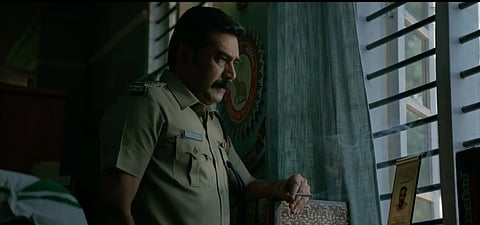
Yet the theme of parenting has never been as explicitly explored in his cinema as it has in the interestingly titled Valathu Vashathe Kallan (The thief to the right). This again borrows its broad construct as a battle between two fathers, each dealing with a crime having committed upon their children. If the computer genius Samuel (Joju George) discovers that his daughter has been killed under CI Antony Xavier’s (Biju Menon) watch, Antony then is forced to use all his powers as a police officer to then find his missing son. But the film doesn’t end with just these two characters. Antony’s subordinate officer played by Irshad too doubles as up as a parent who is extremely concerned about his son. That’s not it, we also get to meet characters like Veena (Niranjana) and then Rajeev (Rinosh), who again act as proxies in the good parenting versus bad parenting debate.
But right from the start, Valathu Vashathe Kallan fixes its sights on exploring the full complexity of Antony’s character and how he chooses to parent his son Philip (Gokul). The film even begins with a shrink taking turns to meet both Antony and Philip, just so he can try to see if there’s room left for reconciliation between these two. Scenes later, we also get a terrific opening sequence to truly understand the psyche of a man like Antony. We see a young girl and her mother approach Antony at his police station with a complaint against his stalker. With each line, we see the mind of a criminal working overtime to pin the blame on the victim rather than offer her help and support. He begins by creating the illusion of empathy to attack the victim by damaging her mother’s trust. So, when she decides to kill herself, it’s not because justice has been denied. It’s because Antony has found a way to manipulate her mother into thinking that her daughter was wrong all along. Even here, parenting styles is what he appears to be of more interest to the team than the crime and the notion of justice.
It sets up the drama incredibly well and by the end of the first half, we feel like the real drama is just beginning, even when it feels like one battle has already been fought. This is also when the film decides to take a massive tonal shift. From going deep into the character study of a man like Antony and what he does to people around him, Valathu Vashathe Kallan changes form to turn into a full-fledged thriller. The timeline shifts the entire second half into an hour-long skirmish with time running out. The film may lose some of its specificity if this shift, but it never fails to keep us guessing, even as a new suspect is thrown up, every 10 minutes or so.
At times, this shift happens to quickly that it becomes too complicated to grasp. For instance, a character named Elizabeth is thrown into the mix, but her involvement begins and ends so abruptly that you don't have the chance to fully plot her position into this large web of deceit. You also feel the same when the film tries to angle itself as a battle between two equals, Antony and Samuel. We’re told that Antony too is expected to be someone just as intelligent as Samuel is. While we’re always able to buy this in the case of Samuel because the script has backed this aspect of his, it feels like a last-minute addition to make Antony appear like a mastermind too. Which means that even when you’re trying to hold on to the film to see what happens at the end and to see how we get there, there are just too many characters and ideas that are thrown at us, without any of it fitting into the bigger picture.
Still we hold on because Antony remains a striking character. We never fully understand the complexity of his personality, even as tiny flashbacks bring back an element that will help us understand him that much better. For instance, we need to wait until the very end to understand the reason why Philip turned out this way because of something that happened to him when he’s in school. Biju Menon anchors all this complexity as though his life depended on it. We see glimpses of a man transforming as he’s been held hostage and most of all, what we see through Antony is a man punishing himself for all the punishments he’s given to people who mattered most.
Jeethu Joseph may not have made a movie that can rival Drishyam, but at least it feels he’s back at home, narrating stories of all the personal battles that come your way when you try to bury your secrets.