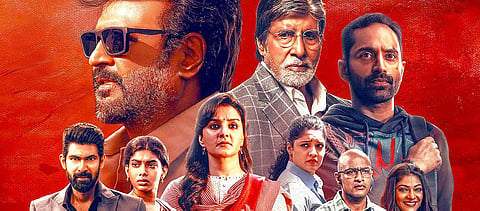


Journalist-turned-director T. J. Gnanavel doesn’t seem to care much for any sort of filmmaking subtleties. It’s as though he enjoys dialling up the volume knob to underline his already-dramatic writing, and doesn’t let you rest until you feel the full weight of a scene’s emotions. This was obvious in the way he didn’t stop by just showing you a police officer dragging a beaten-up Manikandan K. into the back of a police jeep in Jai Bhim (2021). He went a step further to then show a shot of a toy getting crushed under the jeep’s wheels to remind you that Manikandan was on his way to see his daughter and his newly-pregnant wife when this bit of police brutality took place.
Vettaiyan, too, operates on a similar pitch, maybe even louder, given the massier nature of its superstar’s fanbase. Not only are we pushed straight into a high-profile case involving drug-peddling bad guys in Kanyakumari, but we also get elaborate follow-ups involving pieces-to-camera to show you how society is reacting to each development. We get protests, TV debates, and a dozen reaction shots to make you feel the larger impact of the Superintendent of Police, Athiyan (Rajinikanth), and his trigger-happy police force.
Trigger-happy because he’s something of a legend among encounter specialists — a “hunter” known for wrapping up cases in 48 hours when the judicial system takes 48 years to deliver justice. But for a filmmaker whom we’re quick to dismiss as unsubtle, there’s a respectable amount of detail in the writing that makes this first hour very special for a typically violent Rajinikanth film.
This is obvious in the manner in which there’s a faint amount of self-awareness in the way we’re first introduced to SP Athiyan. It’s almost a mirror image of the way he was introduced in films like Darbar (2020), with a group of goons simply waiting for him to arrive to be beaten into submission. The staging is so flat and uninventive that you can hear T. J. Gnanavel telling his stunt choreographer to shoot the whole thing, and give Rajinikanth’s fans what he wants. It’s the same with the ‘Manasilayo’ song, the standard-issue Rajinikanth intro song featuring a little bit of dance and a lot of life advice. These portions are bland and ordinary, but you know the director of Jai Bhim is getting at something by finishing these market-stipulated distractions.
And he does this fairly quickly, reclaiming the film after the half-hour he spends on fan service. An important detail comes in the form of Manju Warrier’s Thara as Athiyan’s wife. You’d be mistaken to think of Thara simply as an accessory, an equal actor to play the superstar’s wife. But during moments of great jubilation for Athiyan and the society around him, Gnanavel cuts to a worried Thara, the only person who doesn’t seem to be celebrating his “victory”. In hindsight, this single shot works like a premonition for what’s to come. Despite her runtime, Thara becomes the film’s conscience and Athiyan’s moral compass.
Although not developed enough, there’s an intriguing dialogue explaining Athiyan and Thara’s decision not to have children. This thought remains with us when we see Athiyan going through something of a dilemma. At first, we only see Thara praying, but later, Athiyan joins her at the temple as he tries to find a moment of solace. He begins to toss and turn, unable to go to sleep, realising that he has failed his conscience.
This is where the film develops into an antithesis to films like Darbar (and even Singam, if you look closely). To understand why this is special, you need to understand the risk the director takes by making a film that respects the rule of law over the pure strength of its superstar. As non-violent (read unentertaining) as this may seem, he finds this balance by rewriting confrontation scenes that would have ended much sooner if Athiyan was allowed to be violent, like in Rajini’s other films.
You get an idea of how well the director’s ideas are working, but not when the audience cheers for Athiyan right after a major encounter. Instead, it happens within minutes when the same audience that was cheering, falls deathly silent. Amitabh Bachchan’s Sathyadev is the reason for this, as Athiyan begins to understand the folly of his ways. This is where the film points its finger right at the audience and asks us to participate in a debate. If the silence that followed was anything to go by, the audience was more than convinced to take part.
What follows is the writer in T. J. Gnanavel expanding this debate by placing this within the context of a compelling murder case and equally fascinating characters that are affected by it. We get a character named Guna, who becomes a moral stand-in for Rajakannu (Manikandan) from Jai Bhim. But, unlike that film in which the decision was already made for us, Vettaiyan plays an Uno reverse card as you catch yourself being judgemental about Gna, since we use his appearance and the place he belongs to as good enough reasons to align with the police.
All of these separate different ideas come together even stronger when the film moves into the second half. From reading Subash Chandra Bose, Athiyan begins to become more of an Ambedkarite. What adds a third layer to this duality is how we get shots of the ancient poet Thiruvalluvar’s statue in Kanyakumari, as though he, too, is taking part as a spectator.
The result is a thoroughly engaging cop drama that goes a step ahead by adding to the politics of films like Jana Gana Mana (2022) and the director’s own Jai Bhim. This, despite the many instances where the film feels rushed in order to accommodate as many backstories. It’s also strangely appropriate for such a film to have action scenes that feel clunky and odd.
Fahadh Faasil adds a lot to this film to make these portions less jarring not just as a reformed thief, but also as the emotional/comical core that makes the film real and rooted. The same goes for the earnest Dushara Vijayan, becoming an almost daughter-like character to Athiyan.
We get a subtler Anirudh Ravichander, too, in Vettaiyan, who decides to pull back to use his heaviest score only when it’s absolutely needed. You also understand what the director meant when he said that we’d see traces of Rajini from Mullum Malarum (1978), given the moral greyness of his character.
It’s also finally a film that allows him to make mistakes and remain human as he evolves from a flawed individual, blinded by his ways, to a compassionate protector. It takes real courage to make a film called Vettaiyan, only to use the entire duration to deconstruct this title (a bullet passes through it on the posters) and make you rethink who you should be whistling for.