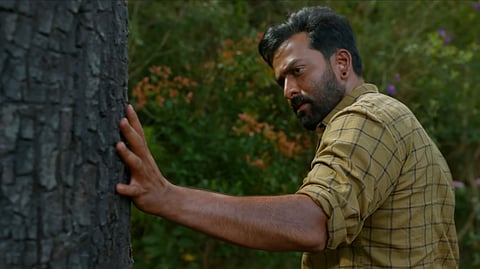


For a film named after the most fragrant sub-species of sandalwood, there’s a lot of talk about the stench people are forced to live with in Jayan Nambiar’s Vilayath Buddha. The most obvious of these stories belong to Bhaskaran (Shammi Thilakan), the out-of-work politician who cannot reverse his reputation, after he gets caught visiting the neighbourhood sex worker. Then there’s the stench Chaithanya (Priyamvada) wants to get rid off of her for being termed this sex worker’s daughter. She has no identity outside of her mother’s occupation and she fears she too will be seen as one. Then of course is the story of Double Mohanan (Prithviraj), the sandalwood smuggler, who will forever remain a thief to everyone in the hill station of Marayur.
In one the film’s most striking scenes, we see Mohanan driving his jeep down the hills in a tearing hurry, only so he can save the life of a dying child. But as he reaches a check point along the way, the forest officials are unwilling to let him through. They've seen several tricks before this, and they fail to believe that this thief is up to some good by trying to save the child.
All three are victims of not just how their townsfolk see them but also of how they see themselves as a result. So, when Bhaskaran declares that he wants to be cremated by being burnt using the wood from his sandalwood tree, it’s not because he’s royalty or because he can afford it. In a psychotic fit, we see reality escape Bhaskaran’s eyes as he says he wants the smell of his body burning on the sandalwood to take over the senses of everyone in his village, if only to finally get rid of his stench. It’s a terrific layer in a film that’s already brimming with dramatic possibilities and a group of wild characters.
And yet why does one feel so shortchanged by the end of Vilayath Buddha? Is it because the film isn’t satisfied by just being about these three people and their desperation to win over their people? At some point, the film begins to doubt this and begins to throw a new sub-plot at us every half hour. This could be the one involving Mohanan building a road, all the way up the hill. But no, he doesn't want to do become the local Robin Hood by doing this good deed; he wants to do this to name the mountain after Chaithanya. Similarly, we see Mohanan having to battle two outsiders who now want to claim Mohanan’s smuggling business from him. This sub-plot isn’t much more than a Red Herring: too obvious of a distraction only to stage massy fight scenes for Mohanan.
Just as frustrating is the undercurrent of the local panchayat elections that happen in the background. It’s a sub-plot that only makes sense if the story belonged to Bhaskaran alone, but with the film struggling to make space for three equally important characters, we struggle to understand who this film belongs to and the strange ways in which they are forced to be connected. What this means is that it struggles to be the ego battle between Bhaskaran and Mohanan, as they fight to see who this last sandalwood tree belongs to. It struggles just as much to be the story of a Brown Saviour, using all his powers as a smugger, so he can build a path and civilise the tribal community that lives atop the hill.
With so many of these sub-plots overstaying their welcome and taking forever to get to their point, Vilayath Buddha never quite manages to achieve the lived-in feeling of the world Indugopan created with his two previous films, Ponman and Oruthee. Characters like Mohanan and Bhaskaran surely deserved a better film but the setting itself could have done a lot better than the dozen blockbusters this film aspired to be like.