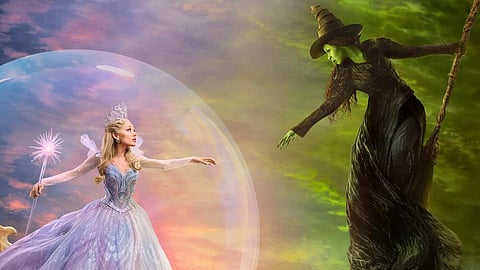


For those of us who had gone out of our way to avoid every trailer, teaser, and TikTok theorist dissecting Wicked, that sudden “Part 1” title card landed like an almost comic jump scare. To discover that this beloved musical had bowed to studio calculus and been split into two halves a year apart felt baffling—an act of tampering with the internal logic of a musical and, frankly, a self-sabotage of a $350 million gamble. As a purist, I confess my hackles rose.
And yet, Jon M. Chu’s Wicked: For Good remains, in many ways, as meticulously constructed as its predecessor. The songs still shimmer. Oz still sings. Michelle Yeoh doesn’t—and shouldn’t. Neither should Jeff Goldblum. But Yeoh glides through the film with a dryness so immaculate it veers into camp, at one point brushing off Ariana Grande’s hand with the driest flick known to man. Goldblum, meanwhile, in all his Goldblum-ness, feels like an inevitable inhabitant of this increasingly peculiar land (the alliteration is intentional).
But Wicked has always belonged to Glinda and Elphaba, and Grande and Cynthia Erivo bear that inheritance with striking conviction. Grande plays a more morally porous Glinda the Good—less the Goodliest Galinda, more a young woman abruptly forced onto the tightrope between public benevolence and private doubt. She’s funnier than she is dramatic, but the levity is essential: it’s her wide-eyed, almost desperate optimism that keeps the film aerated. When the movie remembers to be playful, it’s often because Grande has remembered first.
Erivo’s Elphaba, meanwhile, is a study in incremental hardening: a crusader turning slowly, painfully, into a martyr. By the time she reaches 'No Good Deed,' the room feels electrically recharged, every hair raised, every breath held. And Erivo carries the hum of hope and despair.
The trouble is that, unlike the first film, Glinda and Elphaba spend most of this instalment apart—and the drag becomes instantly noticeable. When they unite (in just three key scenes), the movie momentarily achieves lift-off, hinting at the emotional altitude the two-part structure has otherwise denied it. Together, they defy gravity; apart, the film dips.
The thematic spine remains as sturdy as ever: a government that preserves its authority by marginalising the vulnerable; a population so eager for myth that once they believe the hokum, they’ll refuse to unbelieve it; a place one loves ferociously despite its refusal to love back. The outcasts band together. Protest becomes melody with 'No Place Like Home'. The truth, this film reminds us, is just what everyone agrees on. The film’s political whispers are still embedded in its DNA, even if the subplot about Munchkinland’s governance feels politically intriguing without ever being dramatically urgent. The fact that Wicked's themes remain relevant to this day is its own kind of heartbreak.
There are scattered pleasures: the tender romance between Fiyero (Jonathan Bailey) and Elphaba, the pointed melancholy of Elphaba saying, "They need someone to be wicked for you to be good,” the line readings that feel like small, bright knives. But it’s hard to ignore the sense that this chapter has been built to inherit momentum rather than generate it. Last year’s 'Defying Gravity' was a thunderclap; a year later, that echo has thinned.
Which brings us to the film’s central bind: its almost slavish fidelity to the stage musical. It’s not a bad film—far from it—but splitting the story has doomed the second half to functionally serve as a limping conclusion. As a standalone work, For Good simply doesn’t have enough narrative oxygen. You can count its truly moving moments on one hand and still have fingers left. It’s half a film. Half the joy of watching two of the most committed performances in contemporary musical cinema. Half the magic.
There are moments when this movie defies gravity, but it never quite sticks the landing.