
The ‘Heading South’ series is a monthly catch-up on all things relevant in South Indian entertainment and pop-culture
The word ‘women-centric’ in Indian cinema is seldom associated with middle-class women protagonists. It was in the ‘80s when we saw mainstream heroines break some norms and don the khaki uniform or the lawyer’s cape, or turn into avenging angels for a crime committed against them by morally decrepit men. The regular route in those times for a heroine in South Indian movies — who lasted long enough to see considerable box-office success — was to also be cast as a cop or lawyer to showcase their acting prowess.
Heroines emerging as heroes then were usually ‘kept for’ these kinds of characters that required them to do some action here and deliver a punch line there, much like the heroes. But one film changed that trajectory in the 80s.
In 1986, Mani Ratnam gave the world a middle-class heroine (Revathy as Divya) who was neither a selfless homemaker uniting families (like in Visu’s Tamil films) nor was she a cop/lawyer who had to make a comeback to nab the villain (like Vijayshanthi was in many Telugu films). In Mouna Raagam, Mani Ratnam gave us a heroine who was nursing a broken heart (a wow Karthik playing the boyfriend who dies in a shootout) and navigating a marriage with a highly decent man (Mohan in his best role). We had seen the ‘burdened-with-household responsibilities-sacrificing-her-all-for-the-family’ kind of women during the K Balachander era, but what we saw for the first time in Mani Ratnam’s Divya was an urban, educated, intelligent, all heart and flawed, as-real-as-it-can-get middle-class girl, who became a character template for heroines thereafter. Divya even had a foot-tapping heroine introduction song!
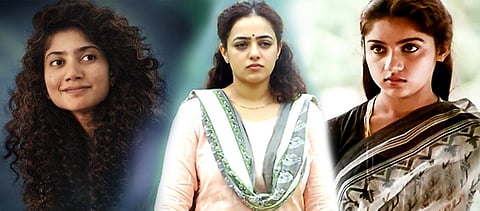
Cut to 2024, and we have Indhu Rebecca Varghese from Amaran. Sai Pallavi’s Indhu is as much a hero of the film as its protagonist Mukundh (Sivakarthikeyan cast against the grain, but what a payoff indeed, showing us his range as an actor). I hope the huge success of this film gives rise to more well-written roles for our girls to showcase their acting skills that need not necessarily be relegated to fighting off offenders. Thankfully, by now, we also have had a Deepika Padukone with a Piku (2015) and Vidya Balan with a Tumhari Sulu (2017) to refer to in Hindi cinema. The cleverly crafted Kolamaavu Kokila (2018), Nelson’s debut film, had Nayanthara in her best role yet, and Trisha , of course, starred in Premkumar’s 96 that keeps her in our hearts.
When we sat for Amaran, the expectation was to see an army officer’s biopic that would involve a template drama, sacrifice and action. However the film’s love story became its calling card, which Amaran’s producer Kamal Haasan described as making you “need (a) handful of tissues to wipe your tears”.
Grief, along with a deep romance, is the spine that backs this solid film and has enabled its successful run. Rajkumar Periyasamy’s decision to let the story unfold from Indhu’s point of view is what makes it a strong contender to set a trend for filmmakers to give heroines roles that are closer to real life. Malayalam cinema consistently has characters from everyday life who become torchbearers; for e.g, Nithya Menen from Indhu VS’s debut film 19(1)(a) (the Article from the Indian Constitution that refers to Freedom of Speech). Her unnamed character is that of an ‘ordinary woman’ whose routine, quiet life, most of which is spent in her xerox shop, changes when an activist-writer (Vijay Sethupathy) gives her his (last) manuscript.
Our heroines’ grit, grind and gumption needn’t be displayed only through physically-demanding roles. Our homemakers, working women, wives, mothers, sisters, lovers and friends can also be our on-screen heroes because heroines, they naturally are. Sai Pallavi’s debut as a college lecturer Malar in Premam (2015) has held up right till her Indhu in Amaran; it is proof enough that commoners can also be superstars when written and presented as one.
