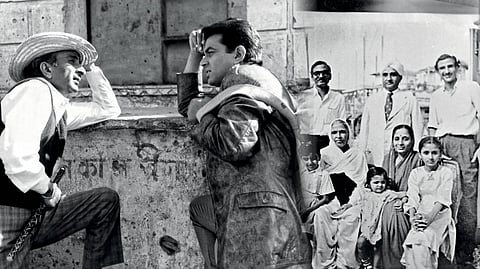


As journalist and author Amborish Roychoudhury notes, director Raj Khosla, despite having an enviable filmmaking career and traversing diverse genres “from noirs to dacoit ‘Westerns’, love stories, family dramas and mystery thrillers to action movies”, his legacy has received scant attention. His latest book, Raj Khosla: The Authorized Biography, published by Hachette India, is in one sense a corrective to this lapse in film history.
Here, in a conversation with The Hollywood Reporter India, Roychoudhury discusses this legacy and the elusiveness of myth-building.
Edited excerpts from the conversation:
THR India: Despite his prolific and well-known films which produced some of the most iconic songs of that era — “Lag Jaa Gale”, “Jhumka Gira Re”, “Yeh Hai Bombay Meri Jaan”, why did his name fall into the footnotes? What drew you to this project, spending four years on this text and filmography?
Amborish Roychoudhury: For starters, Khosla wasn’t as media-savvy as many of his contemporaries. One doesn’t come across too many of his interviews. Despite how successful his films were, he wasn’t spoken of as much. There was obviously no internet or television in his heyday, but print media was ruling the roost. Film magazines were as ubiquitous as the paparazzi are today, but Raj Khosla was rarely mentioned. Secondly, he didn’t make appearances at soirées or frequent
film parties. But even that doesn’t quite explain why, despite the staggering success of his films, he wasn’t celebrated as much as he deserved. I guess it just happens to a certain kind of artist. Why do we know so little about Prakash Mehra or Mukul Anand despite the dizzying popularity of their films? We all know and celebrate [Rabindranath] Tagore, but Bibhutibhushan [Bandyopadhyay] barely finds mention. It is a mystery.
THR India: There is Khosla’s mentor, Guru Dutt, and his protégé, Mahesh Bhatt — both of whom were surrounded by their own myths that have taken over their narratives. Did Raj Khosla’s name slip through because it was unattached to any such myths? Does it take a myth to make a man?
AR: That’s an interesting perspective. Guru Dutt’s genius awaited rediscovery by the likes of Nasreen Munni Kabir. It is when she wrote about him extensively and made her documentary on him that his films were shown at festivals and people woke up to the magnificence of the man. Untill the ‘80s, Guru Dutt was this talented-but-somewhat-obscure filmmaker the world barely knew (or cared) about. Mahesh Bhatt’s myth was built around his films in which he bared the scars on his soul for the world to jeer at. He never shied away from speaking about his foibles or his indiscretions. And this he learned from the mistakes of his boss. In fact, there is this moment in the book where Khosla tells Mahesh Bhatt how jealous he is of him — because he never found it in himself to denude himself so effortlessly. Khosla’s demons had gotten the better of him. He did express some of his anguish in his work — films like Main Tulsi Tere Aangan Ki or Sunny — but they lacked the profundity of Guru Dutt or the candour of Mahesh Bhatt.
THR India: In your book you have kept a sanitised distance from Khosla’s personal life. Anything we know of his life away from cinema feels accidental, like his marriage a day before the shooting for his debut film Milap began. Is this a way of being respectful, or is it that your interest in Raj Khosla is his filmography, not his life?
AR: I have, in fact, covered aspects of his personal life insomuch as they impacted his work. He has spoken about them in some of the handful of interviews he appeared in, and I have quoted those. There are several reasons I didn’t go into exploring his private life beyond a certain point. First, information is scarce — he was a private man and the precious few he may have talked with are no more. He could be fairly reticent, and quite often, not even his daughters knew what he was going through. Secondly, there is the question of privacy. There are other people involved and I could not, without their express permission, mention them. Lastly, for a consummate filmmaker like Raj Khosla, I hoped that his work would reflect on the person that he was. Having said that, I do dwell on his relationship with his daughters and his father, especially his days at Khosla Niwas.
THR India: You also write that he was “burdened by his truth and it was eating him up”, regarding his inability to speak of his life clearly through his films the way Mahesh Bhatt did. Why do you think that is?
AR: Honestly, I am not sure. Perhaps he couldn’t muster the courage to be as direct and open about his problems. Or maybe he thought it wasn’t worth it. Raj Khosla was an extremely sensitive man, almost maudlin in some respects. It didn’t take much to draw tears out of him. What he was going through in his personal life — some of it of his own making — was rather complicated and it was taking its toll. He was surrounded by too many people he loved dearly, and I think he wanted all of them to be happy with his decisions, and that’s not a good place to be in.
THR India: A recurring note in this book is how Raj Khosla’s song-picturisation was excellent and innovative, where even comic reliefs like Johnny Walker were allowed a brief moment of introspection through music. What about his song-picturisation made it stand apart? What were the innovations he introduced into this form?
AR: Khosla inherited his skill of filming song sequences from his mentor Guru Dutt. What we often forget is that mainstream Indian cinema has a language of its own and song sequences (not merely the song itself) are integral parts of it. In the hands of competent filmmakers, such sequences become narrative devices. Mani Ratnam’s cinema is a case in point, or Vijay Anand. What I think was unique about Khosla was that the songs in his films not just pushed the narrative forward, they had a narrative of their own. Take “Achha Ji Main Haari Chalo” from Kala Pani, for example. Even if you haven’t seen the film, the feature has a little story of its own. The sublime banter between Madhubala and Dev Anand, and the three stooges making an appearance (Agha, Mukri and Janki Das) — all of this come together to tell a tale, a short film of sorts, if you will. He had a certain kind of framing, and buttery smooth camera movements that accentuated this feeling. For “Lag Jaa Gale”, it is evident that he took time to ensure the mystery of Sadhana [Shivdasani] — that ethereal quality — really comes through. Again, that song has a story of its own. In the rare eventuality that you haven’t seen Woh Kaun Thi?, the song can work as a brilliant trailer for it. The film was remade in Tamil (as Yaar Nee?) starring Jayalalitha two years later and the same tune was used in the song “Ponmeni Thazhuvaamal”, but the magic was gone.
THR India: Frank Capra keeps coming up in the book. At what point do you think influence becomes plagiarism? Were these legal and ethical questions Raj Khosla’s generation were even wondering about?
AR: In a pre-Internet world, the West was just too far away. Some of our greatest filmmakers have copied generously and blatantly from American and European films they got to see either at film festivals or rare screenings, not thinking too much of it. Guru Dutt did it, Dev Anand did it, so many others did. Barring the wealthy, English-speaking elite, it was near-impossible for lay audiences to have seen these films in their original form. In the book, there is a bit where I write about how Guru and Dev see Giuseppe De Santis’ Bitter Rice and then find ways to “adapt” it as Jaal, which was as different from Bitter Rice as can be, despite the parallels. In the same vein, Raj Khosla “copied” Milap from Mr. Deeds Goes to Town, but if you see Milap, you’d be hard-pressed to spot the similarities. So, technically, it may very well be termed as plagiarism, but back then many of these notions didn’t even occur to most Indian filmmakers.
The excerpt follows:
‘He used to come home. He had a car... his parents were well off,’ the octogenarian artist Lalitha Lajmi, Guru Dutt’s sister, said of Raj Khosla. ‘He used to come in his car and pick up my brother for the shoot. He came and waited in the outer room. There was only one table and one chair, on which he used to sit. I used to meet him, bringing water and all that.’
Lalitha was impressed by this eloquent, dapper man who spouted Urdu poetry and sang like a dream. ‘He was a brilliant man,’ she said. Having grown up with a legend, birthing another (her daughter, Kalpana Lajmi, was an acclaimed filmmaker), and being quite the legend herself (she was a self-taught artist who held exhibitions across the globe), Lalitha Lajmi knew a thing or two about brilliant people.
Guru Dutt and his family were in Matunga at the time. Their flat was near Tejukaya Park, a well-known landmark in Matunga East. It was about a five-minute drive from Khosla Niwas. Raj Khosla would pick his boss up every day and drive him to the studio. During this time, Raj and Lalitha were also joint witnesses to a budding love story.
Twenty-six-year-old Guru Dutt and twenty-one-year-old Geeta Roy had first crossed paths at the rehearsal of a song for Baazi. Geeta Roy was in her prime, with audiences eating out of her hands. In the days and weeks that followed, Guru Dutt and Geeta Roy kept encountering each other at parties and gatherings. He was besotted by her ethereal Bengali beauty. Guru Dutt not only spoke fluently in Bengali, he also read its literature and was seeped in Bengali culture and music. He listened to one of her adhunik gaan (modern songs, a genre of non-film music popular in Bengal) on loop. Love tiptoed in and the two found that they couldn’t have enough of each other.
Hopelessly in love, the pair would often set out on a drive to Powai Lake or Khandala. During these trips, their companions were Raj and Lalitha. Geeta Roy would often sing in unison with Raj. Lalitha reminisced: They used to have some tea and pick up some jalebis and bhajiyas on the way. It was like a picnic. Allowing these two (Guru and Geeta) to be by themselves, I spent time with Raj. He used to recite poems and talk literature all the time. He used to bring books and sometimes lend them to Guru as well. Also, Raj could sing, so when we were in the car together, sometimes he and Geeta would sing film songs. It was a lot of fun.
Raj Khosla seemed to have found his tribe. He was happy with the decision to stick with Guru Dutt. He could see his future with this man. When Guru Dutt and Geeta Roy got married on 26 May 1953, Raj was overjoyed. Leading playback singers of the time were present at the wedding reception and as Yasser Usman mentions in his Guru Dutt biography, Raj Khosla convinced them to sing one song each from a Guru Dutt film.
By now, Jaal (1952) – Guru Dutt’s second outing as a director – had been released. Guru Dutt and Dev Anand were constantly exploring good films from across the world. One evening, they had happened to watch Italian filmmaker Giuseppe De Santis’s neorealist classic Riso Amaro, aka Bitter Rice (1949), at the Excelsior cinema hall in Fort. It impacted both greatly. Guru Dutt wanted to make a film on it and Dev agreed to participate. The latter was enamoured of the grey character portrayed by the leading man, Vittorio Gassman. The film is about two small-time thieves Walter (Gassman) and Francesca (Doris Dowling) on the run. There, they hide among a group of rice farmers, who, despite living in penury, lead honourable lives. They run into the pretty Silvana (Silvana Mangano), who takes Francesca under her wings and teaches her their way of life. Silvana falls head over heels in love with Walter, which puts the rest of the story in motion.
Now, Guru Dutt picked up the seeds of this plot and based his new script on it, and Jaal was born. Instead of Italian rice farmers, he set the story among Goan fisherfolk and the movie was shot in the Malvan area of Maharashtra. Dev Anand and Purnima played the thieves Tony and Lisa respectively, while Geeta Bali portrayed the feisty Maria, a villager who shelters Lisa and eventually falls in love with Tony. In the original, unbeknownst to the peasant girl Silvana, Francesca is hiding stolen goods — a necklace. In Dutt’s adaptation, the necklace became gold bars. Some characters were removed, while others were added, such as Carlos, Maria’s blind brother, played by K.N. Singh. Unlike Bitter Rice, Jaal has a noirish tone and introduces religious elements in the plot. The ending was suitably changed to allow Dev’s character to turn over a new leaf.
In his autobiography, Dev narrates elaborate tales of shooting the film, including one episode in which he got drunk on feni, the popular Goan drink, and almost drowned himself and Geeta Bali in the sea. In another incident, while driving back from Malvan, Dev, Geeta Bali and his sister met with an accident. The actor almost broke his ribs, and spent a few days in the hospital, recuperating. His injury became such big news in Bombay that Frank Capra, the Hollywood legend known for his films like It Happened One Night (1934) and Mr. Smith Goes to Washington (1939), sent Dev a telegram wishing him a speedy recovery.
Jaal was the second film in which Raj Khosla was an assistant director to Guru Dutt. But the former’s involvement with the film did not stop there. Jaal begins with a couplet by Mirza Ghalib appearing on the screen. There are two versions of the film available online: in one of them, Ghalib’s lines are recited, courtesy a voice-over. In the other, the lines appear without narration. The quote is from a ghazal entitled ‘Ibn-e-Mariam hua kare koi’, and goes:
Na suno gar bura kahe koi
Na kaho gar bura kahe koi
Rok lo gar ghalat chale koi
Baksh do gar khata kare koi
(Do not listen to words spoken in malice
Do not respond to words spoken in spite
Show the wayward the correct path
Forgive those who transgress against you) – Translation by Mustansir Dalvi
This is followed by the narrator setting the context, declaring that the good and evil characters depicted in the film are not real, and can be found in any community or nation – a clarification ostensibly needed because all the characters in the film are Christians. The voice goes on to introduce the setting of the story, a colony of traders and fishermen on the western coast of India. No one is credited for the voiceover, and it has never been spoken or written of by film commentators or historians. None from the cast or crew is around to verify this, but the timbre and diction distinctly matches Raj Khosla’s voice. His command over Hindi and Urdu may have been the reason behind the decision to assign him the job.
Raj also appeared in the film as one of two Arab traders who want to buy the contraband gold that Tony and Lisa have smuggled in – this time, his role was credited. Guru Dutt himself made an appearance as a fisherman in the song ‘Zor laga ke haiya’, his second uncredited appearance in his own films after Baazi.
Songs weren’t just interludes for Guru Dutt, but contained stories of their own. Unlike most cinema of the time, songs in his films not only pushed the story forward, they also had narratives of their own. This was something that Raj Khosla picked up and artfully employed in his own films. Even in those early days, being in the shadow of a genius helped the young assistant director sharpen his own tools as a potential filmmaker.
All this while, the desire to sing hadn’t left Raj. His journey in films, after all, began as a singer. Even when Dev brought Raj to Guru Dutt, he had hinted that being an assistant director could pave the way to Raj becoming a playback singer in one of the films he was working in. Guru Dutt knew this, and he offered Raj a shot at singing one of S.D. Burman’s songs in Jaal – ‘Yeh raat yeh chandni phir kahan’. The song was one of the highlights of the album, and everyone seemed to have an opinion on who should sing it. While Guru Dutt wanted Raj, lyricist Sahir Ludhianvi voted for either Talat Mahmood or Mohammed Rafi. S.D. Burman himself was insistent on a new singer called Hemanta Mukhopadhyay, who later came to be known as Hemant Kumar.
It is believed that a version of the song was recorded in Raj Khosla’s voice, but the music director wasn’t convinced. In an interview to Nasreen Munni Kabir, Raj said, ‘He [Guru Dutt] wanted me to sing for Jaal, the song ‘Ye raat ye chandni’; he even recorded me but I failed the test. S.D. Burman said, “Guru, not now. He’s too raw, he can’t make it.” Guru Dutt was very upset as he had wanted me to sing that song.’ Ultimately, Hemant Kumar lent his voice to two versions of the song – one was a duet, the other a solo rendition.
This might very well have been the proverbial last nail for Raj’s singing ambitions. But the desire to sing remained a part of his being till the end of his days.
He would sing a cover version of Mukesh’s song ‘Toote na dil toote na’ from Mehboob Khan’s Andaz (1949) – it was published later as part of an LP from a label called Young India, which was owned by V. Shantaram. Raj even surreptitiously included his songs in two of his iconic films, covered in later parts of this book.