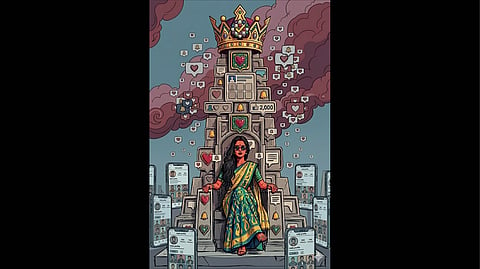


The most viewed Instagram post of all time, in India, is the wedding photograph of Rashmika Mandanna and Vijay Deverakonda. A joint post, with Deverakonda pulling in his 23 million followers and Mandanna pulling in her 51 million followers, the top spot garnered hints at what Instagram covets — marriage and movies.
There is also cricket, with Virat Kohli, and his 276 million followers, clogging most of the available top 10 spots. This is not unlike trends worldwide, where football stars like Lionel Messi and Cristiano Ronaldo frequent the top 10 lists, marred by a Taylor Swift and Travis Kelce engagement announcement. Like the apps, these lists are dynamic and shape-shifting and can be as useful to analyse as tricky. A few years ago, for example, Kylie Jenner was on the top — a photo of her child with Travis Scott — only to be outdone by an egg. Just an egg.
Queens of the Grid
When we received the list of ‘Top 10 Social Media Stars’, the immediate observation that jumped out was that nine out of the top 10 slots were captured by female actors, with one slot being poached by Kartik Aaryan. In an industry where we still use “female-centric” to describe films fronted by female protagonists and where the nomenclature of “female director” has been normalised, what does it mean for the near total capture of women on this particular list?
Social media is not just a tool of pure visibility, but also of monetising that visibility. It is a significant cash stream, and in fact, actors often make more money through brand deals than through their films. In 2019, when actress Parineeti Chopra noted in an interview with Film Companion that the gendered wage gap is a troubling fact, adding, “But then [female actors] make it up with endorsements,” she raised a storm.
“Indian actresses also have international collaborations — Deepika Padukone for Louis Vuitton and Cartier, Alia Bhatt for Gucci, Priyanka Chopra Jonas for Bvlgari. They get an international following from this,” says Aditi Shrivastava, co-founder and CEO of Pocket Aces, a digital entertainment company that developed companies such as FilterCopy and Dice Media.
The question remains — does social media equalise gender parity? Can we read the overwhelming presence of women on this list as some sort of corrective to the wage gap that persists in the industry?
Reel Equality
Viraj Sheth, co-founder and CEO of Monk Entertainment, a creator management company, cautions against such a neat reading of this data. “Generalising along gender lines is a bit of a trap, and honestly, the data doesn’t cleanly support a ‘men vs women’ conclusion,” he says.
Shrivastava agrees. “Maybe, actresses are posting more than their counterparts?” she asks. “An analysis of their followership — where it is coming from, demographics — as well as of the frequency and engagement of their posts are needed to get clearer answers.”
Sneh Chheda, the associate vice president of Schbang Fluence, an influencer marketing and talent management company, notes, “There is a clear disparity in how gender influences growth on social media.” Chheda lists a few possible reasons for this: “Female creators often lead because they have mastered a high-frequency, relatable storytelling style that feels more accessible than the ‘guarded’ approach many male celebrities take.”
Varun Duggirala, co-founder of the creative digital agency The Glitch, and a lifestyle influencer notes, “I am in my mid-40s, one of the few men my age who creates lifestyle content. Most men past a certain age speak of themselves as founders. Women, on the other hand, continue to create content across categories even as they get older. As a man, the perception is that you make certain kinds of content according to your age — unless you are a comedian.”
But Chheda also points to another aspect to this story. “We have to look at the demographic data honestly. In the Indian market, female creators often achieve disproportionate growth because they capture a massive male audience. This is often driven by aesthetic-heavy content and a visual-first approach that attracts a high volume of male followers.” And this can mean the way the women dress, perform, and comport themselves. “This creates a growth trajectory that their male counterparts, who typically only attract a specific subset of male followers, simply don’t see.”
For example, an industry insider told THR India anonymously that gaming apps which target men preferred Shraddha Kapoor because of her sizeable male following.
The Gaze Stays
The paradox here is that on the one hand, when we draw lists of most powerful actors — and power as something gauged by, say, the box-office pull — there is a disproportionate representation of men. On the other hand, where we see women exerting their power and influence — on social media — that, too, is partly pushed by men, who are disproportionately online.
As of late 2025, market and data website, Statista.com noted that Instagram handles in India had a roughly 70-30 split between men and women. Sheth, though, argues for changing the lens with which we look at the data, saying, “If anything, the shift over the last few years is that audiences have become far more open. So, the more useful lens isn’t male versus female. It is about those who understand their audience better, and who can consistently show up with something that works.”
Pocket FM is owned by RPSG Group which is also the licensed owner and operator of The Hollywood Reporter India.