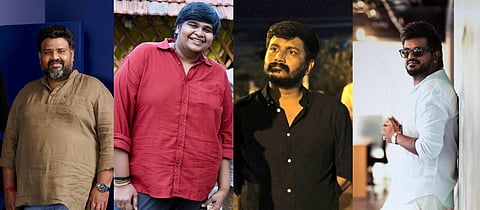

Ashwath Marimuthu’s sophomore project Dragon, drawn loosely from his life and celebrating second chances, has been one of Tamil cinema's biggest hits in 2025 at the box-office. One person who was just not surprised at the reception was K.G. Jayavel, who brought to life, as creator and producer, the seminal show Naalaya Iyakkunar (Tomorrow’s Directors) that ran for six seasons from 2009–2020 on Kalaignar TV, and which set out to identify the auteurs of the future. Jayavel first saw Ashwath Marimuthu, who used the surname Narayan at the time, during the third season of the show. “He was a good conversationalist, spoke with confidence and had immense clarity,” recalls Jayavel.

The judges thought so too; he was chosen for the finals of the contest, though the title was eventually shared by Nithilan Saminathan (Maharaja) and Bakkiyaraj Kannan (Remo, Sulthan).
Even recently, Marimuthu posted on social media about how it all began, and how his friends, still fresh in the job market, chipped in with ₹2,000 each to help him make movies for the show.
“It taught me the value of money and the need to stick to a budget. NI taught me persistence too, because each short film had to cross seven rounds to reach the final. Also, I developed the attitude to shoot with what is available,” says Marimuthu.
When the history of contemporary Tamil cinema is written, this show will find a prime chapter, many say, or at least an important footnote. In the six seasons it ran, it has given Tamil cinema some amazing talent in the form of writers, actors, directors and technicians, who have left their mark on the industry since 2010–11.
Balaji Mohan was the first among the maiden batch of NI to break out with a movie in February 2012, based on his short film by the same name. Kadhalil Sodhappuvadhu Yeppadi, starring Siddharth and Amala Paul, worked so well, it proved that boys making short films could transition well to filmmakers making features.
Mohan says that the reason why NI directors are different is because even though they came from a contest, their originality never suffered; they were never asked to conform to prevailing ideas of how cinema should be. That unfiltered voice appealed to the audience in a big way. Their stamp of approval mattered.
Karthik Subbaraj followed suit in October that very year with the smash hit Pizza, starring Vijay Sethupathi, another star that NI gifted the industry — he was part of many shorts in the series. Subbaraj, who has gone on to become a brand by himself since then, and produced films by other such directors, likens NI to the French New Wave of cinema. Because it launched Tamil cinema directors for the next decade and a half, and they, in turn, have gone on to nurture and build a new set of directors for the future. The show resulted in a change in the attitude of producers too. “They started listening to stories,” says Subbaraj.
Marimuthu agrees, and adds: “I think the world changed from producers asking how many years of experience one had as an assistant to asking how many short films one has done.”
Jayavel — who interacted often with eager students of visual communication, and was part of the programming and production sections in Sun TV and Vijay TV and co-produced the dance reality show Maanada Mayilada (on Kalaignar TV) — thought the time was ripe to do a show to scout prospective directors. Young visual communication graduates needed an opening to set foot into the industry.
In 2007, Jayavel met Sarath Kumar Reddy, then managing director of Kalaignar TV, and floated this idea. Some time later, a set was put up for ₹10 lakh. He picked two judges with great care — senior journalist and cartoonist Madhan, and actor-director Prathap Pothen. The former was a picture of calm, drawing from his years of journalistic experience and dealing with youngsters; the late Pothen was mercurial — he would love fiercely and scold as much. And, Jayavel’s format was clear: Each chosen contestant got to make seven short films in seven genres. The channel paid them a base rate of ₹10,000 per film. Jayavel says, “It taught them discipline, and I encouraged them to look at it as a feature film in a capsule.” This, says Mohan, helped immensely during the show, because they worked without any restriction.
Jayavel and his boys are still in touch. Even today, they get back to him to check their scripts, discuss story ideas and more. There are some who showed great promise but did not get the chances they deserved. “Sometimes, it’s about fate. I tell them to keep themselves sharp, to update their skills and keep pitching to producers. Success will come.”
Helping Jayavel run the show were show directors Vimal Raj, Sivanesan and Vijaykumar. They would filter the responses from about 3,000 to 32. The initial entries submitted were questionable in terms of resolution and camera work, but things soon improved. Some directors recall learning to say action and cut after joining the show. Jayavel banked on his contacts in the industry to come on the show as special guests. So, K. Balachander, Kamal Haasan, K.S. Ravikumar and the like spoke to the contestants and handed out awards. Off the record, many directors told Jayavel that he had cut short their careers by launching the show, because the audience now knew what youngsters were capable of.
Every prospective director who was on the show remembers how merit trumped everything else. S.U. Arun Kumar’s debut was the lilting Pannaiyarum Padminiyum (2014) about a landlord and his desire to drive a Premier Padmini car — this was adapted from a short he made. Kumar, whose Vikram-starrer Veera Dheera Sooran just released, was part of the second season of NI. “When we were strugglers and wanted to seek refuge in the thought that everything was rigged, the show taught us that it was possible to make a solid reality show without retro-fitting emotional highs for TRPs. The show helped me keep my idealism alive.”
Ironically, this format, where the end goal was not mindless entertainment, was possibly one of the reasons why despite being considered a cult classic, and when 10 a.m. to 11 a.m. on a Sunday morning was sacrosanct for devoted followers of the show — not family audiences — NI drew very low TRPs, sometimes as few as 2 points; popular shows average about 10 to 12 points. “But, I knew this show was doing well among the target group, because even at the petrol pump, someone would ask me, ‘Sir, who is getting eliminated this week?’ ” says Jayavel.
Years after he left NI, Kumar remembers every little process of taking part in the show — scraping money to hire cameras at ₹1,500 a day, rushing to Glamour Cine Studio in Vadapalani (a neighbourhood in Chennai) to convert it from DV to CD format, inserting it into a CD sleeve and rushing it to the office in time for the judges to view it. “I had applied for the first season too, but was not selected. After seeing what Subbaraj and Nalan and the others had created, I realised I had miles to go. I would be the last from my batch to decide on a story. Many a time, I would be really past the deadline and would beg the office staff to include my CD,” says Kumar, laughing.
The director, who won rave reviews for his Chithha (2023), credits the show with giving him financial discipline and the ability to handle criticism, both when it was gentle and pointed. “We got a red-carpet welcome into the industry. I finished the show and there was a producer waiting with a cheque. We did not have to knock on a single door. It broke every trope there was about struggling for chances,” Kumar explains.
Marimuthu adds that NI is important because it “offered a new platform for filmmakers who did not take the usual route to enter the industry”.
Jayavel had taken a break post-COVID, but is now looking to replicate the Naalaya Iyakkunar format across languages. But, going by public feedback, another season in Tamil wouldn’t be a bad idea. “Bring back the OG Naalaya Iyakkunar,” say comments for YouTube videos of the show.
Madhan, one of the judges, remembers how he worked closely with the team on the format. “The contestants came with a certain passion and many of them went on to become good directors. What was amazing was the transformation. From shy introverts, they turned into accomplished people who were articulate and confident. Personally, for me, the show was almost like an extension of the battalion of reporters and student reporters I was managing in Ananda Vikatan (a hugely popular Tamil weekly magazine). I would sit up till 2 a.m. watching the CDs, and write down my initial impressions.”
Many contestants remember Madhan’s kindness. All he says is: “As a youngster, I remember cooling my heels outside editors’ offices with my cartoons. Vikatan gave me a chance. Naalaya Iyakkunar was that chance for many.”
Kumar, Subbaraj, Marimuthu and Nalan Kumarasamy, whose break was 2013’s smash hit Soodhu Kavvum, speak fondly of the camaraderie in their respective batches despite the competition, and how they helped each other though someone was sure to get eliminated.
Subbaraj says NI regularised the short-film movement. “It taught us to be professional, to work on cinematography, sound, music. The superb film knowledge we gained from the judges was an additional bonus. The show honed our talent, and gave us confidence in a way nothing else could, because we learnt by doing. And, that nurturing ecosystem is something to cherish. Most importantly, it taught us to be positive, and that no matter what, someone will have your back.”
Kumarasamy, who won the first season of the show, agrees. “My fondest memories have to do with learning to work as a cohesive group. Everyone knew their role, and each one had a style of working, but you pulled it off together. You learnt to make decisions — what suggestions to take, what to ignore. Even today, the friends I made in NI remain my bouncing board.”
To read more exclusive stories from The Hollywood Reporter India's March 2025 print issue, pick up a copy of the magazine from your nearest book store or newspaper stand.
To buy the digital issue of the magazine, please click here.