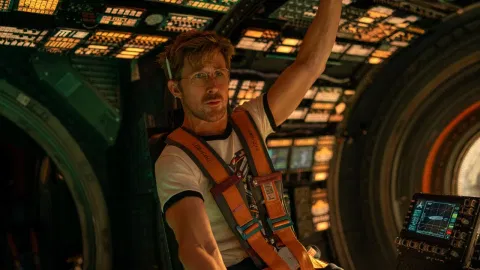


In an exclusive conversation with The Hollywood Reporter India, Sood shared that a seemingly innocuous chess board featured in the film carries historical significance.
“Because India is a big chess-playing community, we have one really great, very subtle chess Easter egg in the movie that someone’s going to figure out at some point,” he said. “There’s one chess board in the movie—you have to look very carefully—and there’s a position in that chess board that actually has real historical significance.”
The reveal adds to the meticulous level of detail that went into the making of the film, directed by Phil Lord and Christopher Miller, and starring Ryan Gosling.
Sood also spoke about the filmmakers’ commitment to embedding personal and cultural touches throughout the film’s world-building, sometimes in ways even he didn’t anticipate. In one such instance, Lord and Miller paid tribute to his family by incorporating his parents’ names into the narrative.
“They surprised me by writing my parents’ names into characters in the movie,” Sood said. “The little girl who asks about the Petrova line is named Rekha—that’s my mom’s name. And a scientist character was named Narendra, after my dad.”
Even after edits forced the removal of the character’s spoken name, the directors found a workaround. “They didn’t tell me this, but they put a little badge on his jacket that says ‘Dr. N. Sood.’ It was one of the very last visual effects they added. I didn’t tell my parents and they were completely blown away when they saw it.”
Beyond these personal nods, Sood described a broader philosophy of hyper-detailed design that shaped the film’s aesthetic. The spaceship at the centre of Project Hail Mary was conceived as a collaborative global effort, with each module attributed to a different country. It was reflected in materials, design language and visual cues.
This approach extended to India’s representation as well. The film’s medical bay, for instance, was imagined as being built by an Indian entity and named “Rekha Shanti,” combining his mother’s and grandmother’s names who were doctors. “We had little signs made up,” Sood said, noting that such details were carefully layered into the production design.
The cumulative effect, he suggested, is what encourages repeat viewings. “It’s those little things that people are noticing now,” he said. “It makes you want to go in for a second and a third watch.”