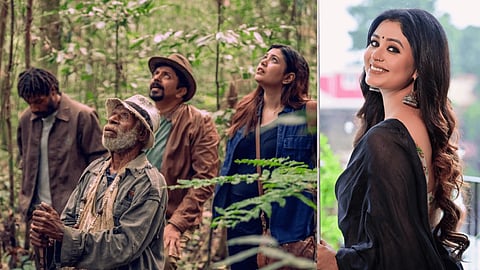


Actor Ritabhari Chakraborty finds herself in a more assured space in the industry today, after having been here for over 15 years, transitioning from TV to films and navigating the limiting 'pretty girl' box. At some point last decade, says Chakraborty, she knew she had to be "reborn" as an artist to rediscover herself, and the journey has led her to her latest drama, Papa Buka—Papua New Guinea's inaugural submission to the 2026 Oscars in the international feature film category.
Backed by Pa. Ranjith, the film follows the titular ageing war veteran (Prakash Bare) as he guides two Indian historians through untold WWII stories that connect India and Papua New Guinea through shared sacrifice and humanity.
The film, directed by multiple National Award-winning filmmaker Bijukumar Damodaran, is a co-production between Papua New Guinea and India, bringing together producers like Noelene Taula Wunum (NAFA Productions), Akshaykumar Parija (Akshay Parija Productions), Pa. Ranjith (Neelam Productions), and Prakash Bare (Silicon Media).
In an interview with THR India, Chakraborty talks about the film, what it means to have a voice like Pa. Ranjith on board, and why she joined an acting school after more than a decade in the industry.
Edited excerpts from a conversation:
What does it mean for someone like Pa. Ranjith to back the film?
I hadn't met him before, but of course, I have been watching his work and I am aware of what he stands for. His work has made an immense contribution to changing the face of Indian cinema in the last 10 years. So when a name like that is attached to a project, your film's credibility increases. He believes in the film and has believed enough to have funded the film as a producer and creative producer. When I came on board, and I was one of the first to do so, he was not one of our producers or presenters back then. Later, when he joined the project, that itself became big achievement for the film.
While filming, did you have a sense that 'Papa Puka' would have such an exciting journey?
I did look at it as something incredible that we were doing. There are not many projects in the world that are this collaborative; it is a co-production of Papua New Guinea and India, directed by a Dr Biju, a Malayali, with a crew from Kerala, starring a Bengali actress, with producers who are from Tamil Nadu and Odisha. On top of that, we had three-time Grammy winner Ricky Kej on music. A global ensemble made this film happen.
What connected with you at a story level?
Honestly, I had no idea that Papua New Guinea and India had any historical connection. It was surprising to know that during World War II, Indian soldiers went to Papua New Guinea, representing the British, to fight a war that was not theirs, and just how much it affected them. It was tragic. My character is a historian whose grandfather was part of World War II but never returned. Did he die during the war? Did he die after? She seeks closure for herself and her mother and heads to the country for historical research, but also to search for his grave.
When I was there shooting, I walked through the graves and saw thousands of tombstones of soldiers, all aged between 17-21. Those were boys who went to war. And whose war were they fighting? Was it worth giving up their life for?
So are you speaking in Hindi in the film, or did you also have to learn Tok Pisin?
Because I'm playing a historian who has gone from India and is not from Papua New Guinea, I did not have to pick up Tok Pisin. In fact, the film proceeds as follows: my driver in the film knows English, he translates whenever Papa Buka talks in Tok Pisin, a language that serves as a tool for the audience to understand it. Of course, there are key sequences with conversations in Tok Pisin as well as Hindi. However, the film is otherwise presented in English and Tok Pisin.
You started your career around 2009 with TV, then a few years later, you moved to films. But then, in 2021, you were at the UCLA School of Theater, Film and Television. Why did you feel the need to attend acting school?
When I tried to transition into films, the biggest challenge was that I had that television stamp on me. The flip side was, the entire industry knew me, but no one was willing to take the risk of casting a popular TV actor in films. Eventually, when I found my footing in films, there came a time when people just wanted me to look pretty. That box got highly uncomfortable for me. How long can one hold this 'youthful beauty'? That was around the same time I did Dr Biju's film Painting Life (2018), followed by Brahma Janen Gopon Kommoti (2020), which was game-changing for me.
During the COVID-19 lockdown, I decided to do something that wasn't allow to while growing up: Learn acting officially! So, I applied to UCLA and got in. It was life-changing for me; I felt I was reborn as an actor and the films I signed after were reflective of that, where I played a bipolar woman, one woman fighting for her unborn child, a woman dealing with agoraphobia, and now Papa Buka.