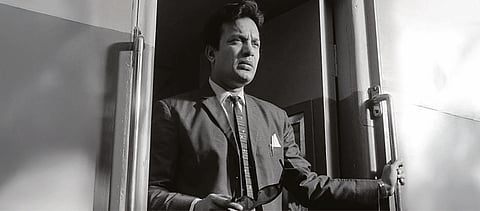


One may argue that Nayak (1966) has all the makings of a typical Satyajit Ray film. In it, he uses the tropes of a train journey as a tool for profound introspection, the hopes and desires of the common man spreading himself too thin to survive in the big city, and the disconcerting male gaze on the female body, et al. And yet, for a brief second, it flickers to fool you into believing that it’s about an extraordinary man, only for Ray to turn that idea on its head and remind you why it’s not. (But more on that later.)
The re-release of Nayak on the big screen, almost six decades since its debut, underlines why this film — much like most others by the auteur — has aged like fine wine.
The screenplay, one of the three originals written by Ray himself, unfolds like a Shakespearean classic, where the train not only carries its passengers from one corner of the country to the other, but also acts like a metaphor for the milestones crossed by an individual and a collective conscience. And who better than a matinee idol — in a meta-narrative — arguably playing a version of himself to be the portrait of said conscience.
The late Bengali superstar Uttam Kumar as Arindam Mukherjee is on his way to Delhi to receive a prestigious award only a night after he lands in a brawl with a man at a nightclub. On having failed to secure a flight ticket, he settles for a train and decides to sleep it off, so he doesn’t have to engage with his fellow travellers, who turn out to be a motley crew.
Soon enough, however, he realises that his plans of quietude may not really materialise. From admirers to naysayers, Mukherjee meets them all, hears them all out, until he stumbles upon Aditi Sengupta (played by a sharp-looking, bright-eyed Sharmila Tagore), a 20-something journalist who is unbothered by his presence.
The novelty of it takes him by surprise at first and proffers an odd comfort later. Aditi is both disinterested and uninterested in Arindam, but still decides to request him for an interview for her magazine — whose readers are young, urban women — to boost its popularity. But it's in Aditi’s gaze on Arindam that Ray’s genius lies; despite being a man— and clearly a feminist outlier for his times — Ray grants impassioned agency to Tagore’s character whose spirit lingers in every frame in spite of her limited screen time.
Arindam floats through his conversations with the others — from fawning female fans, young and old, to disapproving men of all ages — he beguiles them all equally with rehearsed ease. In these moments, there's an almost deliberate conflation of Uttam Kumar the star with Arindam Mukherjee the star.
Kumar really took a gamble with Arindam, baring the fragile egos and crippling insecurities of a cinematic giant who wants to run from his own demons by escaping into another city; the awards were merely an excuse. It’s said that Ray could work with Kumar only twice in his career — the other time being in Chiriyakhana a year later, where he plays the feisty sleuth Byomkesh Bakshi — as his stardom overshadowed the ordinariness of Ray’s heroes.
Then why did Ray choose to make an exception with Nayak, by writing an extraordinary protagonist? The answer is, he didn’t.
The more Arindam’s world collides with that of his fellow passengers, the more layers peel back. With Aditi, he finds himself out of his depth; he simply can’t get through those conversations seamlessly like he can with others. He starts out by requesting her not to ask too many probing questions, as it would prove to be detrimental to his stardom. He wants to linger in the shadows and tells the journalist not to show him in flesh and blood. But even Arindam can't escape Ray’s pathological need to humanise his characters.
Aditi’s self-possessed curiosity compels Arindam to look back at his own life with a certain objectivity, even tenderness, that gets lost in the chaos of polarising opinions projected on stars. And as an instance of cinematic brilliance, Ray makes the audience — not Aditi — Arindam’s greatest confidant, as only we watch him go back in time and memory to run through a Dali-esque phantasmagoria with skeletal hands rising from quicksand made of money.
He confronts deeply-buried feelings of regret, abandonment, and a fear of losing his fame, and seeks out Aditi to tell her his truth. She, however, is still not interested, but now he needs her to listen to him in a near state of suicide when the crutches of alcohol and sleeping pills have stopped working. In this moment, Arindam redeems himself as an everyman among the many everymen he was cooped up with in the train. From the lascivious, corrupt Haren Bose and the conniving Pritish Sarkar pawning off his wife for business gains, to the disapproving old grandfather Aghore Chatterjee, Arindam blends in with them all.
Before landing in Delhi, Aditi shreds the interview pages to pieces, realising she had accidentally scratched the surface too deep, and Arindam is surprised to see that he’s not being used as a means to an end. A second later, he steps out of the train to a sea of fans armed with bouquets and autograph books; his game face is now back on, as Aditi walks past him accompanied by her father.
In those preceding witching hours where Arindam’s bubbled existence crashed into the unvarnished reality of Aditi’s, a portal into a veritable third dimension seemed to have opened. It is Ray’s way of allowing us to examine our relationship with the people we deify, with or without their consent, in a society that is also quick to demonise them when they prove to be human.
It’s a sentiment that doesn’t change even in the age of social media, when we are made to feel closer to the stars lounging in their bedrooms in their pajamas. The invisible walls separating us, however, are their nightmares, which, as Ray reveals, are exactly like the ones we have.