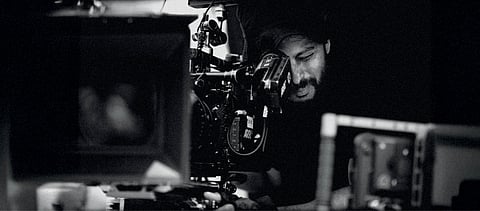


Cinematographer Amit Roy has lensed three kinds of iconic, angry Indian men — Amitabh Bachchan’s Subhash Nagre in Ram Gopal Varma’s Sarkar (2005) and Sarkar Raj (2008), Ranbir Kapoor’s daddy-pegged alpha in Sandeep Reddy Vanga’s Animal (2023), and this year, Shahid Kapoor’s rabid, anti-hero police officer in Rosshan Andrrews’s Deva. We often forget these characters that congeal in our collective imaginations are co-written not just by the writer, actor and director, but the cinematographer too. The camera can celebrate the very thing it can make you fear.
In the early noughties, Roy found himself in Ram Gopal Varma’s camp when he impressed Sajid Khan, one of the directors on Varma’s Darna Zaroori Hai anthology. This was how that episode, shot around 2003, was to begin: “It starts in black. As you zoom out, you hear sounds of laughter, and you realise you are zooming out of the mouth of Manoj Pahwa guffawing with laughter,” Roy tells The Hollywood Reporter India. An image, typical of Varma’s whimsy, at ease in his phantasmagorical filmography.
A “foreigner” DOP was consulted to make this shot possible. He said it could only be rendered in post-production, which significantly spiked the budget — which is sacrosanct on an RGV set, quick on its toes, light on the pocket. Khan then consulted Roy who, instead, suggested they use a particular filter — “only for ₹300”. Khan was shocked and amused by the results and relayed the news to Varma. The director was equally impressed and spoke to Roy about a film he had in mind, asking him if he would be interested. Roy asked him if he was directing the film. Varma said no, and Roy returned the reply. He wanted to be the cinematographer of a Ram Gopal Varma film, not a Ram Gopal Varma production. Note that Roy, a newcomer, had only just completed his first film as a cinematographer, the candy floss Ishq Vishk (2003). Where did this audacity come from? And where else does audacity hold a premium but in a Ram Gopal Varma office? Varma bookmarked Roy’s name, and years later, called him again, this time for a film he was directing — Sarkar.
Sarkar marked the beginning of a visual stamp that would render Varma’s films immediately identifiable. Why not, his images would ask, place a camera on the saucer of a cup while it was being sipped from? Why not shoot a face so invasively that it would disintegrate into its parts? “Varma is a great creative mind, and obviously, boredom creeps in. His mindset was, ‘Show me a shot I have not seen’, challenging both himself and me. A simple close-up becomes boring,” Roy notes.
Roy would often go off on his own and shoot the spaces they were filming at with just his camera and the jib (crane) — to see the way the light falls and folds. “He would explore the characters; I would explore the space.” Per Varma’s standards, a lot of the film was also improvised. “The famous hand waving shot was actually Amitabh Bachchan waving at his fans. I just had a zoom lens and rolled the camera.” It all came together in the edit.
With Sarkar, Roy’s success as a cinematographer in film circles was instant and unambiguous. “The week Sarkar released I got offered around 30 movies, at least 4 movies a day. I have never had that kind of reaction before or since.”
Later, with Sarkar Raj, he was pulled onto Sandeep Reddy Vanga’s radar. Enrolled in a film school in Sydney when the film released, Vanga took a two-hour bus ride to a remote theatre on the outskirts to watch it, two days in a row. A decade later, the director and cinematographer found each other, and Varma’s zoom agility was swapped for Vanga’s well-behaved, but disorienting angularity, where he likes to look characters straight in the eye, or shoot them completely in profile, a directness of gaze that is brazen, sharp and discordant. The movements are smooth, the lighting is clean. The climactic fight between the two men (Bobby Deol, Ranbir Kapoor) is so well lit, every expression on the face is catalogued, and the fight becomes as much physical and emotional.
While Sarkar and Sarkar Raj were mostly shot inside the “Sarkar mansion” — actually a school for visually impaired kids in Mumbai’s Jogeshwari neighbourhood— it is with Deva that Roy got to finally explore the city of Mumbai as a cinematographer. “Once you have a director who is visually ambitious, like Rosshan [Andrrews], like Ram Gopal Varma, like Sandeep Reddy Vanga, they will put their money where their mouth is, by hanging on, by coming back to the same location,” Roy notes.
Deva belongs squarely in the genre of “Bombay” films, where, through the story’s meanderings, the city unfolds — Hutatma Chowk, CST station, Dongri, Bandra-Worli sea link. Nothing north of Mahim, though, which Roy considers the edge of Mumbai.
As a cinematographer, some of these spaces are difficult to light. CST station, for example, has ugly LED lights outside that keep shifting colours, and opposite it, the BMC headquarters has similar lights of its own. It took the production team — line producers, location managers — months to sort out permissions so they could manipulate the lights of the buildings according to their palette.
The scenes shot in Dongri — a pivotal scene where a character is gunned down — were also logistically challenging. They had to return multiple times to get the shots they needed. “That scene took the life out of us. We have security and everything, but some security guard says something rude to somebody, and suddenly the entire neighbourhood is up in arms. It is a total bhai neighbourhood. There was a lot of tension. So, then, the neighbourhood bigwigs in pathani suits walked around the area just to show us everything was okay. It was so dramatic, like in a movie.”
Like any other being in the film, the city too gets muscled by the hero. Mumbai falls in line. Dev, the gangster cop (Shahid Kapoor), loses his memory, so Dev A, before the memory lapse, is shot in Mumbai’s harsh sunlight. “Right from the time you see Dev B in the hospital after he loses his memory, it is raining. You start going a bit bluer, more grim.”
Dev A is a person whose anger is, as one character notes, really his fear, which has turned him rotten. He is a hero but strikes such fear in the hearts of those he comes across, he is also a monster. Part of this comes from Kapoor’s feral performance; but part of this also comes from Roy’s gaze.
When asked, teasingly, with a hint of sincerity, if the low angles — in both Animal and Deva — are to bring out the taut, round asses of the men in tight, snug pants, he laughs and reveals: “In a low-angle lens treatment, he looks big, he looks larger than life. It is a fairly classic way of making the hero look substantive.”
This lens treatment changes as the film flips from Dev A to Dev B. “Dev A is lensed low-wide, 22–25 mm, because I wanted him to look bulked up and masculine. Dev B is more telephoto lenses, 40–50 mm, at eye level. I have lit Dev B softer, with less contrast. Dev A is always lit with hard cross-lights; you can see his sharp jawline, triceps and shoulders.” Triceps and shoulders under which the city is on fire. And when Dev’s memory returns, so does the harsh sunlight of the city — “subtly, not totally”. For what is a city, but a playground for the hero — muse to muscle with, muscle over, and eventually, muscle under. And what is a hero, but this muscle made manifest by light — light that cinematographers like Roy toy with, throw harshly or recede slowly. The hero is, after all, not a person, but an image.
To read more exclusive stories from The Hollywood Reporter India's March 2025 print issue, pick up a copy of the magazine from your nearest book store or newspaper stand.
To buy the digital issue of the magazine, please click here.