

Anees Bazmee loves movies as much as he loves himself. When he is writing his comedies, away from the gaze of impatient producers and much before stars assemble for his feature, he privately marvels at his skills. “My God, kya likha hai (what writing), Anees!” he tells The Hollywood Reporter India with a straight face.
This approach, Bazmee says, has helped him stay anchored through the fickle nature of the industry as he has mounted blockbusters like No Entry (2005), Welcome (2007), Singh is Kinng (2008), Bhool Bhulaiyaa 3 (2024) and faced lows with misfires such as No Problem (2010), Thank You (2011) and Pagalpanti (2019).
“The industry never lost faith in me, because they have all seen how hard I have always worked,” says Bazmee, who began his career assisting Raj Kapoor in the ‘70s and remains relevant today; his last film grossed over ₹400 crores at the global box office and his next, No Entry 2, is gearing up to go on floors.
In an interview with THR India, the filmmaker talks about his films through an ever-changing industry, which he has been a part of for over 50 years, and spills the tea on behind-the-scenes madness.
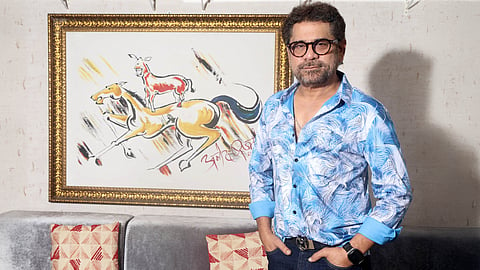
Every scene of Welcome is a goldmine for memes. The biggest of all is the iconic Majnu bhai painting, a donkey on top of a horse. Almost 20 years later, the image still enjoys a legendary status on the internet. Not many know that it was a last-minute painting by Bazmee himself, after his assistants turned up with other “excellent” paintings.
“I had worked with M.F. Hussain on the film Gaja Gamini (2000). He would draw horses a lot and I would just watch him. You can say, I am good at imitation. There were around nine paintings that were brought on set. The production controller told professional painters to make bad paintings. But even then, they looked good. I needed a bad one!”
Bazmee then thought there was “no painter worse than me” and asked for a fresh canvas. He first painted the big horse and then attempted to draw another one standing on top of him. But it got spoiled.
“It made me laugh and I thought this would look good in the film. Majnu bhai is not a great painter. Many of my assistants told me, ‘Don’t bring this art on camera, sir, it is bad.’ I told them that if they were calling this bad, this would be humorous in the film.”
The comedies that land well are often those where the actors aren’t insecure about their co-stars having the better punchline. In Welcome, Akshay Kumar’s Rajiv is a passive character, a timid man caught between two gangsters, Don Uday Shetty (Nana Patekar) and Majnu bhai (Anil Kapoor), who have bigger punchlines, while he remains the punching bag. Or in No Entry, where Salman Khan is the schemer and the rescuer, while Kapoor and Fardeen Khan keep getting entangled in marital (and extra-marital) problems.
How does he convince actors to trust his vision, especially with characters written to be the butt of jokes? The answer is simple. Bazmee says it’s all about communication.
“Akshay was a big star even at that time; he was doing big films. But I could communicate what I wanted from him in the film and he understood that. I think he felt that even though he had done such films before, this guy called Anees Bazmee knew this film a little better than we did.”
Bazmee’s career has been propped up by mass comedies as much as the actors who trusted him, even when his films weren't blockbusters. His directorial debut Hulchul (1995), with Ajay Devgn, wasn’t a big hit, but Devgn worked with him again on his second film, Pyaar To Hona Hi Tha, which turned out to be one of the biggest blockbusters of 1998.
“I had asked Ajay why he said yes, and he said, ‘What happened with that film was its fate, but I have seen how you work, why won’t I trust you?’” The filmmaker says ever since he wrote his first film, David Dhawan’s Swarg in 1990, he has never been worried about whether the industry still has his back.
“Films are about feelings; you make what you feel is right, so of course you can go wrong with it. But yes, every film I have made, I have been absolutely sure that they would work! I am always excited when I finish my script and tell myself, ‘My God, kya likha hai (what good writing)!’ Not in public, but I do praise myself a lot in private!”
Having helmed mostly large multi-starrers, Bazmee says that mounting entourage costs and interference from actors’ crews is a problem he’s faced only in recent years.
When mentioned how producers today talk about certain actors relying on the approval and feedback of their entourage to greenlight a script—over their own instinct—Bazmee said there are "some people" who are indulging in this.
"I think it is insecurity, which is why they turn to their makeup man or manager. I don't know how qualified they are to give input on films, but I feel stories are meant to be felt. If my gut tells me not to sign a film, I won't do it even if others tell me to do so. Everyone has a different way of working, but yes, this happens when the entire entoruage comes and sits for the narration."
The other industry issue has been the rise of production costs. Bazmee recalls filming a scene with 15 actors in No Entry and stepping off set during a break, only to notice a fleet of vanity vans. “I asked my assistant how many shootings were happening on the day, and he told me, ‘Sir it’s just us!’ I was shocked! I was told that everyone has separate vans. So I quickly rushed inside and said, ‘Ok, let’s start’”
When the art directors informed him that the props in the background were still not ready, Bazmee began filming close-ups of the actors, so as not to waste time and money.
“I had that awareness that cost is riding on me, so I will be economical. If I can make a film in 70 days, I will never extend it to 75 days. I will plan in a manner that I deliver, without compromising on the vision and getting into unnecessary reshoots. That doesn’t happen with me.”
The key is in being jugaadu, Bazmee says, about how one can keep costs in check. But what about actors who decide to throw tantrums on a set? Bazmee has a hack for that as well.
“Everyone has tantrums, but the key is to satisfy them. Actors are actually very innocent; they have childlike stubbornness. So you make them understand. If you do it well, the actors always get you. I have worked with some who are so smart that they get you, but of course, some are notorious, like every class has some naughty children! I talk to them lovingly and I do genuinely love them.”
After more than two decades of actively directing comedies, the filmmaker says making a film in this genre still remains challenging. Of course, one can keep the set under control, deliver within budgets, make the actors happy, assure the producers, but it all boils down to one thing: Will the audience laugh at your jokes?
“A great comedy is where you create a situation where the character is doing something seriously, but people are laughing,” Bazmee says. “The audience has obviously changed over the years; they were more innocent earlier, but now they are more aware and smarter. Of course they won’t laugh at the same jokes they did 25 years ago.”
Bazmee says the current times, especially, dictate that filmmakers be in tune with what the new generation is thinking and watching. Which is why his assistants, whom he calls “friends”, are in the age group of 22 to 25.
“You have to be as intelligent as them to write for them. When my assistants get a call and they go three steps away to receive it, I know exactly if they are talking to their mothers or girlfriends. There is no communication gap, which is why I am constantly updated.”