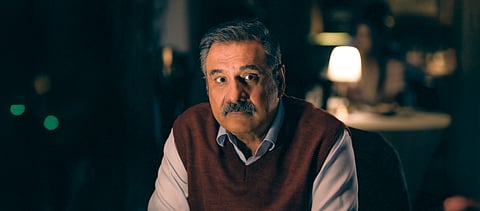


Boman Irani couldn’t be more pleased about his first directorial venture. After 24 years as a prolific character actor, he turns filmmaker with The Mehta Boys (2025), an intimate family drama exploring the volatile relationship between a father and son when the two are forced to spend 48 hours together.
Co-written by Oscar winner Alexander Dinelaris (Birdman), the film stars Irani himself alongside Avinash Tiwari, Shreya Chaudhry and Puja Sarup. After winning Best Feature Film at the 2024 Chicago South Asian Film Festival, expectations are high for The Mehta Boys which is set to premiere February 7 on Amazon Prime Video.
Excerpts from a conversation with the actor-filmmaker:
The teaser of the film reminds one of several coming-of-age dramas from the west; I particularly thought of Tim Burton’s Big Fish (2003) that also explores a father-son relationship. Can you mention some of the influences that made you write a film in this genre?
I've been watching all kinds of films over the years in the English, Hindi, international and regional spaces also, and some of my favourites were Kramer vs. Kramer (1979) and Ordinary People (1980), which incidentally was Robert Redford’s directorial debut. While there were so many other hard-hitting, gritty films and cop dramas that dominated the '70s and some part of the '80s, Kramer vs. Kramer was a film that always stayed with me; the subject was like a soap opera, but the way it was treated and written, and its understanding of the human condition... hit home for me.
Another one that stayed with me always was One Flew Over the Cuckoo's Nest (1975); all these were films that I watched at Regal Cinema in Mumbai over the years. When our film had its premiere at the same venue a couple of days ago, it felt like a homecoming.
But yes, while I’d like to believe that The Mehta Boys has its own voice, I have definitely been influenced by the works of filmmakers like Hrishikesh Mukherjee, Robert Benton and Miloš Forman.
Considering the subject matter, did your personal relationships with your own father or sons play a role in how you conceptualised The Mehta Boys?
Unfortunately, I had no equation with my dad since he passed away before I was born. So my connection on that side of the spectrum is non-existent; maybe I was looking for some answers myself while writing and directing this film. However, I do strangely have a good relationship with my sons. (smiles)
Of course, the story is influenced by the dynamic of the equation changing when boys who have a great relationship with their fathers want to feel independent, find themselves and become their own men. There is a little bit of a push back from them — and we wonder why they aren’t asking us questions or listening to us like they did when they were young. Are we getting too old? But what we don’t realise is that we are pushing them to be successful in a world where we have no idea what actually constitutes success.
We turn out to be a little villainous if we are constantly on their case; the intention is right, but the execution might be a bit archaic or unnecessary. You know, in the foundational years, if you have just given your children a certain amount of values, then nothing else really matters.
The other part of the story comes from the many interviews that I had done with many young men and women speaking about their pain and equations with their families. I truly enjoyed writing this film because I don't think it's only about fathers and sons at the end of the day; it's about relationships. It's about mothers and daughters, mothers and fathers, and daughters and fathers too. A girl told me yesterday that she hadn’t spoken to her father in ten years, and then just before he died, he called her and asked, “Why didn’t you spend more time with me?” She had thought that he didn’t want to see her all these years. This is the miscommunication I have tried to explore.
Did you ever think of casting your own sons in the film at any stage, or would it have hit too close to home?
No no, it never crossed my mind or my wife’s mind. So we knew we were doing exactly the right thing with the casting. And boy, there would have been fireworks on set otherwise! (laughs) Never ask a piano teacher to teach his son the piano; always send the son to learn from the dad’s friend. That’s the nature of the beast.
It’s been customary to see you act in seven to nine films a year constantly for the last two decades, but since the pandemic, it’s obvious that you have cut back. The Mehta Boys is just your sixth release in five years; was this a conscious decision?
Well, firstly, I did think it was time to take it easy on the movie front. Secondly, I became a grandfather, so I wanted to be with family because that period with your grandchildren will never come back again. And thirdly, I wanted to spend the time writing this film. Writing is the most exacting job really, and once you see The Mehta Boys, you’ll realise that there is not much fat in the screenplay at all; there are no unnecessary lines or scenes. Each time I wrote and rewrote the script, I was learning something new. I also had my friend and partner-in-crime Alexander Dinelaris who shepherded the whole thing, and wrote such wonderful stuff with me. But such collaboration and hard work does take time, and I was in no hurry at all. I wanted to stay calm, take care of my health, enjoy the process and ensure that the film struck a chord with the audience on many levels.
It’s always seemed like there has been a filmmaker inside you just waiting to get out and get to work. When and how did you decide to finally give it a go?
Yes, I agree that I’ve always wanted to direct. But then you turn around and ask yourself, 'What do I direct?' So then you find a subject and begin to write a scene; you think it’s great and then it turns out.. it’s not so great. So you go read another book, maybe attend another workshop, and then eventually a subject like this comes along at just the right time. I don't think 65 is the age to debut as a director for everybody, but it was for me. Everyone asked me why I became an actor in my 40s, but I think I came in at the perfectly right time which suited me. Similarly, I knew in my heart that this was the right script and subject, and it was ready... well, it never is ready, but you know that it's at least enough to give it a go.
Actors across film industries in India still cite you as one of the best examples to showcase that anyone can become an actor at any age; do you think it’s gotten easier in recent years?
I… am age-neutral; I really don’t think it matters at all what anyone’s age is. Who makes these laws and timelines? You can become whoever you want at any age.
But has it become easier to enter the industry now? Well, yes and no. There’s so much stuff being made, and with streaming, there are a lot more opportunities for newcomers and for other actors to come out of hibernation. But at the same time, it’s tougher to get noticed with everything swirling around and people consuming new content constantly. However, there is work and sometimes that's the most important thing. And if your work is really good, it will stand up.
What would you want the biggest takeaway to be for people watching this film?
Whoever has watched the film has called me up and said that the first thing they did was give their father a hug. That is absolutely great, but at the end of the day, what was more important for me was to make a film that was going to be remembered — with a script that is strong and muscular and keeps pushing itself forward; it’s not slice-of-life, it's a drama with conflict in it. So the aim was to deliver a solid film first and foremost; whatever comes out of that is a bonus.