

Truly, when did you become an adult? A logical answer would be when you turned 18. A political answer would be when you voted for the first time. But an answer with a ring of emotional truth would be when you were first confronted by the frailty of your parents, when you had to alchemise all that teenage rebellion into reluctant care. To be an adult is to find yourself, disproportionately, in the position of caring — for yourself, for your parents, for another. It is when you situate yourself in the world not as one, but one among many, the decentring of the self.
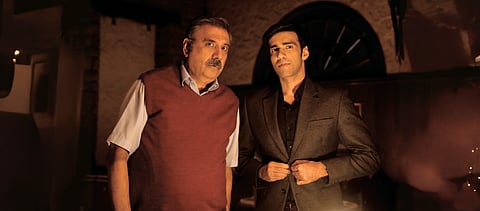
Boman Irani’s directorial debut, The Mehta Boys, a story of a sparring father and son, is, then, really about one man frustrated about relinquishing care, and another frustrated about taking on the responsibility of care — one sees it as a prized possession, and the other, a burden. The former is the freshly widowed Shiv Mehta (Boman Irani), an ageing man, grumpy, but just as easily given to joy, and the latter is his moping son, Amay Mehta (Avinash Tiwary), an architect living in Mumbai, away from his parents.
We see Amay first, waking up, eating the cold remains of last night’s dinner for breakfast, in a bed that also serves as a dining table and workstation. This is by no means a life worth fighting for, and yet, we find out, he fought his parents for this. His father, too, asks him later in the film, “[You fought for] this?” He has a good view from the balcony, but a hole in his ceiling. Dreams in Mumbai are best left dreamt.
Amay is struggling to tell his boss — an encouraging mentor — that his designs are better, more thoughtful and inventive than what the old guard has proposed. He has a supportive girlfriend, Zara Gonsalves (Shreya Chaudhry), who also works at the architecture firm. The question that circles his character — why is he like this, then, mousy and uncertain?
Like the predictable hum of a rote-learned therapist, the narrative asks: What about daddy? And the wound takes centre stage in the shape of Boman Irani as Shiv, who needs to be taken care of after his wife passes away, being shipped off to live with his daughter, Amay’s sister, Anu (Puja Sarup), in Florida. Anu is the mediator, both between father and son and India and America, her accent quietly switching, not as an inconsistency, but as traces of one culture being painted on another. It is, perhaps, one of the few perfections of the NRI way of speaking we have seen, alongside one of the few perfections of the father figure reluctantly embracing this NRI identity. A swirl of incidents causes Shiv to spend a few days living with Amay, in Mumbai, before he takes his flight for Florida. Before it heals, the wound first festers.
And suddenly, Amay’s timid personality clicks into place. He makes sense. But, really, if you dig deeper, he doesn’t. The film is so certain of its cause and effect, so certain, in fact, it doesn’t even state it. In one of the most assured decisions Irani makes as director — and Alexander Dinelaris as co-writer — there is no flashback, no neat explanation of their fraught relationship. But by stacking the film the way it does — all the kindness in the world on the one hand, the father’s barbs on the other — it really does not need to. The illusion is secured, we now know Amay. Even Zara, a character who is more shoulder to rest on than person to be with, is etched with a quirk that gives you the illusion of knowing who she exactly is — whenever a waiter comes, she reads his badge, and insists on calling that person by their name. Remember the advice Munna gave in Lage Raho Munna Bhai about knowing a man by the way he calls out to the waiter? These are ways stories ring as true, by being half-true.
If Irani has the face of the father — brittle, unforgiving, but when pressed, soft wax — Tiwary really has the “Imtiaz Ali film” face, always searching, always innocent, but not really searching, not really innocent, and of course, an emotional brokenness that is held not as a wound but a prize. It is a face that brings the full force of trauma to the surface. Thank god for the gentle tone of the film — for the most part — this surface never gets to explode too much.
Because when it does, the scenes play out not as a disruption but as discordance. This is the problem of tone The Mehta Boys suffers from. Its conversational pace — full of unresolved moments that circle outward into chaos rather than inward into coherence — is suddenly set aside to give space to moments of unbridled rage, to clumsy incidents that set the stage for rage. This rage, Amay’s that is, rings false, because the film so far has given us the illusion of a man incapable of expressing himself. Then, to see him express himself so bluntly, so fully, feels like seeing an alternative version of this character play out. To see the soft but troubled tone of the film swerve into a formulaic arc searching for narrative catharsis is to see a Piku become a Paa. For a film with the sure-fitted maturity to step away from an expository flashback to give us a climactic speech is to see a film’s soft edges harden.
And yet, the picture that emerges is of a heart coming full circle. Cinematographer Krish Makhija’s bracing close ups that almost rub up against their faces keep these characters in your centerfold, his smooth movements directing your emotional tanlines — keep an eye out for a camera move that begins from behind Zara, towards Shiv, then tilting, towards Amay, as he watches his father speak of the first time he fell in love with his mother. Something melts. When you state with softness, and lens with thought, something always does.