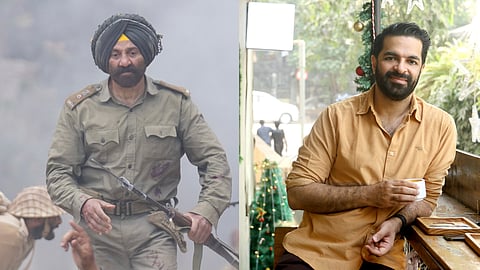


Most people go to cafes for good food and ambience. Sumit Arora heads to cafes and comes back with a hit film. An early-morning ritual of scrambled eggs, toast and coffee has, more than once, sparked career-defining ideas for one of Hindi cinema’s most in-demand screenwriters who went from the teen sensation TV show Dill Mill Gayye in 2008 to a blockbuster run, writing dialogues for Stree (2018), 83 (2021), Jawan (2023), as well as streaming crowd-pleasers such as The Family Man (2019) and Dahaad (2023).
As he awaits the release of the patriotic drama Border 2, Arora chats with The Hollywood Reporter India about his writing journey, and how some of his most popular lines were born in a cafe.
Edited excerpt from the conversation:
THR India: What did you keep in mind while writing Border 2, and how long did you take to write the screenplay and dialogues?
SA: We (me and Anurag) took around six to eight months in total after the initial groundwork. But a script is a constantly living thing till the scene is shot. So the work actually ends only when the shot is taken.
I saw the original Border as a kid in Meerut and to access that memory, of that kid watching the film in a packed theatre, and what I felt as an audience, was a very important part of the process.
When the original still remains a landmark film, what were the challenges like with the sequel?
To live up to its legacy. To make sure that people who love the original go back home satisfied after watching this one.
When you know that your lines will be spoken by someone like a Sunny Deol, does it help to write accordingly?
It’s a privilege and a challenge at the same time to know that your lines will be spoken by a legend like Sunny sir. We have all grown up watching and repeating his lines. He is known for his dialogue delivery and we had to make sure that the dhai kilo ka haath halka na pade (a reference to Deol's iconic line from Damini). And Sunny sir, of course, brings so much of gravitas to every line that you give him. He is an icon for a reason.
You’re known as the guy permanently found in an Andheri (Mumbai) cafe, which is where you were “spotted” by (producers) Raj and DK...
That’s true. There were two cafes I frequented, Silver Beach and Potluck, both in Andheri, right next to where I lived then. I was transitioning out of television and writing my short film, and Potluck became my workspace. I was writing Selection Day (Netflix) at that time, when filmmaker Amar Kaushik walked in and told me he was working on a new film produced by Raj & DK. Guess what that was? Stree! He asked me to write a sample — about 15 pages — and that’s how I came on board, around 2017.
What did you write there?
I wrote a large chunk of Stree, including some of the most popular lines, before the cafe shut down. The sample that was approved was the scene with Vicky (Rajkummar Rao), Bittu (Aparshakti Khurana) and Jana (Abhishek Banerjee), who says the now iconic line, “Bicky pleej!” It was also the same place where I wrote, “Woh aaj ki stree hai, who kuch bhi kar sakti hai.” After we finished, in the same cafe, Raj and DK told me about their next project, The Family Man.
What’s the story behind the cafe we’re in right now?
I like this place, Grey Soul, because it’s quaint and gives me a homely vibe, unlike the big corporate cafes. My usual order is the mezze platter along with a cappuccino. I wrote some bits of my directorial debut here and portions of Border 2.
Which was the Bandra [Mumbai] cafe that led you here?
Bagel Shop. It was my favourite cafe for years. I wrote a lot there — parts of Jawan, Guns & Gulaabs, and Chandu Champion. I wish it would reopen soon; I’d go back in a heartbeat!
Why do you find writing in cafes so calming?
I get bored writing at home after a while, so I need an energy shift. Writing is a solitary life, and cafes give me a blend of comfort and natural chaos. I’m not looking for inspiration, but the ambience helps. I need warmth. Even in a chaotic cafe, I slip into a zone. I’m not observing people or soaking in “vibes.”
Many writers follow rituals — music, scents — to get into a zone. Do you have any quirks?
Not at all. My writing has always come from an internal space. I’ve been writing since I was 13 or 14, and it emerged from my environment. Growing up in a lower-income household in Meerut, surrounded by limitations and people with real struggles and aspirations — those experiences shaped my worldview and my writing. I never relied on external triggers to write.
So, you write in chaos?
Absolutely. I grew up around chaos — financial, emotional, spatial — so I’m used to it. I think I even thrive in it.
What’s the most unlikely place you have written a film?
It was a 10-day silent retreat, and they didn’t allow any writing material. I snuck in a tiny notepad, the size of a small calculator, and I told myself I wouldn’t use it, but after five or six days my mind was buzzing with ideas.
One night, when everyone was asleep, I took it out, switched on the small torch they’d given us, and wrote a scene under my blanket. It turned out to be one of the best scenes in the film I’m working on!
Do you have a fixed writing schedule?
I don’t keep fixed hours like “10 to 2,” but I do need to write every day. I have to put in at least three to four hours. Otherwise, I feel restless at night, like I haven’t done my bit, my “dharma,” so to speak. I prefer writing between midnight and 4 a.m. — it’s flexible because of travel and shoots, but the daily writing is non-negotiable.
1. Know where your characters come from
2. Know what drives them
3. Know what haunts them
4. Know how their relationships impact them
5. Know what their want is in each and every scene
To read more exclusive stories from The Hollywood Reporter India's January 2026 print issue, pick up a copy of the magazine from your nearest book store or newspaper stand.
To buy the digital issue of the magazine, please click here.