

For much of his career, Shahid Kapoor says he has been chasing two things at once: The satisfaction of doing good work and the validation that comes from seeing it embraced by a wide audience. Now, he wonders whether that pursuit has cost him more than he realised.
There is no self-pity in the reflection, nor any attempt to rewrite the past. Instead, Kapoor speaks with honesty about how the last few years have forced him to reconsider old instincts, rethink how he chooses projects and accept that even after two decades in the business, there are still things he doesn’t fully understand.
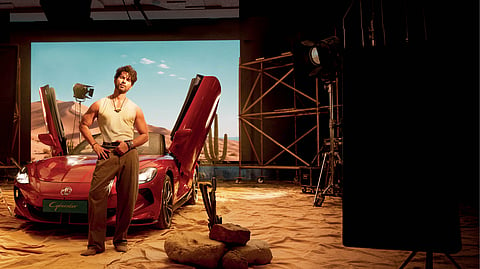
We caught up with Kapoor at the Four Seasons Hotel Mumbai, as he posed for the cover of The Hollywood Reporter India against the stunning new MG Cyberster.
Ahead of Cocktail 2 and while finishing work on the next season of Farzi, the actor spoke about reinvention, disappointment, the lure of stardom and why learning remains his favourite part of the job.
Edited excerpts from the conversation.
THE HOLLYWOOD REPORTER INDIA: You and the rest of the Cocktail 2 cast are looking incredibly hot in the film. Does Homi Adajania just say, ‘Be hot’?
SHAHID KAPOOR: You also have Anaita [Shroff Adajania]. Homi is more like, ‘Have a hop and a skip in your step and be happy and bubbly’. Anaita is more like, ‘Just look sexy, guys’. So yes, that brief does exist.
THR INDIA: How do you do it?
KAPOOR: I don’t know how to explain how to be sexy. If a film requires you to look a certain way, you do the work. But I don’t think you can ever try to be sexy. When you’re feeling good, when the energy is right and you’re surrounded by good people, it comes through naturally. You can’t manufacture it. What excited me more was the character. After a very long time, I’m playing someone who isn’t alpha, edgy or morally grey. He’s warm, relatable and genuinely likeable. Initially, I thought I’d get bored because I’ve done this space before, but I was also getting tired of constantly playing complicated characters.
The last time I really visited this genre was around Jab We Met (2007). Homi pushed me in a fresh direction. His take on relationships feels natural and believable. He looks for reality in people rather than broad characterisations, and that helped me discover something new.
THR INDIA: What was the artistic risk in returning to this space?
KAPOOR: The risk is repetition. People might say, ‘We’ve seen him do this before’. Sometimes actors look completely different because everything around them is different, but the performance itself isn’t necessarily changing so much.
For me, the challenge was the opposite; doing something familiar but finding a different way into it. Homi came in without being influenced by my previous work. He had a very personal understanding of the character, and I submitted to that from day one. That helped me find something fresh.
THR INDIA: Your recent performances in Deva (2025) and O' Romeo (2026) were praised even when the films themselves didn’t work. How do you process that and still give the next project everything you’ve got?
KAPOOR: You go through different emotions. Some days you’re fine. Some days you don’t know how to feel. When you’ve worked for so long, you expect to get it right more often, but that’s not how films work. They’re incredibly unpredictable.
As an actor, you control only a small part of the final result. Cinema is collaborative. The director has to be happy, the producers have to be happy, everybody has to feel satisfied. The one thing I do tell my team now is that maybe I should not be deciding on my scripts.
THR INDIA: Really?
KAPOOR: Very openly. Maybe I know exactly what to do in front of the camera, but maybe I don’t always know which films to choose. I used to insist on hearing scripts alone. I felt that if I connected with something artistically, I should do it. But I’ve changed that after my last couple of films. Now I want other people in the room. Sometimes, if you have a vivid imagination, you can see a film in your head that may never actually exist.
We don’t know exactly where the audience is today. The industry is going through a churn. Look at us, we live good lives. We’re stars, we live in good houses, we sit in good cars, we get to wear nice clothes. So, if there is a rough patch and we have to figure it out a little bit, it’s an opportunity to go back to the basics. Start learning — and learning is my favourite part of life, and of this job.
THR INDIA: Has the industry’s obsession with the ₹1,000-crore benchmark changed the way actors think about success?
KAPOOR: I think we’ve moved beyond a phase where actors can claim all the credit for a film’s success. Producers are hugely important. Visibility is expensive. A lot of what appears organic today isn’t organic. Everybody is spending money to be seen.
We need to be able to break genre. We need to be able to give the audience different genres that work. It’s like we’re cooking one dish and there are four or five cooks who are making the same dish in their own way, but the dish is the same. So, at some point, you’ll need to find a new dish, a different cook who cooks a different kind of meal and gives the audience a break. And actually, when a different genre does well, it helps the other genres.
THR INDIA: You don’t take on the pressure of that ₹1,000-crore figure?
KAPOOR: I’ve never reached that number, so why would I take the pressure? That pressure comes with success. If you’re wearing the crown, you’ll feel its weight. Right now, I’m figuring out how to get my next genuinely successful film. In some ways, that makes me feel lighter.
THR INDIA: Do you think actors are more insecure today than they’ve ever been?
KAPOOR: I can only speak for myself. My last couple of films may not have worked, but I’m not any more insecure than I’ve been at other points in my life. Generally speaking, when success and failure become unpredictable, people do get more insecure. That’s human nature. But I also don’t believe everything I hear. Unless I was in the room and saw it happen, I take things with a pinch of salt. The negativity comes with the job. The fame, the money and the love come with a darker side. That’s the balance. Today, people can see through constructed personas very quickly. I think artistes should be comfortable showing who they really are. Even if you’re imperfect or insecure, let people see it.
THR INDIA: Martin Scorsese said that artistry requires a certain cruelty. Do you agree?
KAPOOR: Excellence requires sacrifice in almost every field. If you’re trying to achieve something exceptional, you’ll inevitably push yourself and sometimes the people around you. The real question is, how much of that is acceptable?
I’m definitely harder on myself than anybody else. And by extension, I can be hard on others too. That’s something I’m actively working on. I don’t want to lose the pursuit of excellence, but I also don’t want to create unnecessary friction. That’s a challenge I deal with every day.
THR INDIA: You’re an avid biker. What does riding give you?
KAPOOR: Focus. When you’re on a sports bike, you have to be completely present. One mistake and the bike will throw you off. That kind of hyper-focus is incredibly liberating because you’re not thinking about anything else. I’ve always loved it. I started riding when I was around 18 and I’ll always be a biker at heart.
THR INDIA: Your IMDb page has a long list of projects in development.
KAPOOR: IMDb should call us and ask. We’d happily tell them what’s actually happening!
THR INDIA: So, what is happening?
KAPOOR: Cocktail 2. Then I finish the next season of Farzi. I’ve shot around 60 per cent of it and should wrap in September. After that, I genuinely don’t know.
THR INDIA: Is that unusual?
KAPOOR: I think it should be normal right now. I don’t want to jump the gun. What hurts me the most is when audiences leave the theatre unsatisfied. They didn’t buy a ticket to watch my performance. They came to watch a film. If the film doesn’t land, then at some level I’ve failed too.
THR INDIA: Is that also because the scripts aren’t good enough?
KAPOOR: Itna bhi nahi bolte na, yaar (let’s not go that far). People are trying to write better stories. We went through a phase where we were only making remakes and franchise movies, and I’m sure there were writers out there with good content who got tired and just left. I mean, a writer doesn’t get paid that much money. Writers have to survive too. At some point, either they start giving people exactly what they want or they walk away.
I’m listening to things, but I’m not in a rush. I like working. I’ve been doing it for too many years, so I think, ‘If I’m not on a set, who am I?’
Transcription by Asrath Upreti and introductory text by Urvee Modwel.