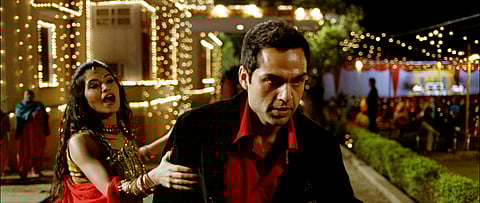


In 2009, when Dev.D arrived in theatres, it didn’t feel like a film so much as a glitch in the system. A punk remix of Devdas, it swapped chandeliers for cheap neon, tragedy for bad decisions, and turned heartbreak into something you could almost smell—alcohol, sweat, and ego.
Seventeen years later, as it heads back into theatres, the film has aged into what people like to call “cult.” Which is polite shorthand for: it confused everyone at the time, and now everyone claims they always loved it.
But if you ask Anurag Kashyap today, the real story is less romantic. “Today… Dev D can’t be made. The authenticity is what makes people uncomfortable. If it’s inauthentic, you will get away with it,” says Kashyap.
And that, perhaps, is where this oral history begins—with an admission that something about the ecosystem that allowed Dev D to exist has shifted. Maybe vanished.
The origin story of Dev D sounds suspiciously like a drunk idea that stuck. Abhay Deol remembers it clearly: a hotel, a match on TV, and a story he pitched without naming it. “I basically contemporized Devdas. I didn’t tell him it was Devdas. I just narrated a love story… and he didn’t put two and two together,” says Deol.
Kashyap, on the other hand, was coming off a losing streak—films shelved, banned, or ignored. “I was in survival mode… I said, okay, the best love story is Devdas. Everybody loves Devdas. I’ll give you Devdas with lots of great music.”
Somewhere between Deol’s instinct and Kashyap’s desperation, a third force entered: Vikramaditya Motwane, who, by Kashyap’s own telling, actually loved the original novel. This was not a minor detail. Motwane adapted Devdas faithfully. Kashyap took that script and, in his words, “did whatever I wanted to do with it.”
Which is how a 1917 novel about feudal heartbreak became a film about MMS scandals, cocaine, Delhi nightlife, and a BMW hit-and-run—a reflection of the India of the early 2000s, when mobile cameras had just begun to ruin lives.
If Dev D feels like a collage, that’s because it is. Kashyap describes discovering underground music in New York—especially the Sunny Jain collective—and wanting a similar sound. That impulse led him to Amit Trivedi, then an unknown. “Amit got back to me with some 8 tracks… I was like, I’m going to use all of this,” says Kashyap.
The result: an 18-track album that jumped genres with reckless abandon and went on to win a National Award. The film itself followed the same logic. Nothing was too precious. Everything was usable.
A chance encounter in London led to the inclusion of the Twilight Players. A lack of money led to production design hacks—Heavy Metal magazines blown up into wallpaper. A DSLR experiment by cinematographer Rajiv Ravi created the film’s now-iconic visual texture. “We had no money… so we started filling the frames with anything from anywhere,” says Kashyap.
If there’s one role that defines Dev D, it’s Chanda. But casting her was more of a last resort. “We couldn’t find an Indian actress who was willing to play the role… they were offended, upset,” says Kashyap.
Enter Kalki Koechlin. Kashyap initially resisted. “She doesn’t speak Hindi, how can she be Chanda?” She got a month and a half to learn the language. She did. The rest had to be rewritten around her—literally. “I was constantly figuring out how to justify her being Indian… so we made her mixed parentage,” says Kashyap.
Koechlin, for her part, approached the role like an overachieving student. “You could have woken me up at 2 AM and I would have said my lines… I was so worried about my Hindi,” she says.
And yet, the key to her performance wasn’t emotional prep. “I never practice emotions… that depends on the day, the co-actors, the weather,” she says.
The breakthrough came not on set, but in a mirror. “I remember the makeup test… and thinking—this is a disguise. She’s playing roles all the time.” Which is how Chanda became a series of performances within a performance.
There is a scene in Dev D where Chanda performs phone sex in multiple languages—French, Tamil, English—switching personas like radio stations.
Who came up with it?
Depends on who you ask.
Koechlin says: “That is something I improvised based on the languages I knew.”
Kashyap says: “Yeah, because she spoke all those languages… I just totally improvised, used everything she did.”
Deol says:“ I was uncomfortable with the idea that she was having sex with someone else right before me. So I said—what if the moaning is actually her on the phone having phone sex… and that made it work.”
At this point, it’s safe to conclude that Dev D was such a collaborative process that everyone seems to be claiming the same scene. Which, frankly, feels on brand.
If the film feels lived-in, that’s because the crew quite literally lived in it. “We were all staying in one shady hotel in Paharganj… everyone ate together, hung out together,” says Koechlin. It was, as she puts it, “very theatre-like”—a rarity in cinema.
But not every day was a party. Her first shoot—in a village outside Chandigarh—was disorienting. “I felt very lost… I didn’t know where I was, what I was doing.”
That isolation, she admits, fed directly into Chanda’s loneliness. Meanwhile, Mahie Gill had the opposite experience. “We shot in Chandigarh, which is my hometown… the character of Paro is a lot like me.” Her biggest moment—the spontaneous dance in “Tauba Tera Jalwa”—almost didn’t happen. “I was like, the bride shouldn’t be dancing… but Anurag was adamant,” says Gill.
The audience, as it turned out, disagreed with her.
For Deol, Dev D wasn’t just a role. It was a slow bleed. “I wasn’t experienced enough to not take my work home… it affected me way after the shoot.” The character’s self-destruction seeped in. “It took time to realise I’m getting affected… and that’s not healthy.”
His Dev wasn’t meant to be romantic. “He is a misogynist… but he’s romanticized. So let’s not romanticize him. I wanted him to be a character you could smell,” says Deol emphasising on the disgust he wanted to evoke.
Instead, the film did something radical for mainstream Hindi cinema at the time: it gave Paro and Chanda agency.
Everyone who worked on Dev D remembers the same thing: nothing was fixed.
Scenes were rewritten mid-shoot. The ending changed halfway through. “If again the same thing happens and the guy doesn’t learn… there’s no point making the film,” says Kashyap.
Whole sequences were built and discarded. One elaborate (and expensive) set piece—Paro turning into a goddess in Dev’s hallucination—was shot and then cut. “It cost us 5 lakhs… and we removed it,” says Kashyap.
Crisis wasn’t an obstacle. It was the process. “We try to turn crisis into opportunity,” Kashyap says with a laugh.
The night of the premiere at Chandan cinema has already entered film folklore. The invite came with a miniature vodka bottle and a condom. Mid-premiere, the first review dropped: five stars.
Kashyap called Motwane immediately.
It did not go well. “He abused me… said shove it up your ass, all the 5 stars,” Kashyap recalls.
Motwane, unhappy with the altered ending, didn’t even attend the screening. "I remember there was a power cut at the premiere. I just walked off. I was very pissed off. I was so steeped in the story of Devdas after I had assisted Sanjay Leela Bhansali on his adaptation that I couldn't understand why Anurag would change the story," says Motwane.
Years later, he would reconsider. “I was wrong… and I’m happy he chose the way that he chose,” Motwane tells The Hollywood Reporter India.
If Dev D is about anything, it’s about bad decisions that make sense in hindsight.
Dev D was stitched together from the anxieties of a very specific India: MMS scandals, urban alienation, new money, new media, and a generation figuring itself out in public. It was also polarising. “Men hated it, women loved it,” Kashyap recalls.
It made modest money on release, but slowly built a reputation as something else entirely—a turning point, a provocation, a dare.
Kashyap’s answer is blunt: the system has changed. “Even Sacred Games won’t be possible today… the authenticity makes people uncomfortable.”
Deol disagrees—gently. “That’s his perspective… someone else might come up with something relevant for this time.”
Maybe that’s the final contradiction at the heart of Dev D. It was born out of friction—between collaborators, between eras, between instinct and structure. It shouldn’t have worked. It barely held together. And yet, here it is. Back in theatres. Still messy. Still alive.
Still, somehow, everyone’s film.