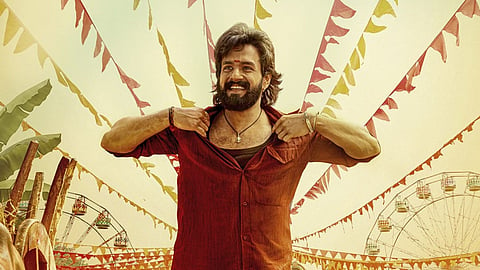


The success of the recent Telugu film Lenin is quite special for actor Akhil Akkineni. The actor, who returned to the big screen after a three-year-long hiatus, has come back not just with his career-best commercial hit, but also with a repurposed sense of drive.
Produced by Akkineni Nagarjuna and Naga Vamsi, the charged actioner with a side of romance has made a dent at the worldwide box-office, also making sure its exhibitors and distributors recover their investments well within the opening weekend.
In an exclusive interview with The Hollywood Reporter India, Akhil Akkineni opens up about the emotional moment he shared with his father after the film's release, why the team was careful not to oversell Lenin, and how injury, life and a series of deliberate choices helped him slow down and find clarity.
Excerpts from an interview:
Lenin has emerged as one of your biggest hits. How do you look at this moment?
I think there's just a lot of relief because there have been many people who believed in me and wanted this sort of box-office success for me for a long time. I've tasted a little bit of it in one or two films, but it didn't go as big as this one. I can see the relief in the people who believed in me. I'm not jumping for joy yet. My wife and my family are asking me why I'm so calm, but I'm just relieved for all the people who wanted this.
You shared a very emotional response with your dad at the studio right after the release. What does success mean to him and the two of you together?
We don't really share those moments at home, and it happened very organically there. It sank in when we all met up at the studio. The team was overjoyed. There's probably a buildup of 10 years of me not getting to where I want to be. Hello (2017) and Most Eligible Bachelor (2021) are two films that are very dear to me, but I did not see this sort of response for them.
We work very hard to ensure every film is received like this, as this is our ultimate goal. But when it happens after a long time, there's a certain flow of emotions that comes in. And as a father, I guess he also had bottled up some of his emotions over the last decade. He hasn't shown it to me as he's always been very supportive, but when it finally happens, you get a little soft and warm.
Producer Naga Vamsi recently spoke about how the team was always conscious of ensuring the distributors and exhibitors made a comfortable profit. How important was that consideration?
Mass films typically do well, and if the content works, it garners some hype. The opening weekend can get big. But what that makes producers do is sell it in bigger numbers to the distributors, which takes the latter longer to recover. When we came together as partners, I remember my father saying one thing clearly: 'We're making a mass film. We're coming after a long time; Akhil needs to give back as the market has taken a hit when some of the movies haven't worked." We wanted to build a market in a healthy partnership with the distributors and producers.
They were very clear about this. If distributors make money, my market will automatically increase. It was all a strategic and healthy business decision that it was better for the ecosystem. We had an opportunity to oversell the film because the content and the trailer had worked. We got some positive interest in the film, and my father and Vamsi very rightfully stuck by their word and did not oversell the film. They humbly sold the film so that everyone could recover their investments and make a profit.
The treatment of your character in Lenin was a largely refreshing outlier. He is a soft, vulnerable man who goes to war for love. Do you think the definition of action heroes is changing today?
The definition of right and wrong, the hero's graph, and how the hero should be, has changed. It should change, and never go back to what it was until the audience wants differently. Right now, the perfect hero is not something the audience wants to see. They need to have relatable human flaws.
When it comes to fighting for Bharathi [character played by Bhagyashri Borse], Lenin is ready to give up his life, but he couldn't do it [stand up for their love] with his own best friend. Now we aren't judging whether what he did was right or wrong, or if he was the man he should've been. We are telling a story very honestly. It's more relatable when we stop making our heroes this perfect demigod.
You’ve been very frank about your journey, acknowledging that you learnt from your mistakes. Could you speak about how important that was for you?
It's been tough, but it's also been beautiful. I got married and found my partner. But professionally, it's been quite a long journey. Every time I've tried really hard, it's backfired on me. Every time I've made a small positive step, it's worked out. When we made Bachelor, if I'm being honest, I wanted to do something bigger with it. But the film became my biggest hit in terms of numbers and reviews. It was my most successful film until Lenin.
Along the way, I understood that it's not just about what you want to do, but it's about what's right for that moment. Sometimes when I've over-revved my engine, even if it's been with Agent, the wheels have spun out of control. Lenin was something fresh and new, but within the commercial boundaries.
In this journey, it's important to also know where I want to be five years from now. This year marks one step closer, so I need to be clear on that path. I need to be aware of what the audience is expecting as well.
That's some solid clarity to navigate this with...
It's come with a lot of bad decisions. (laughs)
Did the break also help with a lot of direction?
Yes. The break, my marriage, and my injury slowed me down in the right way. I am an "over-hyper" and active kind of person, whether it is in sports or my profession. I had some time to see how to channelise my energy, and I think that helped a lot.
I had this extreme hunger to perform, and I needed to understand how to release the energy into my performance in the most efficient way. Then came the decision of picking the right script. Basically, me being real with myself also helped.
You said the comeback has been good, and I agree. It feels like a redemption for a lot of people, but that also empowers me to speak about what I've been through. It empowers me to be even more open because my journey is my journey, and that's why the comeback was strong. I have no regrets, I've learnt a lot, and I'm trying to learn more.
Everything is about taking momentum and moving forward. I shouldn't even be holding on to Lenin for too long. It's doing its thing right now, people have accepted it, and I'm really happy and proud.
But come August 1, I should move on and try something again.
Was there a palpable moment post-release when you felt the film was really taking off?
Everyone decided to give Lenin a chance because somewhere they saw an honest attempt at a cinematic experience. They're not coming to see a regular formatting of stories or hero worship. There was genuine hard work behind the film, and I think it was visible to the audience.
I said in one of our success meetings that I was scared that Lenin would be carrying my [earlier] baggage.
I was scared that it would not get a good opening, but clearly the baggage was left way, way behind.
Can the film also be read as an extension of an 'Akhil 2.0' journey, as a few are pointing out?
It does feel like I'm starting my journey right now. (smiles) I always wanted to be part of cinema like this. Even if you see my previous attempts, I wanted to be part of something big. Whether it failed or not, I like the larger drama and the larger-than-life new stories. This is the new commercial cinema that I want to dig my claws and teeth into. I hope I'm Akhil 3.0 the next time we speak after the release of my next film.