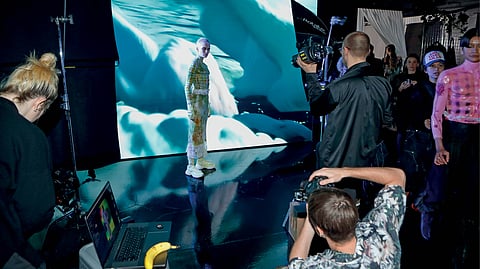


“Clients used to send me a Pinterest board and pray I could read their minds,” says photographer Sasha Jairam. “But now? They feed a prompt into an AI generator, get back a fever dream-like image of a model floating in liquid, neon mercury with 14 toes and say, ‘Make it look like this… but natural’.”
Jairam, who has worked with celebrities such as Ananya Panday and brands like indē wild, says her job now involves as much expectation management as photography, especially when clients treat the laws of physics as optional.
The anxiety isn’t new. “More than a decade ago, Photoshop caused an epistemological crisis,” Aperture noted in 2026, tracing how extreme retouching first taught the public that images could lie. AI has simply made that lie easier to manufacture.
In April 2026, Pakistani label WajAyesha Clothing used AI-generated images of Alia Bhatt, retaining her likeness while swapping her outfit, to showcase a new collection. Two months earlier, Gucci faced backlash for AI-generated images promoting its Milan Fashion Week show. And in 2019, Bella Hadid appeared to kiss the AI-generated influencer Lil Miquela in a Calvin Klein campaign The Guardian called a “terrifying glimpse into the future”.
That future has arrived.
Commercial fashion has always played with perception, but generative AI has changed the scale and speed of the manipulation. For everyone involved — models, photographers, stylists, brands, set designers, agencies — the question is no longer how to create an image, but where to draw the line between enhancing reality and inventing it.
“People are already getting sick of [AI],” says Dabboo Ratnani, one of Bollywood’s best-known commercial photographers. He finds it useful for product shoots but restrictive when shooting people. “The joy and the mood,” he believes, can never be generated artificially.
Unlike Jairam, Ratnani finds AI-generated client references useful because they clarify expectations. He keeps editing minimal for the celebrities he shoots, who are already familiar from paparazzi photos, fixing lighting or stray hair is one thing; inventing a sunset is another. He’s comfortable generating backgrounds for time-strapped brand shoots, though editorials, he feels, still benefit from real locations and light.
Jairam agrees AI makes ambitious concepts affordable. “Want a high-fashion editorial on the rings of Saturn with a budget of $500? Previously impossible. Now you shoot the model in a Brooklyn studio and generate Saturn behind them.”
For Ratnani, the bigger concern is credit and copyright. “Many times, I see a picture of an actor and the face looks like my lighting, but the body is from another photographer’s picture,” he says. Jairam expects transparency to become a badge of luxury, saying, “Consumers aren’t stupid, and deceptive marketing is tacky.” She believes creative credit belongs to whoever brings the taste.
AI is the brush, she says; you don’t credit the paintbrush at the gallery opening.
Stylist Divyak D’Souza, who dresses Kareena Kapoor Khan, Hrithik Roshan and Farhan Akhtar, uses AI apps to sharpen mood boards for advertising jobs — a quick way to communicate ideas, though one that still needs a human conversation around it.
“A stylist’s eye comes from understanding proportion, personality, references, culture, clothes, context — and the tiny details that make an image feel intentional,” he says. “It’s also about knowing what not to put in the picture. AI can give you 100 options; a stylist’s job is knowing which one is worth pursuing.”
The bigger shift, he says, is that planning now starts with imagination rather than production. “Earlier, you asked, what can we physically make, source, build or shoot? Now you visualise first, then figure out if you need to produce it at all. When everyone has the same technology, the differentiator becomes the idea, the taste, the point of view.”
At Dentsu India, a majority of first-pass visuals and model outfit renditions are now AI-led, says Abhinay Bhasin, executive vice president of product and technology, helping teams explore casting, locations and concepts virtually, and sometimes generate the finished product. But brief, brand nuance, cultural context and art direction remain people-led.
“It empowers our talent to think beyond the brief, without the practical constraints of cost,” he says, pointing to tools like Dentsu Product Intelligence and mugen.ai, and to brands such as Zara and Tapestry using AI for virtual try-ons and ideation while creative teams hold on to brand identity. “AI will help fashion advertising generate a greater breadth of outcomes, but human talent will be better placed to generate meaning, direction and depth,” he says.
Ava Alloo, executive director at talent agency Inega, is drawn to faces with something distinctive. “It’s less about seeing a beautiful face and more about seeing what that face could become. You have to imagine how they will photograph, move, and respond to light,” she says.
As AI makes technically perfect faces easy to generate, Alloo believes individuality becomes harder to automate. “A real person brings something that cannot be generated: presence. A beautiful face is no longer enough. Brands are looking for identity, personality, perspective; someone you remember after you’ve seen them.”
AI can expand possibilities, she adds, but fashion has never been only about the image. “It is about the person behind it.”
Model Avanti Nagrath, who has walked for Versace, Dior and Sabyasachi, sees AI mood boards as useful starting points but believes a reference should inspire rather than dictate the final image. “Some of the best photographs happen when you leave room for spontaneity, and that’s something you can’t always plan into a generated image,” she says.
Nagrath sees the rise of AI models as something the industry will have to navigate rather than simply accept or reject — an evolution of retouching fashion has always done. “There’s a difference between polishing an image and completely altering someone’s face, body or identity,” she says. “Models should have a say in how their image and likeness are used, especially when AI can create something that looks like you.”
AI could be useful for certain commercial work, she thinks, without replacing real models. “I hope the industry continues to recognise that efficiency shouldn’t come at the expense of authenticity,” Nagrath adds.
What AI still can’t replicate, she says, is chemistry, “a moment on set when you hear the photographer say something, the music changes, you move slightly differently, and suddenly everyone in the room feels that something has happened. You can’t always explain why it works.”
Some models exist entirely within a generated world. Naina, who first appeared in late 2022 built through a mix of AI and 3D modelling, uses a process her creators say mirrors a traditional shoot: brand brief, references, styling and mood, then final images and videos constructed digitally rather than on set. “The creative direction behind it remains very human,” they say.
Naina has worked with Kotak Life Insurance, Sofy, Oppo India and Yas Island, and collaborated with fitness instructor Yasmin Karachiwala. Her face, body, voice and visual content are AI-generated, but a team of writers, AI artists and tastemakers sits behind her. “AI can generate an image, but it doesn’t inherently know what is cool, what feels culturally relevant, what tells a story,” they say. “Those decisions still come from people.”
Even her commercial rights are handled conventionally — usage, duration and territory defined in an agreement between the brand and her representing team.
As AI edges closer to manufacturing an entire campaign, the legal questions sharpen. Lawyer Lavin Hirani says two questions often get confused: Who owns an image, and who has the right to use a person’s face or likeness?
Under Indian law, the author of a computer-generated work is the person who causes it to be made, though whether a fully AI-generated image attracts copyright at all remains unsettled — which is why, Hirani says, contracts should establish ownership before a dispute arises. His advice is, “Owning the copyright in an AI image does not protect you from the person whose face you borrowed to make it.” He points to H&M’s 2025 “digital twins” — real models cloned with consent and paid per use — as the lawful cousin of the deepfake.
The harder question is what happens when AI systems train on existing photographs and campaigns, the issue Ratnani raised. Copyright protects expression, not style, Hirani notes — a photographer’s specific composition or lighting may be protected; a broad aesthetic, like a moody desert shoot with hard shadows, isn’t something anyone can own.
“Can a photographer sue? Yes,” he says, “if she can show real similarity between an identifiable image of hers and what the model produced. The catch is proof — these systems are close to a black box, so showing the model actually saw your photo, rather than landing somewhere similar by chance, is where most of these cases get stuck.”
What should brands, agencies, photographers, and models be doing now?
Lawyer Lavin Hirani suggests:
Model contracts should include clear AI clauses, separately negotiating and paying for AI-generated likenesses and digital twins, with defined scope, duration and the option to withdraw
Agency and photographer agreements should specify how original images can be used, including whether brands can use them to train AI models or alter them with AI
Brands, meanwhile, should seek warranties that AI-generated content does not infringe third-party rights, while disclosure requirements are becoming increasingly important