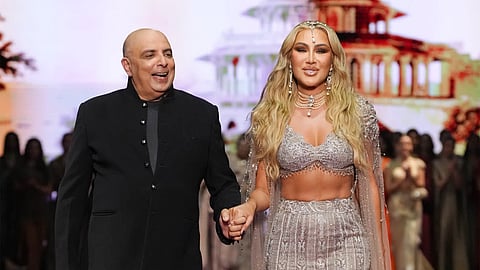


Minutes before the finale, it’s crowded backstage at Dubai Fashion Week. Models from the previous show hurry to change, PR representatives grab sandwiches, photographers switch lenses, and journalists queue up for their turn with designer Tarun Tahiliani.
The Hollywood Reporter India catches up with the designer in Dubai, barely a week after Tasva’s show at Lakmé Fashion Week in New Delhi. In between fashion weeks, he has also made a stop in Dehradun to attend an event at his alma mater, The Doon School, as chief guest.
“And that has consumed me more than anything else this week,” he says with a laugh.
This is Tahiliani’s first outing at Dubai Fashion Week, and every now and then, a buyer or guest from the city stops by to say hello. Some are also hoping to catch a glimpse of the evening’s showstopper, Lebanese singer Maya Diab. Notably, there isn’t a Bollywood star in sight.
“We wanted someone who represented the Arab world,” he explains. The team did approach an Egyptian actress, too, though Tahiliani admits he doesn’t know enough about the film industry to take that conversation much further. “Everyone comes here and does the Bollywood [thing], but I thought if we’re talking to a new market, I want them to see the possibility of what we do in their cultural context.”
At Dubai Fashion Week, celebrity appearances are hardly unusual. In February 2026, Manish Malhotra presented the finale, with actor Kriti Sanon closing his show, before going on to open his own flagship store in Dubai. Tahiliani, however, has never been particularly interested in making a famous face the centre of a collection.
“I think the PR machinery likes it when there are people who are famous,” he says. “So some brands will fly this one in and that one in. But then, there are brands who sell on the strength of their product. We're one of those brands.”
The designer admits he tends to resist the idea of a celebrity showstopper, though he sometimes has little choice when a major sponsor is involved.
“I find that it distracts. At one level, yes, it gets a lot of eyeballs. But the conversation turns to their personal lives, and then it's all about that. I don't want to be standing at a press conference discussing that,” adds Tahiliani.
Of course, a familiar face can be useful when entering a new market. Diab is a major name across the Gulf, and her presence gives local audiences an immediate point of connection with the show.
“Showstoppers have been more important since the advent of big Instagram, and there are designers who absolutely won’t show without their one or two or three. It’s their strategy and that’s fine. But typically, what I've noticed across the globe is that the people who spend that much time refining their clothes don't feel like they need it,” Tahiliani says, with his characteristic laugh.
A viral runway moment or a red-carpet appearance doesn't necessarily translate into business, either. He points to the enduring image of Naomi Campbell's dramatic fall at a Vivienne Westwood show in Paris in 1993: a moment that became fashion history, even if its cultural impact is a different thing from selling clothes. What matters, he suggests, is whether an image evokes an emotion. In an age of information overload, that is perhaps the hardest thing to achieve.
“My showstoppers are the clothes,” he says. “But the PR company sees 100 million followers because, you know, it’s a transaction.”
For all his reluctance to use celebrities as publicity vehicles, Tahiliani does have a clear idea of the woman who best embodies his aesthetic. If he had to pick one, it would be Amal Clooney.
“She's so sophisticated, intelligent and has her own style; nothing overdone, not prancing around for eyeballs. No matter what designer she wears, she's got her own elegance. That's what style is,” he says.
He has always admired people who develop a personal style and stay true to it. He points to designers he looked up to while growing up, including Giorgio Armani, who maintained his distinctly modern Italian sensibility throughout his career, as well as Donna Karan. Closer to home, he sees the same consistency in Rajesh Pratap Singh.
It’s a philosophy he practises himself. Today, Tahiliani is dressed in an all-black bandhgala, paired with a shirt and cap — a look that has become something of a signature.
But for his first Dubai Fashion Week showcase, he wanted to offer a broader introduction to the brand. Titled Many Moods, the collection brought together different facets of the Tahiliani universe: a little OTT fashion, bridalwear and couture, alongside five special looks he described as his “homage to the Arabian woman”. These were, in essence, his interpretation of the abaya.
The collection also offered an opportunity to make a larger point about Indian dressing, particularly the enduring appeal of draped silhouettes.
“We, in India, come from a culture that’s timeless,” he explains. “The West, a country like England for example, went from Georgian to Edwardian to Elizabethan to the sixties, the seventies. Because we’ve been textile based, it never came in or went out [of trend].”
He goes on to describe how Indian clothing has evolved through cultural exchange, from Mughal influences that brought new shapes and embroideries to their eventual assimilation into local traditions.
“So, the draped form, which I love, and which to me is the essence of what India has always been, is timeless. It’s when you become very structured, rigid, of a moment and of a body type [that] things become restricted to a specific shape or size.”
It is an argument that sits at the heart of Tahiliani’s work; clothing should move with the body, rather than dictate what the body ought to be. And in a market where he is introducing his brand to a new audience, it is also a way of making Indian craftsmanship and design legible without diluting what makes them distinctive.
The UAE is not entirely new territory for Tahiliani. The brand already has a substantial clientele in Dubai, making a permanent presence here a natural next step. The store was originally meant to open earlier this year, but the geopolitical climate repeatedly interrupted work. Eventually, with the situation appearing to settle, the team decided to proceed.
“We were advised not to go anywhere close to downtown because the traffic is just too insane,” he says. The store is instead located along the waterway, in a new development whose design, he notes, was completed around two years ago. The expansion is about more than opening another retail space. It has also forced Tahiliani to reconsider how the company operates.
“I’ve also been in the store since last night, and I thought, we need a whole system overhaul,” he adds. “We’re in another country and everything has to lead by the legal route. And I think we have to be much more streamlined and systematised as a company to then look at opening [others].”
North America, particularly the United States, is next on his radar. But he is under no illusions about what international expansion demands.
He says, “I'm nervous because in India things are different. I mean, to run anything in Dubai was three times as much. That's how they maintain these standards.”
For a business accustomed to the flexibility of operating in India, the adjustment is significant. Timelines, procurement and planning all need to be more tightly managed. There is less room to improvise at the last minute, even when improvisation has long been part of the way things get done.
“You can’t just send someone on a plane to Mumbai,” Tahiliani explains. “The attitude has to change completely. Everything has to move with better planning and timeliness.”
The collection unfolds in several segments, with a large cast of models — a familiar feature of a Tarun Tahiliani showcase. But compared with his elaborate presentations back home, the Dubai show is notably intimate. There is no elaborate set or raised stage, just a carpet, a row of photographers and a tent filled with guests watching the clothes pass by.
“This show is to announce our arrival, and show them what we do, right? You might have seen it on Instagram, but when you see the clothes walk in front of you five, ten feet away, a seasoned eye knows if there's a point of view, and sees the quality,” he says.
Movement is something Tahiliani returns to often when discussing his work. Photographs can be edited, filtered and manipulated, but a garment in motion offers a more honest assessment of its construction and craftsmanship.
“It's just that this is a much simpler, purer show,” he says.
The contrast is particularly apparent after the designer’s recent Tasva presentation, choreographed by Aparna Bahl Bedi and accompanied by live fusion music. Does he get involved in the details of staging and choreography?
“Yeah, absolutely. These things don't happen by chance. It's very heavily monitored by Aparna and I would give her the full marks for this,” he says.
For Tahiliani, though, the production is always in service of the clothes. Luxury, in his view, is not simply about status or how an outfit looks to other people. It is about how it feels against the skin, how it moves and how the wearer engages with it. That relationship between garment and wearer, he believes, still needs greater emphasis in the Indian market. He is, after all, someone who continues to treasure his Armani sweaters from 1991.
As the Dubai show draws to a close, the final looks return to the collection’s tribute to the Arab woman. The tailoring is precise, the fabrics carefully chosen and the execution a reminder that the work begins long before a model steps onto the runway. For Tahiliani, these looks also underline what it takes to build a truly global business: not simply exporting an aesthetic, but building the systems that allow it to travel.
“I think if we want to start to think about being global, jugaad bhul jayo [forget the hacks],” he says, getting up to go and check on the models as the show is about to start.
After all, the clothes, the shows and the drama may look effortless, but getting them right — and taking them to the world — is anything but.