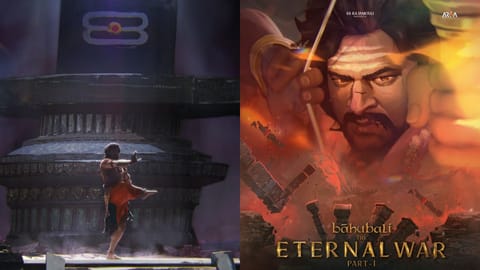


The last time we see Amarendra Baahubali (Prabhas) in SS Rajamouli’s Telugu epic Baahubali, he is ruefully killed by Kattappa (Sathyaraj). He dies in the mortal world, but what about his soul? What if he were to travel across realms in his afterlife, where he finds himself at the centre of yet another war, but this time, an ancient cosmic battle between devas and asuras? This forms the central theme of the upcoming two-part animation film Baahubali: The Eternal War, which was officially launched with a teaser on November 4. The eclectic teaser, which features the voice of both Prabhas and Ramya Krishnan (who will also reprise their roles in the films) as Baahubali and Sivagami, is visually distinct in terms of form and colour. The first part of the film is aiming for a late 2027 theatrical release.
The film, directed by Ishan Shukla, also reunites the winning combination of filmmaker SS Rajamouli and Shobu Yarlagadda, who will serve as co-producers, alongside Prasad Devineni. The film will also feature music by Academy Award-winning composer MM Keeravani. Shukla, an acclaimed animator in the indie space, has directed an episode of Star Wars: Visions (2023) and the festival darling animated feature Schirkoa: In Lies We Trust (2024). In an exclusive interview with The Hollywood Reporter India, the filmmaker speaks about how SS Rajamouli and Yarlagadda’s trust propelled him, and why animation is the perfect medium to explore the endless possibilities of the world of Baahubali.
Excerpts from the interview:
Can you talk to us about the animation style of the film?
The idea was not to rehash the same animation style, such as 3D, Pixar style, or anime. I have been trying these new styles independently, and then Spider-Man: Into the Spider-Verse came out in 2019, and Arcane came out a little later, and I saw that the world was experimenting with new styles.
We are travelling to different lokas in the films. You see the Patal Loka in the teaser, but there are multiple lokas in it. I wanted it to feel completely new. The style here is painterly 3D animation. We make it seem like it's hand-painted, but it also provides the flexibility of moving the camera around. It is aggressive in terms of movement, but it is painterly in terms of the colour palette.
How did you become associated with the film?
It was around the time I had just finished the Star Wars Visions episode, and Schirkoa completed its festival run. Shobu Yaralagadda saw one of the articles about my work and reached out to me. As much as I'm indie, I love what SS Rajamouli does in his maximalist filmmaking. I never thought I'd dabble with it, but I took a shot in the dark.
So I thought, “What if we dabbled with the afterlife of Baahubali?” I created concept art, wrote a story and pitched it to Shobu. He liked it and sent it to Rajamouli sir, and things moved quickly from there.
Can you speak to us about the Baahubali films? How did the films appeal to you, and what was it like adapting yourself to the world?
It was pretty smooth, and the reason for that is that I come from the world of graphic novels, anime and sub-genres in anti-superhero films and literature. Baahubali does this very well, and this is not just in terms of action choreography and spectacle, but with how it gets the emotions right. There is something personal about action when the emotions hit. That really spoke to me.
Can you speak about Eternal War and the themes it deals with?
The idea is to take it to the next level. When we say next level, it is not just making it big in terms of action or spectacle, but going deeper into Indian and Vedic cosmology. It is very clear that the universe is made of 14 different Lokas, and each Loka is a different dimension. Each dimension has its own physical roots. We also have a mythology consultant, Vinay Varanasi, on board.
We are showing the journey of Baahubali through these different realms and showing how he can travel with different factions. The primary factions are Devas and Asuras, and we're keeping them very close to how they're shown in Indian scriptures. Animation is the perfect medium to tell something of this scale.
We think Amarendra Bahubali's story ends after he is killed by Kattappa, but if we follow Indian scriptures, it never really ends [there] because we have so much written about the afterlife. What happens to his soul? Where does he go? What does he do? How does he stay close to dharma, as he has done in his life?
What are some of the characters we can expect to return?
Amarendra Bahubali and Sivagami are going to return. A host of new characters, primarily Indra and Vishasur, will be introduced. Indra is the king of devas, and Vishasur is the king of asuras. There will be a supporting cast and some surprising gods as well.
What is the interest in animation in Indian cinema today? With the success of Mahavatar Narasimha, do you see a surge in appeal among theatre-going audiences?
My career started in Singapore, and I started off as an ad filmmaker. For a while, nothing inspired me in Indian animation because nothing was happening. Indians were doing VFX work for big-budget animation and live-action films. It wasn't such a great landscape back then.
But I see a surge in interest over the past four to five years in the indie short film animation scene. The landscape has changed since then, and thanks to COVID, everyone is watching everything, and everyone's getting inspired. Mahavatar's box office success is a very good thing, and it is a good time for animation in India.
Do you think Indian stories lend themselves well to the animation format? Considering how a lot of our stories are deeply emotional in nature.
Certainly. Indian stories prefer drama. A lot of our stories are centred around personal tragedies, which is really amazing. Lord Ram had to leave his family in Ramayana, and Mahabharata is all about brothers who rift. A lot of the anime that we see are wrapped around such tragedies, but our stories have always had them. We have been reading it since our childhood, so we don't even think so much about it.
What were some of the pressures of directing something of this scale and expanding the legacy of a film that's a common household name?
The pressure is always on the scale. I come from an independent background. Even though Schirkoa was an Indo-French film, it was still a low-budget film for a niche audience. We are talking about a big film. The first thing was to get the story right, and I got very good feedback from Rajamouli sir and Shobu, and their trust brought a lot of confidence. Their belief propelled me.
I didn't have to mimic anything, but just had to go back to the time when I read so many Amar Chitra Katha stories and consumed Indian cinema. They gave me a lot of creative freedom. Shobu went all out and asked me what it was I needed, the studios, etc, and he didn't hold back. Shobu made sure the project lived up to its expectations. There's a reason for this to have a ₹120 crore budget.