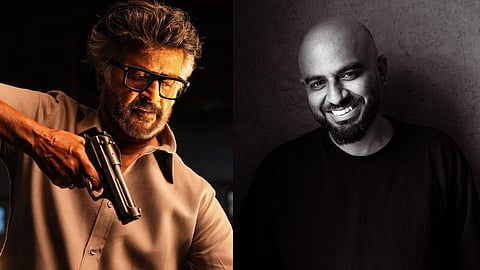


As the cinematographer of one of the biggest South Indian films of 2026, you’d expect a lot more excitement from Vijay Kartik Kannan. It’s been a week since the release of Rajinikanth and Nelson's Jailer 2, and Vijay has fielded a few thousand calls and messages of admiration since then. But the DOP is just about recovering from a viral fever that got him missing out on all the action.
On the day of the film’s release, October 15, he was shooting for Chiranjeevi’s Kaaka. And the days leading up to the 15th were spent juggling Kaaka’s high-profile shoot with the final grading work of Jailer 2, a tightrope walk he hopes never to attempt again. In recovery, he finds time to talk to The Hollywood Reporter India about the two films that changed the look of the big-budget superstar film. Edited excerpts:
Should the sequel to a film as visually distinct as Jailer look similar to the first? Was that the idea?
We had this confusion right from the start. If it looks very different, we run the risk of alienating viewers who’ve liked the first film. To avoid this, we decided to stick to the motif of using centre framing, but with the condition that we change the lighting pattern. The look of the first film was accepted also because it was grounded. If we set the film in a suburb, then the house must look like a regular suburban house. Similarly, if we’re changing the setting to Kerala for the second film, we didn’t want to make it look too lush or lavish; that's the reason why we chose to shoot in places like Kozhikode and Attapadi.
This is also a franchise where the big mass moments are built around visual ideas rather than punch lines. There is the tissue box in the first film, for instance, and the way Rajini sir pulls out a weapon from under the car seat...
In the early 2000s, I enjoyed listening to movies that got played on the radio. The same movie that was made for the theatre would later be played on the radio, and you could clearly make sense of the entire story, even without seeing it. But a film like Jailer won't work as a “radio play”. Can you imagine ‘listening’ to the tea shop scene from Jailer 2?
It wouldn’t make sense…
Exactly. I think this too is a post-OTT phenomenon. More than a film being entertaining, a mass film must create the effect of watching a film in a stadium. A couple of years back, producers worked overtime to pull down or block any clips uploaded from the theatre. But today, they’re encouraging it because the viewer gets an idea of this stadium-like feel during a show.
Has that been Nelson’s point too?
We both have a similar POV when it comes to this. In my case, even when I was shooting documentaries, the point was never to beautify a shot. I’m not here to make showreels. It must add to the story. The tissue box was one such idea Nelson pitched in the first film. Then I got to work on all the cool ways to present this tissue box to create the effect Nelson has in his mind. I jumped in with the idea of asking Shiva Rajkumar sir to push the tissue box towards the camera. It’s like we’re treating the tissue box like a hero too.
Does it help that Nelson likes to hold his shots?
Surely. I guess we complement each other. In Nelson’s case, he also trusts his script enough to let us keep a certain visual for long in an era when “Skip AD” is just five seconds away. The reveal shot for Hrithik Roshan is 17 seconds long! It takes 17 seconds for Hrithik Roshan’s face to go from out-of-focus to focus. No other director will let you do that.
This reminds me of the Jailer 2 teaser. We do not even see Rajinikanth’s face…
That’s the idea behind the Hrithik intro scene too. We had planned a few shots even earlier but on set, it was Nelson who suggested we do something with Hrithik’s eyes. His eyes are very distinct so we got working on revealing them in stages. He first wears dark glasses. Then we thought of a shot in which he must scan his pupil to open his secret lair. It builds anticipation.
Are these visual liberties you can afford because of how big they are as stars?
Of course. There’s a shot we didn’t use in the final cut that was just Rajini sir’s shadow moving in and out of a frame.
Were you happy with that shot?
I was, but we just couldn’t fit it in…maybe I’ll use it another Rajini film (laugh).
You mentioned the idea to repeat symmetrical shots of actors in which they appear at the dead centre of a frame. How did you both end up with that idea?
In Doctor, we’d played around with the idea of keeping subjects towards the corners of each frame. In Jailer, we wanted to try the opposite, but not to the point where we’re obsessing over it. It’s not like we had one set of lens, one type of lighting and one spike mark for actors to create that symmetric effect. In some cases, we achieved the same centre framing shots, almost by accident. Or maybe it was just muscle memory from having shot two films.
Do you worry about repetition?
Someone recently pointed out to me that all the middle-class houses in my films are either blue or green. But he was right. So in Jailer 2, I decided to make Rajini sir’s house pink. It’s the same with the tea shop too as long as it looked look vibrant. The idea was to keep the tea shop look really dark because we wanted it to be illuminated later on with Rajini sir’s gunfire. My uncle saw the tea shop scene and complained that it was too dark. I joked and told him that there was a power cut in that area on that day (Laughs). It’s creative liberty we take to pull off that scene.
Both Jailer are films are big hits, but they’ve also gotten love for its looks. Would such big mass movies have attracted such appreciation for visuals had they released thirty years ago?
I don’t agree with this thought at all. I feel the best looking Rajini films released more than thirty years ago. For me, the best looking mass movie is hands down Annamalai. The shot breakdown of the iconic escalator scene itself is just insane! Then there’s the cigar shot, right after he wins that election. Sarath Babu sits at the centre of that conference room and if you look closely, they’ve put an apple box or something under him to add to Sarath Babu’s power play. He steps down from that apple box to show his “descent” and Rajini sir takes that one step up. No conference room in the world will have such a dais or a pedestal, but it adds an insane amount of coolness. We don’t think of such ideas anymore.
I’ve never looked at that scene in this manner…
See but that’s why I feel I gel so much with Nelson. Nelson is obsessed with the films directed by CV Sridhar from the 60’s, which were all shot by Vincent Master. I love these films too and it was one of the reasons we felt a creative connection.
In Jailer 2, what was that one scene from the script you were most excited to shoot?
In terms of drama, I was excited for the scene in which SJ Suryah comes to Rajini sir’s house to reveal that big secret. In all other aspects, I was looking forward to that scene on that bridge in which we play up the mass of Moorthi Anna. Imagine this; we have India’s biggest Superstar and he has nothing to do in that scene. He underplays all through and it’s still the best mass scene. No punchlines, nothing.
I feel people don’t give Nelson credit for inventing a new mass movie formula. With Jailer, he’s proved that a Superstar like Rajinikanth needn’t do any fighting himself to show his might.
I agree. It’s only now that Nelson is getting the credit he deserves as a top director. I know his other scripts too and I know what he’s truly capable of.
I’m equally surprised that the comedy scenes have become such hits, that too in its non-Tamil versions…
My colourist is a German man. I took him to Prasad Labs after shooting the first few days. He knew the full script but he obviously cannot understand the dialogues. As he was seeing these rushes, we could see him cracking up. The biggest Moorthi fan is now a German.
Aren’t you just as pleased that people are pulling out individual shots to talk about your imagery?
It’s more relief that I feel. Take the case of the shot in which Rajini sir has to walk towards the camera on that airstrip. We shot it in Hyderabad and it was scorching hot, which helped in creating that mirage-like shimmer of light due to heat. We used these rare 1000mm lens and we had to show Rajini sir’s character nearly 500 metres away as he walks towards SJ Suryah’s private jet. At first, we tried to shoot it with a dupe but it just was’t working out. We then had to trouble Rajini sir to get that right.
That is also what I do not get. Like you said, even Rajini sir’s silhouette is enough to recognise that it's him. How do dupes work in situations like this?
I’ll give you an example of this. We first tried to use a dupe for a scene between Rajini sir and Yogi Babu. It needed close-ups of Rajini sir’s hands and fingers especially because it's that scene in which Yogi Babu comes with those three conditions. We shot the close ups with a dupe and when I saw it, it was obvious that those fingers were not Rajini sir’s. We shot it again. That’s 50 years of superstardom!
Given the confidence you’ve developed from both the Jailer films, do you feel you can push the limits of what cinematography means in mainstream cinema?
Will you believe me if I tell you that Nelson and I have been dreaming of releasing Jailer in a version that’s entirely black and white? I mean if they could do it with Nicholas Cage’s Spider-Noir, why can’t we try something like that? Nelson is a huge monochrome man too.
On a related note, one of my favourite monochrome Tamil films shots is in Saani Kaayidham, which was shot by Yamini Yagnamurthy, your wife. How does she validate your work so far?
She is very critical of my work. Until Doctor she used to find my cinematography to be just OK. She feels there’s a certain finesse to my work, even that is only after Daaku Maharaj. I’m genuinely scared to show her my films…it’s like standing in front of the principal with your report card.