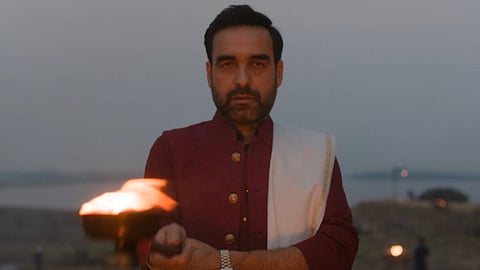


A few days ago, Pankaj Tripathi received a rousing welcome in Patna, striding up the grounds of the International School of Management (ISM). A crowd of 5000-6,000 youngsters had congregated in the sun as Tripathi, Ali Fazal and Divyenndu took the stage. Tripathi, one of Bihar’s most recognisable exports, spent a long and nourishing stretch of his youth in Patna, and has been back several times since. But this was special; after all, he was there to promote Mirzapur: The Movie, the big-screen expansion of the series that sealed his star. The last time a film promotion was this big a deal in Patna, it was for Allu Arjun’s Pushpa 2.
“Bohut zabardast mahaul tha (the mood was fantastic),” Tripathi tells THR India. “The way those kids welcomed us and showered us with love… I often don't realise how popular I am!”
Indeed, after Gangs of Wasseypur (2012), where he played the butcher Sultan, no other film or show of his has penetrated the heartland quite like Mirzapur. “They knew all the characters and were completing our dialogue before us. To go back to the same city to promote my film where I used to ride around on a bicycle and perform theatre at various auditoriums was amazing.”
Arriving in cinemas on September 4, the Mirzapur film is directed by Gurmmeet Singh and written by Puneet Krishna, who co-wrote the first two seasons of the obscenely popular show (the third season, deemed the weakest by fans, had a different writing team). Tripathi —a looming, fearsome presence when he wants to be — returns as Kaleen Bhaiya, the embattled sovereign of the Mirzapur mafia. Curiously, the film is not a prequel or sequel but ties into events past the sixth episode of the debut season. “This is set within the time frame of season one and explores an untold chapter in Mirzapur’s politics and power dynamics,” Tripathi expounds.
Excerpts from a conversation…
The story travels to Rajasthan and my character Kaleen Bhaiya also goes there. An important new character, played by Ravi Kishan, joins the fray. It's interesting because half the film unfolds along the Ganga plains and the other half in the desert. So visually, the contrast is striking. For people who have seen and loved season one, there is obviously a lot, including the return of several fan-favourite characters. However, for people who have not seen Mirzapur, it is still an enjoyable film with a proper beginning, middle and end.
Yes. In fact, you don't need to be familiar with Mirzapur at all to enjoy the film. We have shot it from the point of view of community viewing, as opposed to personal viewing on TV and mobile devices. While shooting the series, we would finish three-four scenes in a single day. Here it was not like that. We could take our time and shoot in a relaxed and grand fashion.
I am deeply familiar with the Purvanchal region and I have met lots of characters like Kaleen Bhaiya. I strongly believe that whatever the role, if a character does not have a sense of humour, he becomes boring. Even if I am playing a ‘boring’ character, he has to be interesting. Main kisi bhi kirdar ko baandh ta nahi hoon (I never restrict a character).
Kaleen Bhaiya does a lot of satire. He does it with such speed and understatement that if you are not paying attention, you will miss it. His subtle sense of vyang (satire, irony) is key to his charm.
I have not disconnected from ordinary life yet. I don't live behind black glasses and black screens. Even today, I love to put on a mask and wander around the parks of Mumbai observing people. If I encounter an interesting-looking individual — say someone who walks a little animatedly or has a particularly unique ‘posture-gesture’ — I start imagining what his mental state is like. What is the rest of his life like? What is his political belief system? I immediately start extrapolating these answers. Human beings are endlessly fascinating to me. I don’t care about larger-than-life things or which brand launched which product today. I know which of my staff members has a son who is undergoing physiotherapy. I also love reading books of philosophy which, if not in regular existence, certainly has relevance in the discipline of acting.
We have limited scenes in Mirzapur: The Movie. I first worked with Raviji on Mani Ratnam’s Raavan (2010). For two months, we used to wake up at 4am in the morning and wander the forests and waterfalls of Athirappilly in Kerala. When I sit with Raviji, I usually talk about politics. He listens to me quite intently and asks me how do I have such deep perspectives on political subjects. “You should come to politics,” he keeps telling me. I always respond that politics is not for me. Mere bas ki nahi hai. In fact, whatever little I understand about politics, every Bihari does too. It’s inherent in us as a people.
This is not something to be told to the press (laughs). But if you insist… I am still searching for a larger purpose in life. Is life meant simply to be successful, or should it be meaningful as well? I am still exploring these things. And I am travelling a lot. Recently, I went to see the Ajanta and Ellora Caves with my wife. This was her first visit and my second. I wanted to show it to her. I also visited Melvan in Maharashtra. I am planning a trip next to the forests. I find such journeys to be deeply spiritual. Bhraman karne se bhram door hote hai (travelling dispels your illusions).
There are a lot of restrictions now. I don't find streaming to be very exciting at the moment. The game of numbers and viewerships has taken over this space as well. In that pursuit, some quality will always get compromised. However, I recently produced a show called Perfect Family, which was released on YouTube and then went to SonyLIV. I am planning to make two-three more shows that have meaning, depth and cater to a more refined taste.
There are certainly good stories in the market, but it’s a matter of bringing these stories to the correct platform. The streamers should also not fall into the trap of just making what has already been successful. We made Perfect Family with no creative conditioning. It had no other heads than its creator and director. Platforms should realise that too many cooks spoil the broth. They should trust the makers they are hiring and not encumber their creativity with too many voices.
I am still searching for a good script. I am really inclined to do an independent film. But the ones that have come recently have failed to excite me. They are lacking a certain flavour. If you know somebody with a good script, will you send them to me? I would really love to meet them.
Sanskriti Ke Char Adhyay by Ramdhari Singh Dinkar. It's a study of Indian history and civilisation in four chapters.
(To his publicist: Are we done with calls? Main gym jaa raha hoon)